
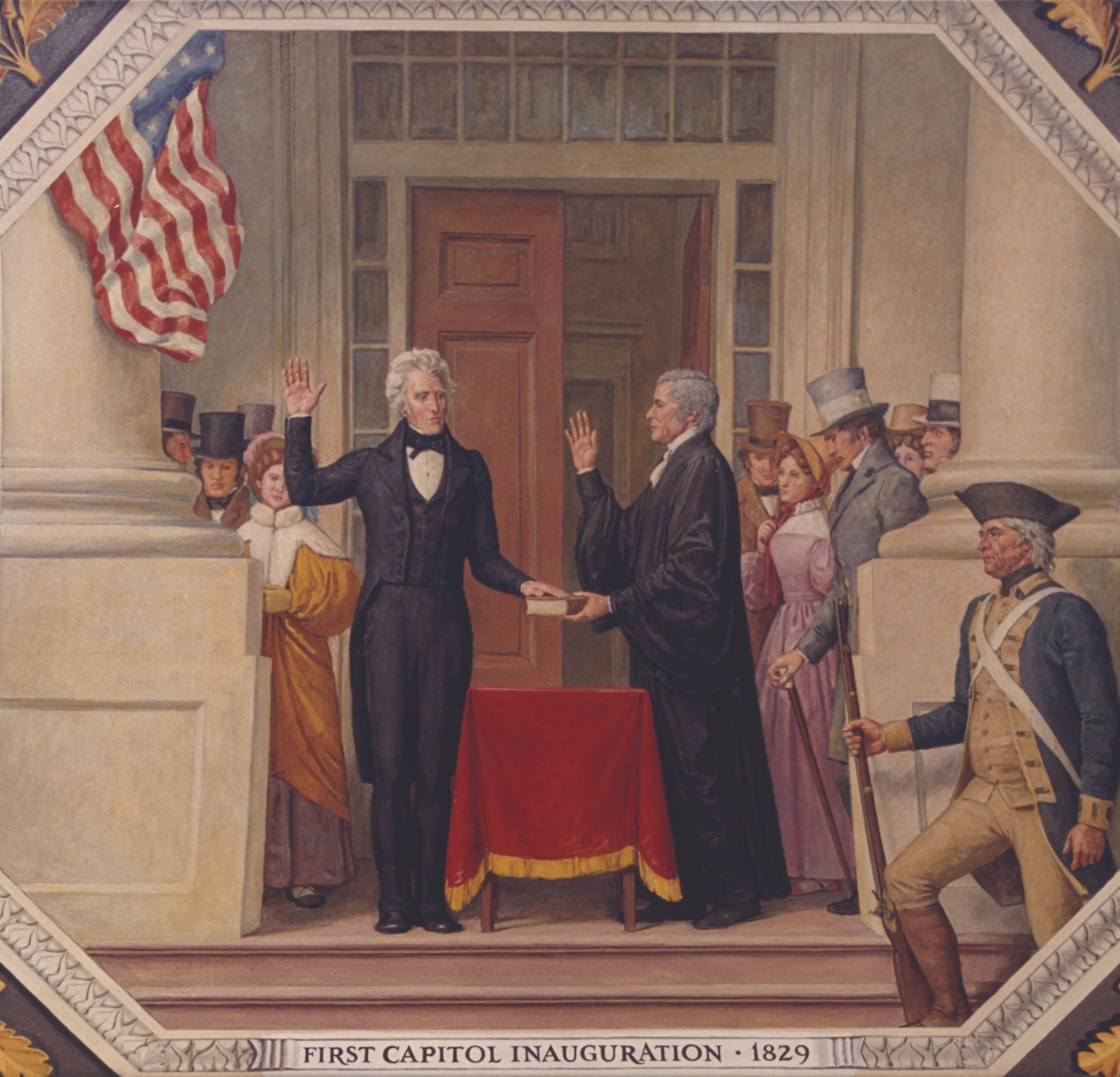
1829 Inauguration of President Andrew Jackson.
A White House Party to Remember
by Jack R Johnson 06.2026
An upcoming celebration of America's 250th anniversary, “The Great American State Fair," recently had multiple musical guests back out, likely because of the event's connections to President Donald Trump. Now, Trump is declaring that he—“the Greatest President in History!”—will headline the festivities himself, maybe in an attempt to emulate another populist president from a bygone era, Andrew Jackson.
Like Trump, Jackson was a boisterous populist who formed a “man of the people” candidacy for his 1824 election. This wasn’t just an empty campaign slogan, either. In the early years of the Republic, state legislatures chose their electors, not the people. By the time of the 1824 presidential election, six new states joined the Union, and those states extended the right to vote to white, male non-landowners (previously only landowners could vote). Many existing states followed their lead, giving the vote to “a less affluent and less educated citizenry.” Additionally, most states gravitated away from state legislature appointments, and toward the selection of electors through a popular vote count
When the ballots were tallied, Jackson won 99 electoral votes and Adams took 84, but the two other candidates took 78 between them. Since Jackson hadn’t won a majority of the total electoral votes, the decision went to the House of Representatives.
“It looked like a rigged election where the honest soldier was forced out and these slimy connivers were brought in,” wrote Harry Watson, a history professor at the University of North Carolina at Chapel Hill.
“Adams was awarded the presidency by promising that he would choose Henry Clay (the fourth-runner in the 1824 election) as his secretary of state, a position recognized as a stepping stone to the White House. Jackson’s supporters were incensed.”
The stage was set for a rematch election in 1828, where the slogan of the Jackson campaign was “Andrew Jackson and the will of the people.” In that second contest, Jackson crushed Adams 178 electoral votes to 83, and took every state west of New Jersey. The people, it appeared, had spoken, and Jacksonian Democracy had its start. That was the background for the greatest inaugural party the new nation had ever witnessed.
On March 4, 1829, ten thousand people arrived in town for the ceremony. Makeshift camps were set up all around the city. Jackson’s inauguration was the first fully public ceremony, and it took place in front of the Capitol on the east side. As many as 30,000 people attended. The author of the Star Spangled Banner, Sir Francis Scott Key wrote of the event: "It is beautiful; it is sublime!" Excessive adulation was certainly in the air. One eyewitness described the inauguration this way:
“Never can I forget the spectacle which presented itself on every side, nor the electrifying moment when the eager, expectant eyes of that vast and motley multitude caught sight of the tall and imposing form of their adored leader, as he came forth between the columns of the portico, the color of the whole mass changed, as if by miracle; all hats were off at once, and the dark tint which usually pervades a mixed map of men was turned, as by a magic wand, into the bright hue of ten thousand upturned and expectant human faces, radiant with sudden joy.”
But one Washington socialite, Margaret Smith, had a different view. She wrote:
“Thousands and thousands of people, without distinction of rank, collected in an immense mass round the Capitol.” After Jackson’s inauguration speech, a cable separating the public from the Capitol steps broke and Smith described the moment: “[T]hey rushed up the steps all eager to shake hands with [Jackson]. It was with difficulty he made his way through the Capitol and down the hill to the gateway that opens on the avenue. Here for a moment he was stopped. The living mass was impenetrable.”
Jackson rode his horse back to the White House with the crowd close behind. By tradition, the executive mansion was open to the public on inauguration day because, in the past, receptions were relatively small. Not so in 1829.
People from all walks of life flooded the mansion that afternoon, knocking over furniture, spilling beverages, and breaking china. At one point, Jackson was basically backed up against a wall, completely surrounded by well-wishers. Smith wrote: “Ladies fainted, men were seen with bloody noses and such a scene of confusion took place as is impossible to describe,—those who got in could not get out by the door again, but had to scramble out of windows.” Jackson himself was finally forced to climb out a window so he could escape to a local hotel, The Gadsby.
After Jackson left, Antoine Michel Giusta, the White House steward, moved the party out of the White House by moving the punch outside. Other reports indicated that staffers passed punch and ice cream through the White House's windows to the crowd outside. The incident of drunken supporters nearly overwhelming Jackson’s staff and was used as a metaphor by Washington society and Jackson's enemies, who feared the new regime and its lower-class roots.
No presidential inauguration before or since has been quite so raucous. Fittingly, Jackson ended his final term with another populist moment. In 1835, New York dairy farmer Colonel Thomas S. Meacham gifted President Andrew Jackson an enormous, 1,400-pound wheel of cheddar cheese. Jackson aged the cheese in the White House foyer for two years before inviting the public to eat it in 1837—his final year in office. The pungent dairy was entirely devoured in just two hours, leaving the carpets and curtains soaked with cheese grease and its pungent odor lingered for months.