
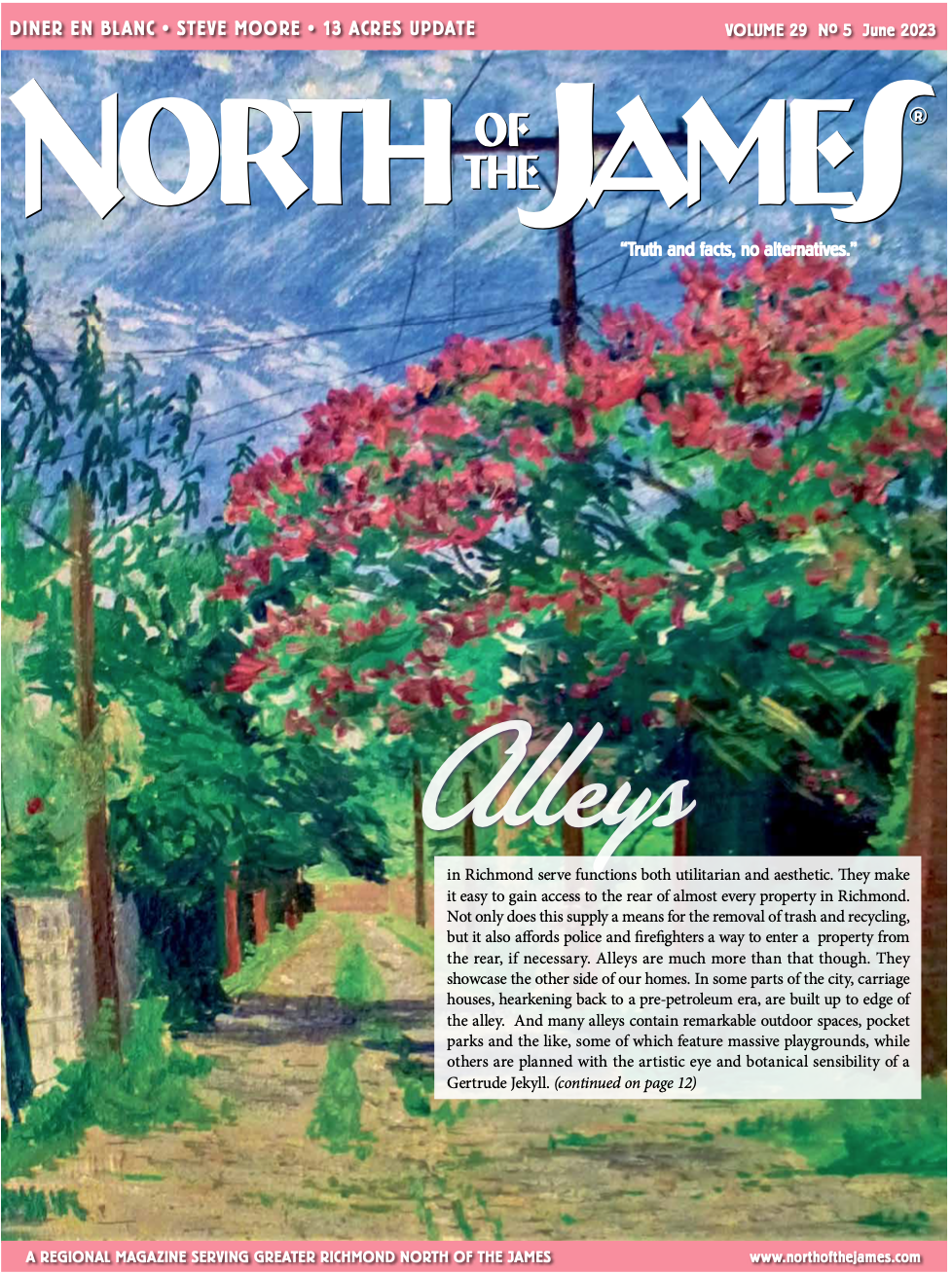
Alleys: Roads Less Traveled, Part 1
by Charles McGuigan, originally published June 2023
Having grown up in Northern Virginia’s sprawling suburbia, alleys were something new to me. I had experienced them to some degree in Philadelphia where my grandparents lived, but my explorations there were merely cursory. So when I first arrived in Richmond to attend VCU I became immediately enamored of these extraordinary byways that traversed every neighborhood in the city. I came to know them as well as I did all the streets in the city, and would more often than not map my routes along them when I traveled by foot or by bike.
That first year I lived in a dorm at 806 West Franklin Street, a Victorian era building that had once served as a YMCA, and beneath many layers of paint I could trace grout lines on the wall next to my bed and imagined that the room had once been a large shower stall. I had one window in that room, but it was massive, almost floor to ceiling, and the ceilings were twelve feet high. Many nights, sleepless and melancholic and morose as any other freshman, I would open the window, climb out on the ledge and slide down to a wooden fire escape that two floors below opened onto the alley between Franklin and Grace Streets. My spirits would lift instantly as I began exploring the alleys of the Fan, and by the end of the year, late at night or very early in the morning, I would wander the alleys as far afield as Church Hill, and witness wonder after wonder that so many had never seen before.
For a brief period I lived on Church Hill in a slave’s quarters at the corner of 29th and Franklin Streets, overlooking Sugar Bottom. From the alley, which was right outside the gate of my courtyard, I could travel late at night on foot to a nearby shot house in the English basement of a three-story house near the Confederate Soldier and Sailors Monument (removed) on Libby Terrace. They served Friday and Saturdays from midnight till six in the morning. Some nights, after a few drinks, I would wander through the maze of alleys until the sun rose.
It was on one of those sojourns that I stumbled upon St. John’s Mews, that block-long alley between 23rd and 24th Streets. It was a full-moon night in the early autumn, and the leaves had just begun to change and there was a faint chill in the air. As soon as I entered the alley from 24th Street, my breathing stopped for a full minute, and my eyes roved along the extraordinary brickwork and the fanciful cast and wrought iron. Years late I would sit on a cast iron bench there with a woman I loved most deeply.
Many nights I would wander the city alone, and could make my way from Church Hill all the way over to the Fan down different alleys without ever walking along a street, except for a few blocks in downtown Richmond.
Mainly though, I lived in the Fan, and there I lived extensively. Not long ago I did a count of the places I inhabited. Over the course of almost 20 years I had 35 different addresses in the Fan and Museum Districts from apartments to efficiencies to single rooms in Suitcase Alley, that odd strip along the 1600 and 1800 blocks of West Grace Street. When I left a rental space—sometimes only after a month—I traveled light. I took only my books, my albums, my stereo, my file cabinets, artwork, box springs and mattress, and my clothing. Everything else I left behind—desks, chests of drawers, tables, chairs. Because within a week or two of scavenging I could easily refurnish an apartment. It was as simple as that.
Alley shopping became a favorite pastime, and from the detritus behind the grand homes of the Fan I would discover remarkable finds from signed oil paintings to first edition books. And there were also completely serviceable items like gas and charcoal grills. All free.
When I waited tables at Matt’s British Pub, which was just around the corner from the Tobacco Company down on 12th Street, toward the end of each night shift, my fellow servers and I, as we broke down the waiter’s station on the second floor, would often pause at the one window there and stare down into the alley below which was strewn with dumpsters and trash cans, many of which spilled their guts of garbage onto the cobblestone alley that ran behind the restaurants on Shockoe Slip. We would watch well after midnight, and gradually the rats would come out, just several at first, but thirty minutes later there were hundreds of them and they moved across the alley like a relentless incoming tide that devoured everything in its path. Within the hour the alley had been scrubbed clean of refuse, and the rats simply vanished.
There is much more to tell about the alleys of Richmond, and how the alleys of the Fan differ from those of my home village for the past 25 years—Bellevue. And the pocket parks, and the botanical gardens that neighborhood folks created on raised beds over concrete and gravel, and brick and cobblestone.
Next month we will feature Part 2 of this story. We’ll hear from Bellevue resident Liz Scarpino. And we will also hear from the Maestro of Alley, Richard Bland, an artist who lives in a former carriage repository on an alley in the Fan. And Richard knows more about Richmond’s histories—great and small—than anyone else I have ever known.