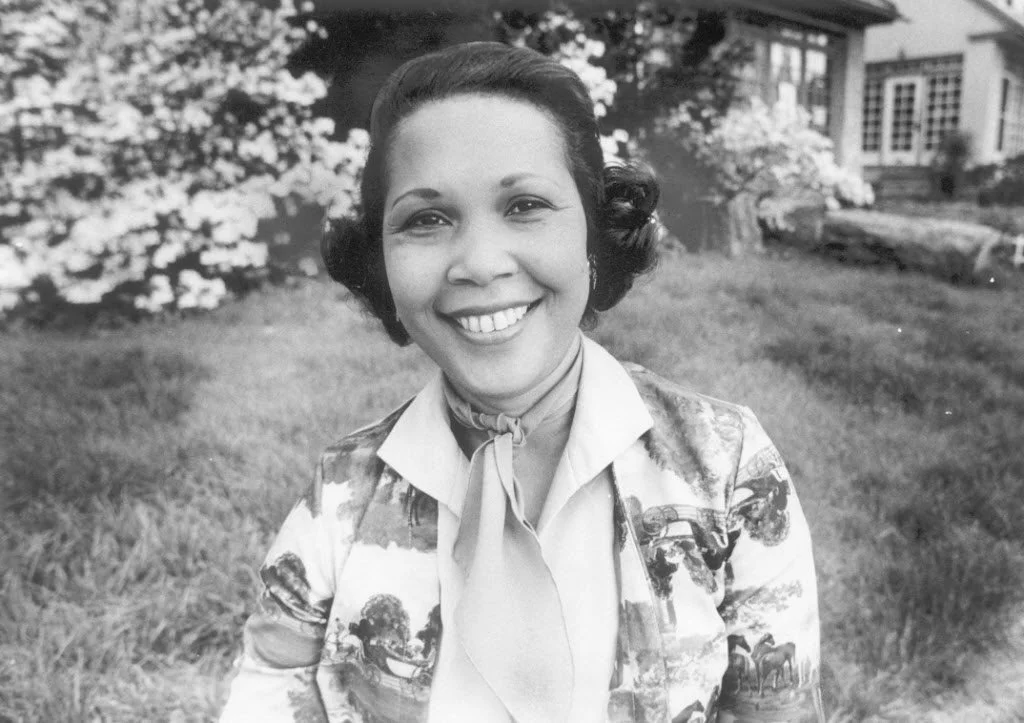
Barbara Johns, image courtesy of the Library of Virginia.
Barbara Johns
by Jack R. Johnson 02.2026
If you really want to know about the beginning of the civil rights movement in this country, don’t start with Martin Luther King Jr., or even Rosa Parks. Begin with a young woman named Barbara Johns in the backwater of Prince Edward County, Virginia.
For years, Barbara Johns found the conditions at the old Robert Russa Moton High School in Prince Edward County, Virginia, appalling. The school was designed to hold 180 students, but in 1951 held over 477. Classrooms built to handle the overflow were made of tar paper that students nicknamed “chicken coops.” The roofs leaked, and students sat under umbrellas when it rained. According to Joan Johns:
“In winter the school was very cold. And a lot of times we had to put on our jackets. Now, the students that sat closest to the wood stove were very warm and the ones who sat farthest away were very cold. And I remember being cold a lot of times and sitting in the classroom with my jacket on. When it rained, we would get water through the ceiling. So there were lots of pails sitting around the classroom. And sometimes we had to raise our umbrellas to keep the water off our heads. It was a very difficult setting for trying to learn.”
The school also lacked a gymnasium and cafeteria. Edwilda Allen, a classmate of Johns’ recalled that in her biology lab, “the only person who had the microscope was the teacher and she had the frog and we all had to gather around to see her dissect it.” Students also used hand-me-down textbooks from the white school. Oftentimes these books had negative comments in the margins and pages torn out. “I came to realize,” explained, John Stokes, student body vice president there at the time, “that by … providing schools that were grossly unequal to the ones white children attended, the white power structure was programming us to fail.”
Provoked by the inadequacies, Johns approached her favorite teacher, Inez Davenport, to ask her advice. Earlier, the music teacher had told a class about a student strike in Massachusetts in support of higher teacher salaries. When Johns fumed about the conditions at Moton, Davenport replied with a simple question: “Why don’t you do something about it?” Recalling the incident in her journal, Johns said she first felt dismissed by the query. Nonetheless, Johns wrote, she continued to think about the challenge, sometimes praying, “Please let us have a warm place to stay where we won’t have to keep our coats on all day to stay warm.” Then, in the autumn of 1950, an incident occurred that cemented her determination to act. After missing the school bus, Johns stood by the side of the road for over an hour, hoping that a passerby would offer a lift into town. Eventually, a half-empty school bus carrying white children to Farmville High School drove by without stopping. “Right then and there, I decided indeed something had to be done about this inequality,” Johns wrote in her journal. That night, what she believed to be a divinely inspired plan began to form in her mind.
She met with her fellow like-minded students on the cinder block bleachers facing the school’s athletic field, planning a strike for late spring. This planning committee dubbed their project “the Manhattan Project” and spent months secretly working out the details.
“We planned this thing to the gnat’s eyebrow,” recalled John Stokes. They discussed strategies for gaining community support and the possibility of jail time. They made pickets and catchy slogans to win over the student body. The committee even checked the weather report for the designated date (D-day), April 23, 1951. The weather was promising.
On the day of the walk-out, Principal M. Boyd Jones received a phone call. Muffled voices told him that several of his students were causing trouble downtown. While the principal scurried away to resolve the issue, Barbara Johns forged a memo from that principal telling the teachers to bring their classes to a special assembly. Teachers led their classes to the auditorium. When the curtain raised, Barbara Johns was standing on the assembly stage. She announced that the assembly was for students and asked teachers to wait outside. She then passionately argued for a student strike. After she finished, the entire student body walked out and began picketing the school. Word came down that the students were trespassing on school property and would be arrested if they didn’t leave immediately. They moved to the border of the school property and continued their protests.
The strike lasted two weeks with Farmville minister Rev. L. Francis Griffin giving immediate and consistent support to the students throughout. During the strike, the students met with the white superintendent who told them that Moton was just as nice as any other school in Prince Edward County and that money was being procured by the school board for a larger building. They just needed to be patient.
Fed up, the students called the NAACP office in Richmond, who sent out two lawyers–Oliver Hill and Spottswood Robinson–to review the situation.
The lawyers told the student protesters that they could only take on their case if they demanded full integration with the white school.
This wasn’t what Barbara had initially envisioned. Johns wanted a decent school equal to the white facility, but the NAACP lawyers argued you needed to change the law so that all black majority schools would be properly funded. They wanted to push for integration, not separate but equal.
After careful deliberation, the students and their parents agreed to help the NAACP. They filed a suit to integrate the Prince Edward County school system. Known as Davis v. County School Board of Prince Edward County, it became one of the five cases involved in Brown v. the Board of Education, which legally dismantled public school segregation. This case was eventually grouped into the famous Brown v. Board of Education Supreme Court case, which resulted in racial school segregation being deemed illegal and unconstitutional. Of those grouped into Brown v Board of Education, Barbara John's case was the only case originating from a student-led protest.
In response to the Supreme Court’s decision, the state of Virginia closed its public schools for five years, a period now known as Massive Resistance.
Barbara Johns and her family faced significant backlash, including threats of violence and a cross burning. Many suspected local white supremacists, although no one was ever charged. Fearing for her life, Barbara Johns’ father sent Barbara to live with her Uncle Vernon Johns in Alabama for safety and to finish school.
She went on to receive a degree in library science from Drexel University, married William Powell, and raised five children, living in Philadelphia, Pennsylvania.
On December 16th, 2025, a statute of Barbara Johns was unveiled and dedicated in Emancipation Hall within the U.S. Capitol. Artist Steven Weitzman depicted Johns during the pivotal moment in her life when she was speaking to her classmates at Robert Russa Moton High School in Farmville, Virginia, convincing them to join her and other student organizers to strike for better school facilities.
“Barbara Johns’ courage and example was all in service,” said Virginia Gov. Glenn Youngkin in remarks at the dedication. “Service of a noble mission to ensure that all Americans would receive an excellent education. This statue is a fitting memorial and tribute to a teenager in Virginia who became an American hero. A hero whose courage inspired a nation to overcome injustice and to more fully realize our founding promise as a nation. And now this fitting memorial has a fitting home.”
Fittingly, Barbara Johns statue replaces the statue of the Confederate general Robert E. Lee.