
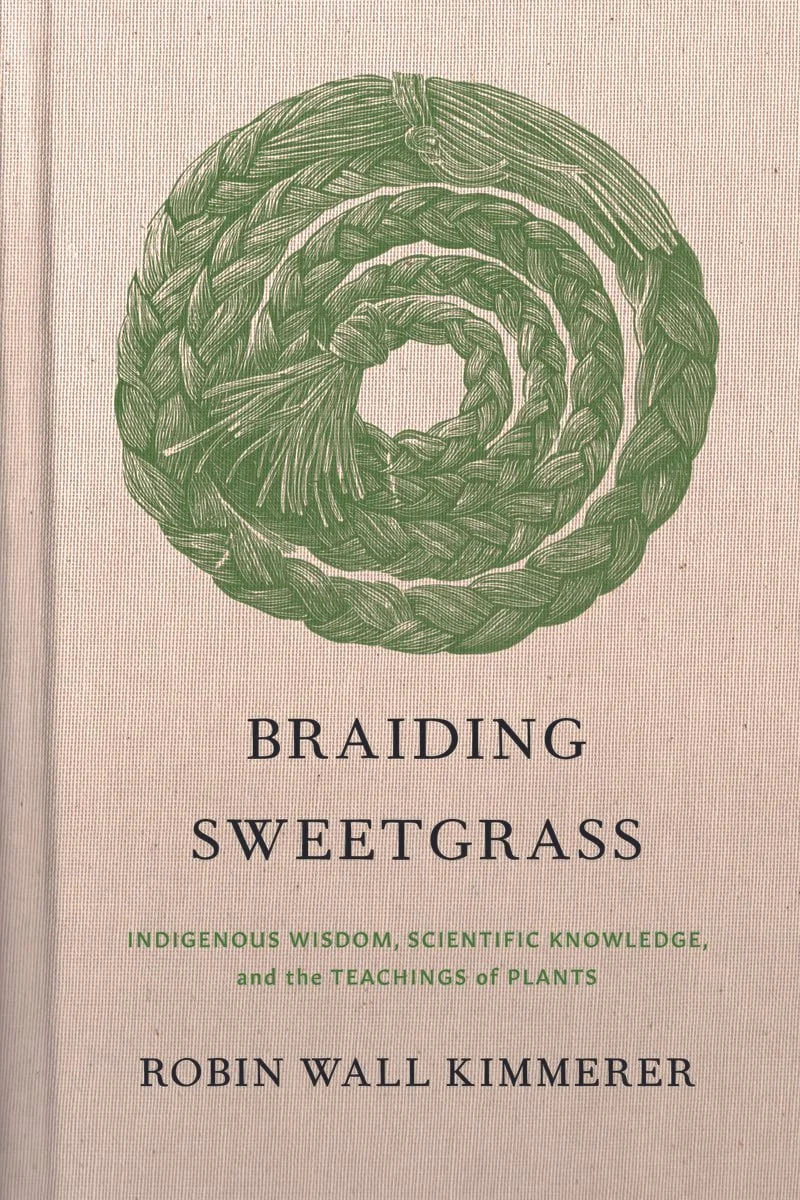
“Braiding Sweetgrass”
By Robin Wall Kimmerer
408 pages
Milkweed Editions
Hardcover $40.00
Paperback $22.00
“Braiding Sweetgrass”
by Fran Withrow 04.2026
Robin Wall Kimmerer’s beautiful book, “Braiding Sweetgrass” is as lovely as its title. This type of grass is sacred to many Native Americans, and braiding strands of it is a way to honor our relationship with the earth, a way of demonstrating gratitude to her for all she gives us. Kimmerer’s book delves warmly and deeply into this subject.
Kimmerer, a botanist and member of the Potawatomi Nation, braids a series of essays and stories together to remind us that we have a reciprocal connection with the earth; a responsibility to care for her as she cares for us. Kimmerer states that we are too focused on what we can acquire from the earth: we take repeatedly from her without giving anything back. However, by responding to earth’s gifts with gratitude and mutual care, we can ensure that she will be able to continue supporting us.
Kindness, respect, and compassion thrum throughout this book. Kimmerer’s stories abound with examples of how indigenous peoples cared for the earth for millennia, and how the earth responded by taking care of people. Kimmerer explains that plants are our oldest teachers, and we can learn so much from them if only we will stop and listen. Picking wild strawberries, making maple syrup with her daughters, and describing how beautifully the “three sisters” (corn, beans, and squash) grow if planted together are just some of the stories she uses to demonstrate how thoughtful attention to the earth allows us all to thrive.
One example Kimmerer uses is that of trees felled by traditional harvesters. They are “not taken, but requested.” These indigenous people see each tree as a nonhuman forest person, and they acknowledge the interconnectedness between them. They know that respect for trees, and for all creation, is integral to our survival. Our relationship with plants of all kinds is one of balance, each caring for the other, allowing the equilibrium to remain constant.
Kimmerer loves the earth. She lies down among the moss, walks in the rain, and leads her college students into meadows, trying to imbue them with the awe she feels about the land. Yet she is very aware that our world is in crisis, that we are out of sync with the earth. She joins a group trying to help salamanders cross a busy road, her heart heavy with grief. Too many of us do not understand that the earth’s resources are not infinite. “If grief can be a doorway to love,” she writes, “then let us all weep for the world we are breaking apart so we can love it back to wholeness again.”
The sorrow she feels at the earth’s suffering is palpable, yet Kimmerer remains focused on hope. She writes, “Even a wounded world is feeding us. Even a wounded world…gives us moments of wonder and joy.”
Gratitude, she says, is the obvious response to the gifts the earth gives us. What can we give back for all the riches we are given? Life on earth may depend on our answer.