
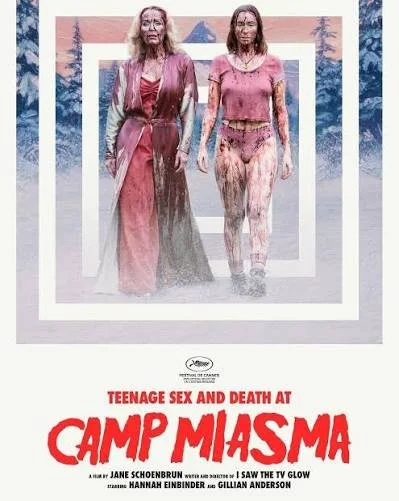
Teenage Sex and Death at Camp Miasma
Director: Jane Schoenbrun
Run time: 112 minutes
Teen Sex and Death at Camp Miasma
by Chris Stewart 09.2026
What do we want when we create a private space for ourselves? Is it safety, the exaltation of loneliness, the purging of apprehension, or something entirely different? Jane Schoenbrun has some thoughts on the matter.
Teenage Sex and Death at Camp Miasma ransacks the entire prospect of the slasher film era, pulling out ideas like an anxious empty-nester yanking scarves, notebooks, scribbled lyrics, and Polaroids from a box marked “Senior Year – Do Not Touch!” in an attic.
In doing so, they arrive at a work that meanders until it is deeply charged. Slow until it reveals the reasoning behind its pace. Unfocused until it underlies its humor with pain, fear, and sexual possibility.
In this movie, young indie filmmaker Kris (Hannah Einbinder, perfect) sets out to reboot the “Camp Miasma” series of slasher flicks from the 80s. She is set on tracking down reclusive original “final girl” Billy (the brilliant Gillian Anderson – making choices). In doing so, she enters Billy’s world, the world of the Miasma films, that of the town where they were made, and so on and so forth. It is Persona by way of Greg Araki.
Schoenbrun has a kinder, gentler take on grunginess. And while Araki is referenced (a bisexual hunk named Thor is surely pulled from his “Kaboom!”), so is Sunset Boulevard. And when Schoenbrun wants to be scary and not just obsessed with scariness – they manage several penetrating moments.
This is a visionary film in the plainest sense. Kris loses touch with reality, and begins to meld with the artificial world of the fake slasher. A central sequence reinterprets the slasher rampage. It is nearly sublime. But Schoenbrun’s approach is always a tad protective, and never without commentary.
Fair enough.
Miasma is an essentially referential work, but its maker does bring particular, specific things.
Schoenbrun is capable of evoking certain emotions better than just about anyone else– isolation, need, and the smallness and wideness and grandness of a world that happens entirely between one young person and the things they are left alone to watch and digest. These are evoked with craft and control.
And yet.
How one wonders what their full-steam-ahead work will be when the time comes. What real visions, cosmic humiliations, and moments of beauty will look like when they have untangled the knot just a bit more.
Miasma circles and circles fear, dosing out jokes and pastiche; appropriately anxious about the things it really wants to talk about. It is flirting with its audience when it’s not threatening them. And when it threatens them, it is inviting them in, directly. To death. To embarrassment. To orgasm. It is a film largely about the line where the three meet, and how the raised-by-video generation might forever see these as bundled together, achievable only in concert. Unobtainable otherwise.
Bring on the fountains of blood. Lie down awhile. Be loved. Be free.
And next – may we hope? – the truths Schoenbrun has found at the end of the yellow brick road.