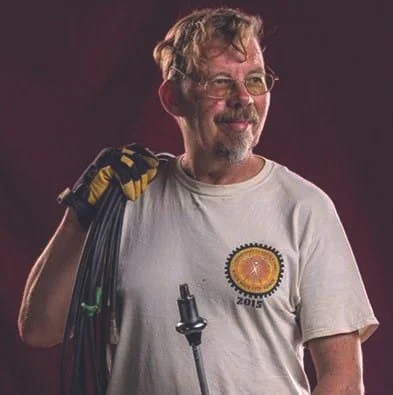
Christopher Maxwell. PHOTO by Peter Gedeon.
Christopher Maxwell: An Environmentalist Activist’s Last Wish
(Dying Florida Man Becomes an Angel)
30 November 1965-18 March 2026
by Jack R Johnson 04.2026
Christopher Maxwell, ‘Max’ to his friends, progressive activist, environmentalist and co-founder of WRIR and WRWK radio stations died in the middle of yet another Middle Eastern war. Just about the time that Israel bombed the South Pars oil fields and the Iranians retaliated by taking out much of Qatar’s natural gas processing infrastructure, Max drew his last breath. Had he lived, Max would have known the significance of this act, and would have told anyone in ear range to fill up their tanks. Gas prices would be spiking directly. And indeed they did.
The ultimate DIY activist, Christopher Maxwell was both a renaissance man and a realist. He had a no-nonsense approach to everything, including his cancer diagnosis and his own death.
“I’m a Florida man,” Max told me one afternoon, embracing the pejorative phrase. “I was born in Florida and had many of the cultural biases.” But he also grew out of them. Indeed, he said the idea of women ruling the planet was especially appealing. His second community LPFM station, WRWK gave voice to the Liberal Women of Chesterfield County, an organization that was pivotal in the election of Abigail Spanberger to Congress. Seeing the coral reefs of Florida dying oft mattered to Max. He evolved beyond that ’Florida man’ background to study urban planning at VCU, and become one of the most beloved progressive activists in Richmond.
Max believed in our ability to change systems that too often seemed immutable. He understood that much of our media did not reflect the way street level folks often felt. Ian Mouer was one of Maxwell’s close friends since the early 1990s. He noted that they started the recycling program at VCU together, an effort that “made millions for the school.” He also said that Maxwell regularly attended and spoke at Burning Man Festivals and helped to establish an international youth hostel on North Second Street in downtown Richmond. He did this as a way of ensuring that the community’s voice was heard.
Classic Max story: the decision to start a LPFM station came after someone told him they couldn’t run a radio show he wanted to hear.
An older person at the local NPR affiliate refused to play an environmental show called “The Bioneers.”
“No one wants to hear that.” they said, according to Max. But as anyone who knew Max can tell you, he was persistent. After a half dozen such rejections, Max told me someone at the same station said, “If you want to listen to ‘Bioneers,’ start your own radio station.”
So Max did.
With the help of local volunteers, Max created not just one community radio station but two for our region and he worked with Pacifica radio to help other localities set up their own lower power fm (LPFM) stations across the South. In fact, his advocacy, along with help from Senator Tim Kaine, created legislation that made independent low-power public radio available nationwide.
“The more we are the media the less likely we will fall for false narratives from the media,” Max once said.
He pointed out that we’ve seen it work with the videotaping of ICE’s murderous actions in Minneapolis. Actions that this administration lied about before the crime scene was even cleared. The major networks played catch up with the local video uploads.
Those false narratives are everywhere today. As Rain Burroughs, Max’s wife, has noted: “Our President unfortunately makes people feel good about their bigotry. Max wanted to make people feel good about being nice to each other and helping each other. He had faith in local communities.”
Max’s final project was trying to advance a technology that could extract carbon from the atmosphere and convert it to fuel, thus offsetting any carbon footprint.
Max’s idea—breaking down carbon from the atmosphere into a usable fuel for vehicles—might seem radical, but the science is valid enough. The benefits of quick adaption are enormous because the fuel would be used by gas-powered vehicles built today, thus the adoption time would be fractional.
“Scientists in Zurich have figured out that if you heat cerium oxide, which is a common thing – you can buy it on Amazon for ten bucks, like a tub of it,” Max said. “If you heat it to 1500 degrees Celsius, it will take carbon dioxide and water out of the air, and make syngas – which you then feed into a redox reduction oxidization chemistry set.”
“We’ll always need fuel,” Max told me, “but we don’t have to extract it from the ground. We can collect it from the air. My dying wish is to have a comic book that could teach a twelve-year-old how to make a device for that process.”
I imagine Max was thinking of himself at twelve, brainy beyond his years, wondering why the coral reef near his old Florida home was dying off.
“It’s about fairness,” he said, “it’s about our environment, it’s about taking our future into our own hands.”
A memorial service will be held at 11 a.m. on April 4 at Richmond Friends Meeting House, 4500 Kensington Ave. A Celebration of Life program will be held at the Byrd Theater at a date still to be determined.