
Richmond and Henrico residents tour TFC recycling facility where all material in CVWMA curbside and drop-offs ends up.
Central Virginia Waste Management Authority All For The Common Good
by Charles McGuigan 12.2025
It was 35 years ago that Central Virginia Waste Management Authority (CVWMA) was born, and since that time, thanks to a diligent staff, a forward-thinking board, and the cooperative effort of 13 disparate jurisdictions, this organization has been responsible for recycling a veritable mountain of trash that would otherwise have ended up in a landfill, in yet another assault on our Mother Earth.
“We have recycled about three and a half million tons,” says Kim Hynes, CVWMA’s executive director. “And that’s not just paper, cans, and bottles, but that includes things like yard waste and tires and electronics.”
We’re sitting in her office located near the western origin of Laburnum Avenue, a stone’s throw from Acca Yard. CVWMA was founded when the Commonwealth mandated that localities throughout Virginia meet a 25 percent recycling rate.
“So back in the late eighties there was some discussion about a regional solid waste authority,” says Kim. “Some of the leadership folks on county boards of supervisors and city councils were interested in forming a regional authority.”
At that distant time there was little recycling infrastructure in place. Reynolds Aluminum accepted cans. A few facilities recycled old newspapers. But aside from that, there wasn’t much else you could do with your waste but toss it in the trash. And the different localities within the region were not equipped to create recycling facilities.
“CVWMA took the burden off of each individual locality to develop a solid waste plan to achieve that twenty-five percent recycling rate,” Kim tells me. “That was the impetus for forming the authority. We started out of the Richmond Regional Planning Commission.”
It wasn’t long before other nearby jurisdictions joined the authority, including Petersburg, Hopewell, Colonial Heights, and Prince George County. Today, CVWMA encompasses more jurisdictions than any other waste management authority in Virginia.
When it was founded, curbside collection was a brand new concept and to make it a reality CVWMA had to find a way to make this idea work,.
“One of the first things the authority did was put out a procurement to get a company here that could collect curbside and expand drop-off recycling for those who didn’t have a curbside program,” says Kim. “We got seven of the jurisdictions to agree to a pilot curbside program.”
It wasn’t until 1991 that curbside recycling began in Richmond, Henrico, Chesterfield, Hanover, Ashland, Colonial Heights, and portions of Goochland. “In the beginning there were a little less than 20,000 households and that’s expanded over the years to 200,000 households.” Of that number 62,000 households are in Richmond, and 95,000 in Henrico.
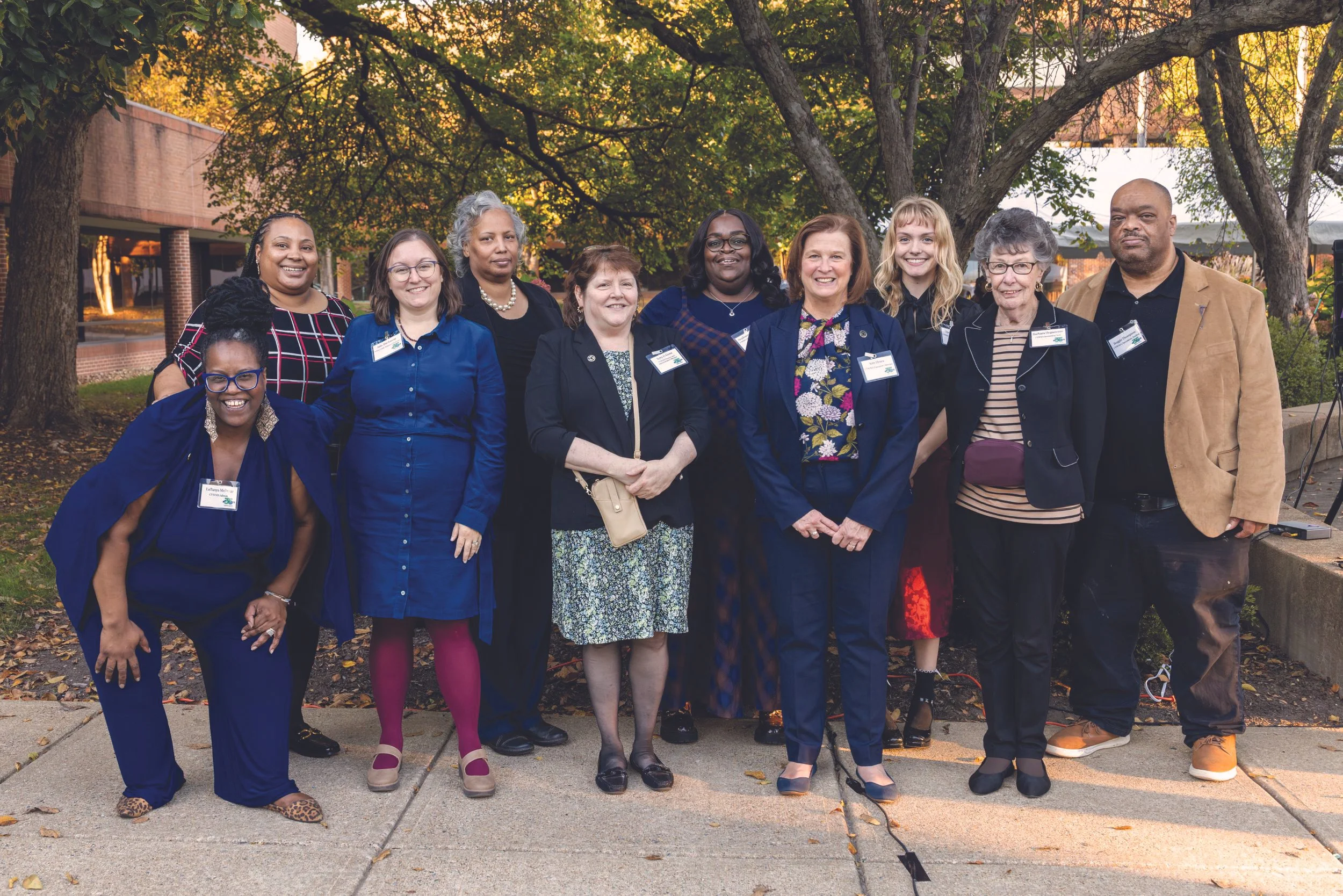
CVWMA staff.
“We started with the small eighteen gallon bins and the jurisdictions had a choice of weekly or biweekly collection,” Kim says. “Most were biweekly which is what our program is today.”
By the time curbside recycling began, CVWMA had secured a contract with a Chester-based material recovery facility, the same one they use today.
“Once they pick it up from the curb or drop-off site, the paper, cans and bottles are sorted, and then TFC Recycling markets it,” says Kim.
Included in those recyclables are plastic products. When I tell Kim I had heard that the vast majority of the plastic products are not recycled, but simply end up in a landfill, she shakes her head.
“If it’s recyclable in our program, it’s getting recycled,” Kim says. “If you’re putting it in the right can, it is getting recycled.”
And then she adds this: “The national reports are misleading. What some of them claim is completely erroneous. What plastic you put in your recycling can, if it’s an accepted material, will get recycled.”
There are certain plastics that, at this time, are not recyclable through CVWMA. “Things like five gallon buckets, plastic cutlery or plastic flower pots are not accepted in our program,” says Kim. “Those should go in the trash unless you can find another outlet or take them back to a flower shop.”
But many other commonly used plastic containers, found in virtually every household, are recyclable. “We tell people, ‘We recycle plastics you can find in your kitchen, bathroom and laundry room,’” she says. “Things like water and soda bottles, plastic produce containers, yogurt cups, laundry detergent bottles.”
“PUT THAT IN BIG AND BOLD LETTERS,” says Kim. “CVWMA RECYCLES PLASTIC.”
Glass is another material recycled by CVWMA. After it is thoroughly cleaned, the glass is transported to a company in Wilson, North Carolina. “They recycle glass back into glass products,” according to Kim.
There was a time, not long ago, that many items were not simply disposed of. “But we have become a more and more disposable society,” Kim says. “It used to be that if you bought a TV it lasted twenty or thirty years, and you called a TV repairman to fix it if there was a problem. Today, when it stops working you just throw it away.”
Fortunately there are times that you can ensure that your electronic items and small appliances do not end up in a landfill.
“There are opportunities in the region for folks to recycle their old TVs, their computers, laptops, even cellphones, now,” says Kim. “So our program is anything with a plug, even microwaves and things like that.” And though they are not able to handle large appliances like washers, dryers, refrigerators, or stoves, those items can be carted off to Richmond’s transfer station over on Hopkins Road.
Even some of the most egregious offenders of the environment can be recycled. “Periodically some of the jurisdictions will have an event for household hazardous waste for some of the more toxic things like oil-based paints and solvents and used motor oil,” Kim says. “We try to educate folks on not pouring things like this down the storm drain or even dumping it down the drain.“
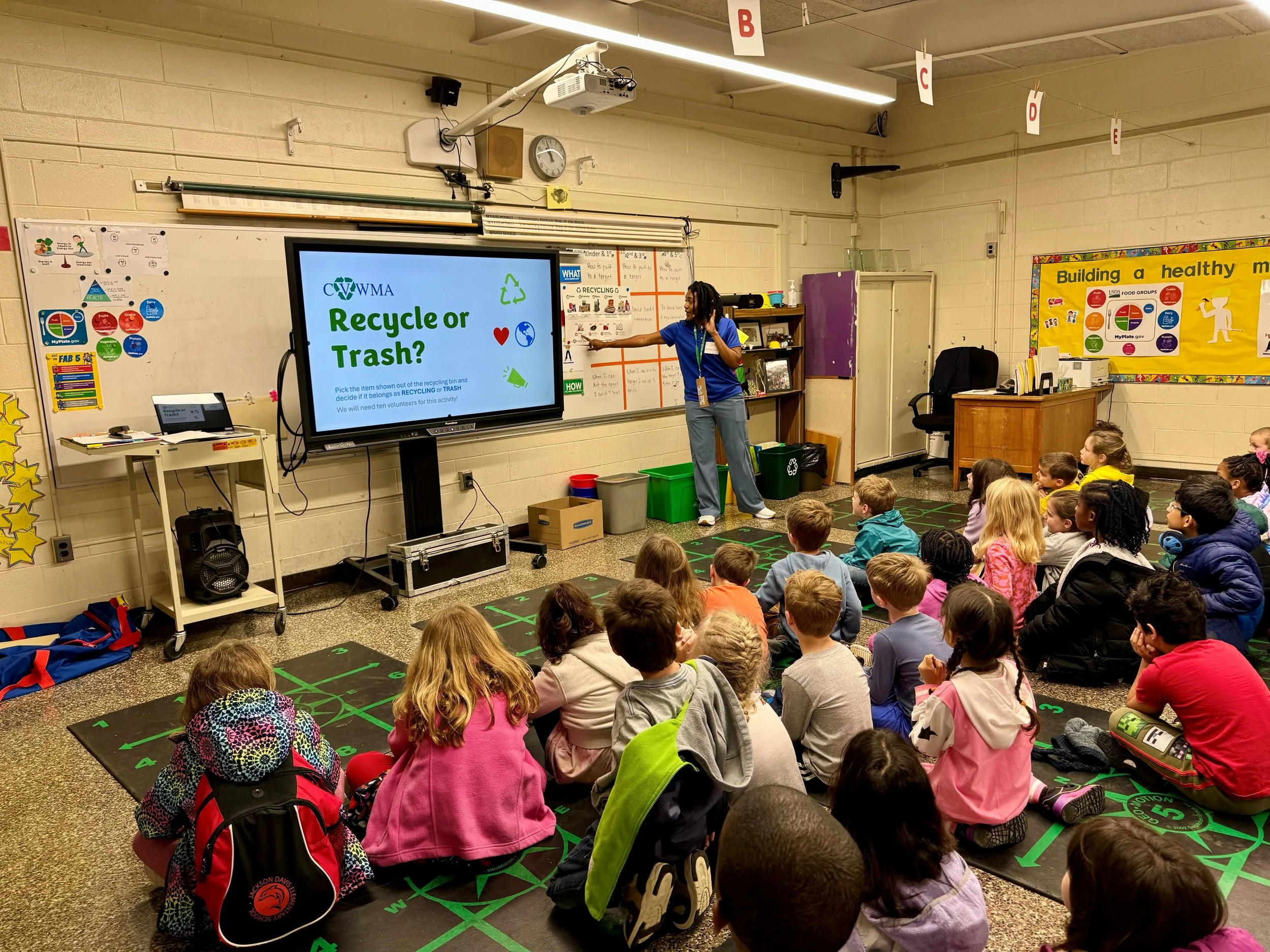
CVWMA school program.
And recently CVWMA started a new initiative that will help reduce something that accounts for a good portion of what ends up in landfills. “We just launched a food waste collection and composting program in July,” says Kim. “About a third of what’s going into landfills is organic and a good portion of that is food.”
Throughout Richmond there are 18 collection sites for this kind of refuse, many of which are located near community gardens. “You’ll see purple cans with lime green lids,” she says. “All kinds of food wastes are accepted. This includes meats and proteins and other compostable products, even food-soiled napkins. The city started a program with just fruits and vegetables a couple years ago under a grant they received and then we transitioned it to accept the proteins and meats.” That means bones and all. Many restaurants and grocery stores are using this latest recycling program. Once collected, the organic waste is taken to a composting facility just off Route 460 in Waverly.
“We are hoping to expand the food waste collection to other jurisdictions and to other public facilities, schools and jails, places like that,” says Kim.
She reflects on the great strides CVWMA has made over the past 35 years. “I am proud of what we’ve accomplished, but we still have a lot of work to do. The landscape of solid waste has changed and evolved and we’re working toward being less reliant on landfill disposal. The thirteen localities in our region generate about 1.3 million tons of waste a year. And we’re recycling about 58 percent of that now. But 600,000 tons still go into the landfill. We’re working to reduce that.”
And then Kim Hynes says this: “Our region is very diverse, ranging from urban to suburban to rural communities and one of the things that I’m most proud of is that all thirteen jurisdictions can come together to achieve their goals collectively. It’s all for the common good.”
Central Virginia Waste Management Authority
2100 West Laburnum Avenue, Suite 105
Richmond, VA 23227
(804)340-0900