
The Greening of Richmond
by Charles McGuigan 04.2026
More than half a century ago, the United States did several extraordinary things in rapid succession. It all began on the first day of 1970 with the bipartisan passing of the National Environmental Policy Act, the most significant environmental legislation in American history. Later that same year, the Clean Air Act, first adopted in 1963, was given more teeth, granting the federal government a greater role in air pollution control. Then, on April 22, Earth Day was celebrated for the first time with the largest single-day of protests ever seen, before or since. From sea to shining sea, more than 20 million Americans showed their outrage over corporations that were willfully destroying our biosphere for profit. Toward the end of that same year, again with bipartisan support, the Environmental Protection Agency was born. This was the literal birth of the international environmental movement, and the United States led the way.
Today, under the current administration, this country has all but abandoned its commitment to protecting our beloved biosphere. On his first day in office, the current president signed a slew of executive orders that did everything from streamlining the permitting process for corporations to circumvent the Clean Water Act requirements, to withdrawing our country from the Paris Climate Agreement.
His has been a wrecking ball approach to environmentalism. He fired more than 1,800 employees of the US Fish and Wildlife Service, canned 2700 National Park Service workers, and fired over 7,000 men and women from the US Forest Service and the Bureau of Land Management.
This, too: he has opened almost 60 million acres of a National Forest—land that is owned by all Americans—to the logging industry. Likewise, he expanded mining on public lands by expediting permitting approvals and expanding the list of critical minerals.
His administration rolled back protections under the Endangered Species Act that have prevented the extinction of hundreds of species. He even opened the pristine waters of the half-million square mile Pacific Island Heritage National Marine Monument to commercial fishing.
He has attacked clean energy on multiple fronts, canceling wind and solar farm projects, while at the same time reviving the coal industry, and vowing to permit oil drilling on hundreds of thousands of acres of public lands.
The list goes on and on and on and on.
This past September, in an address to the United Nations General Assembly, the current president of the United States said this: “This ‘climate change,’ it’s the greatest con job ever perpetrated on the world.”
Global climate change is a fact. There are no grounds for arguing otherwise; it’s specious to do so. And human activity is responsible for the devastating damage to our environment. More than 99 percent of peer-reviewed scientists agree there is indisputable proof of a link between global warming and human activity.
And guess what activities contribute most to global climate change?
Using fossil fuels – coal, oil, and gas. The burning of these substances accounts for 68 percent of global greenhouse gas emissions and nearly 90 percent of all carbon dioxide emissions.
What is happening nationally on the environmental stage is staggering and almost impossible to understand, let alone take action against. But not long ago I had a conversation with a young environmental scientist. This is what she said regarding the removal and management of invasive species: “If we take the big picture, it’s overwhelming and it seems that you can’t make a difference, but when you look at it on a smaller scale, you can make a big impact and you can build resiliency in your communities. Just like elections. You can go vote in your local elections and make a difference nationally.”
RVAgreen2050
Richmond is the perfect counterpoint to the federal government’s backpedaling on environmentalism, starting with RVAgreen2050, the City’s initiative to reduce greenhouse gas emissions by 45 percent in the next five years and to achieve zero greenhouse gas emissions by 2050.
To achieve this ambitious goal, the Richmond Department of Transportation is managing almost a billion dollars in transportation safety projects that will encourage people to become less dependent on their cars.
“Some (of these projects) are obvious like road reconfigurations to create bike lanes and bus lanes, pedestrian hybrid beacons, and high-visibility crosswalks,” according to Michael Hinkle, a City spokesperson. “Some are less obvious like speed tables, bump-outs, roundabouts, and other traffic calming measures to make streets more pleasant.”
The City of Richmond has also been steadily moving away from gasoline-powered vehicles. Not long ago, Richmond received the Best Electric Vehicle Policies 2025 at the Sustainable Fleet Technology Conference in Winston-Salem, North Carolina. This award recognizes Richmond’s electric vehicle replacement policy to improve efficiency and advance sustainability goals. Richmond’s fleet—comprising sedans, pickup trucks, medium and heavy-duty vehicles, along with emergency response vehicles and fire trucks—was recently named the 16th greenest fleet in the country.
And last year, the City’s Department of Public Works, in conjunction with Toole Design and the Timmons Group, produced a guide to “greening multimodal buffers.” Which means, in ordinary English, the planting all sorts of all sorts of perennials in curb-ringed beds built in that no man’s land between bike lanes and roadways, or in that oft-neglected devil strip between sidewalk and gutter. “Urban greening is increasingly recognized for its ability to improve air quality, reduce urban heat, manage stormwater, and foster healthier, more vibrant communities,” Michael explained.
Overseeing much of the environmental progress in the City is the Office of Sustainability. It’s mission:“to enhance the quality of life for all residents by making Richmond equitable, healthy, and resilient. The Vision is that all Richmonders, regardless of their identity or neighborhood, thrive in a climate-neutral community. The Office works at a systems level to change the underlying policy and structural.”
In Richmond today there are scores of public and private initiatives that are hell-bent on making the city as green as Oz. Many of them, in one way or other, focus on chlorophyll-based life. Whether it’s community gardens, green grocers, farmers’ markets, or integrated pest management, the objective is the same: restoring a balance with nature,
A number of these programs concentrate their efforts on the virtual lungs of our planet by planting trees—hundreds of them—and they do make a difference.

Qui Nguyen at Northside Nursery. PHOTO by Reforest Richmond.
COMMUNITY FORESTRY
Qui Nguyen is the coordinator for the Community Forestry program which is part of the City’s Department of Parks and Recreation. This program educates the community on the importance of trees in the city. More than that though, it helps residents become better stewards of the trees, and our urban forests.
“My role as the coordinator is not only to build programming to make this goal possible,” Qui told me. “But I also manage the Northside Nursery, and help develop internal policies and processes that grow and protect our urban canopy.”
That urban canopy actually protects Richmonders from some of the horrific effects of climate change. Trees reduce the risks of extreme heat, help reduce surface temperatures and provide immediate relief for people working, playing, or exercising outdoors. Trees also improve air quality as leaves absorb harmful gases such as nitrogen dioxide. They also remove carbon dioxide and other greenhouse gases from the atmosphere.
“We have found that if we engage with a community that uses our parks and ask them, ‘Hey, not only do we want you to come and enjoy it, but help us take care of it,’ their sense of ownership really improves,” said Qui, who is passionate about her work. “The whole purpose of what I do is inviting the community into our parks and green spaces and look at and appreciate the trees and help us steward and maintain them if possible.”
The amount of parks throughout Richmond, big and small, is staggering. “We have over 400 parcels throughout the city,” Qui said. “A lot of people are blown away by that number, but it includes all of our parks, from the little pocket parks in the middle of the Fan to the large parks like Bryan Park, or the James River Park system.”
Qui is also responsible for the city’s Northside Nursery. “This is the city’s only tree nursery, where we grow and cultivate trees, shrubs, woody perennials, and native herbaceous plants for planting in our parks properties,” she said. “It is also a learning and collaborative space where we work with local groups and nonprofits who also help preserve, conserve, and grow our natural resources.”
Before taking a position with Parks and Recreation, Qui had been employed by the Department of Public Works. “I was previously the AmeriCorps service member serving the Urban Forestry Division within DPW, where I lead volunteers in helping us update our tree inventory, as well as a number of street tree planting projects,” she told me. “I love trees.”
CAPITAL TREES
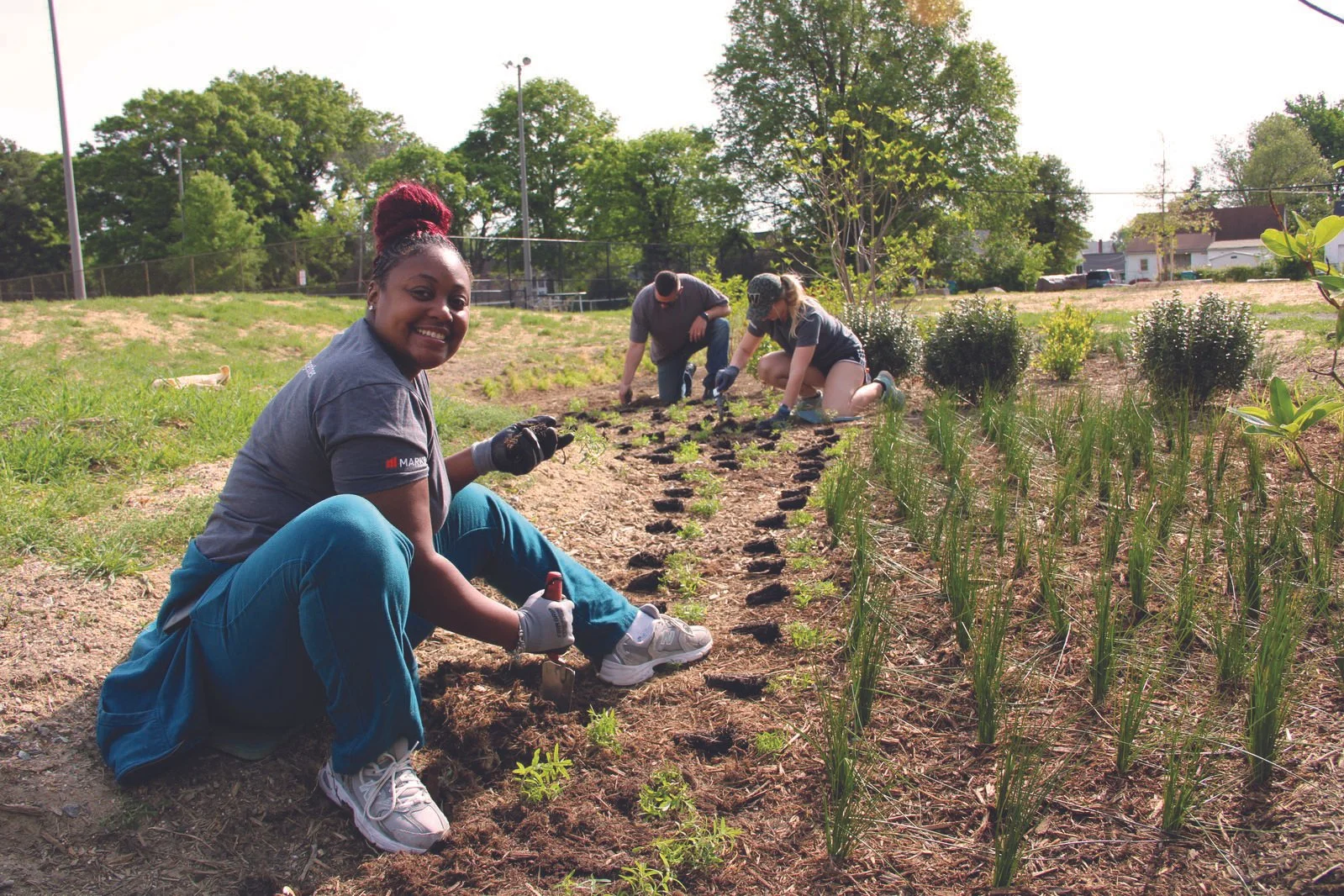
Rain garden planting at Hotchkiss.
Formed by four Richmond garden clubsa little over fifteen years ago, Capital Trees is a not-for-profit group dedicated to transforming Richmond through the power of public greenspaces.
“We seek to pull people together who are trying to build a more climate resilient and kinder community through green space projects, tree canopy increase, and sustainable management of those green spaces,” said Shelly Barrick Parsons, the organization’s executive director. “So, we try to get people from Richmond to get their hands in the dirt through a variety of ways. Whether that’s planting a tree, caring for a completed landscape, learning about tree identification or even contributing ideas to future parks. Not only do we build a tree canopy and green space, we also care for it and connect and educate the community about the value of green space.”
The trees they introduce to these public lands are selected based on what experts recommend. “We work with urban foresters to confirm that those are the best species to plant,” Shelly said. “We do aim to plant primarily native trees. Our goal is about 90 percent, but sometimes it’s 100 percent.”
Every year the group plants more than a hundred trees. And folks from the community do get involved. Last year alone over 500 volunteers helped out in both planing and maintenance.
Capital Trees works closely with the community before creating a green space. “We try increasingly to engage the community in conversation about what they would like out of the green space when we’re designing it,” said Shelly.
One of their latest projects is at Hotchkiss Green on East Brookland Park Boulevard where the City is nearing the completion of its renovations to the community center there. In the summer it was one of the hottest spots in Northside, and had no tree canopy at all.
So far, Capital Trees has planted 85 trees there including a small stand at one of the entrances, and other along a trail. And some of them aren’t the standard trees you see in greenspaces.
“We’re developing what would be called a food forest there with some fruit-bearing trees and shrubs,” said Shelly. It’ll be a virtual garden of Eden with fig trees and plum trees, and cherry trees and hazelnut. And there will be pawpaws and jujubes, and highbush blueberries and strawberries.
Hotchkiss Green will officially open on April 26 with a ribbon-cutting ceremony.
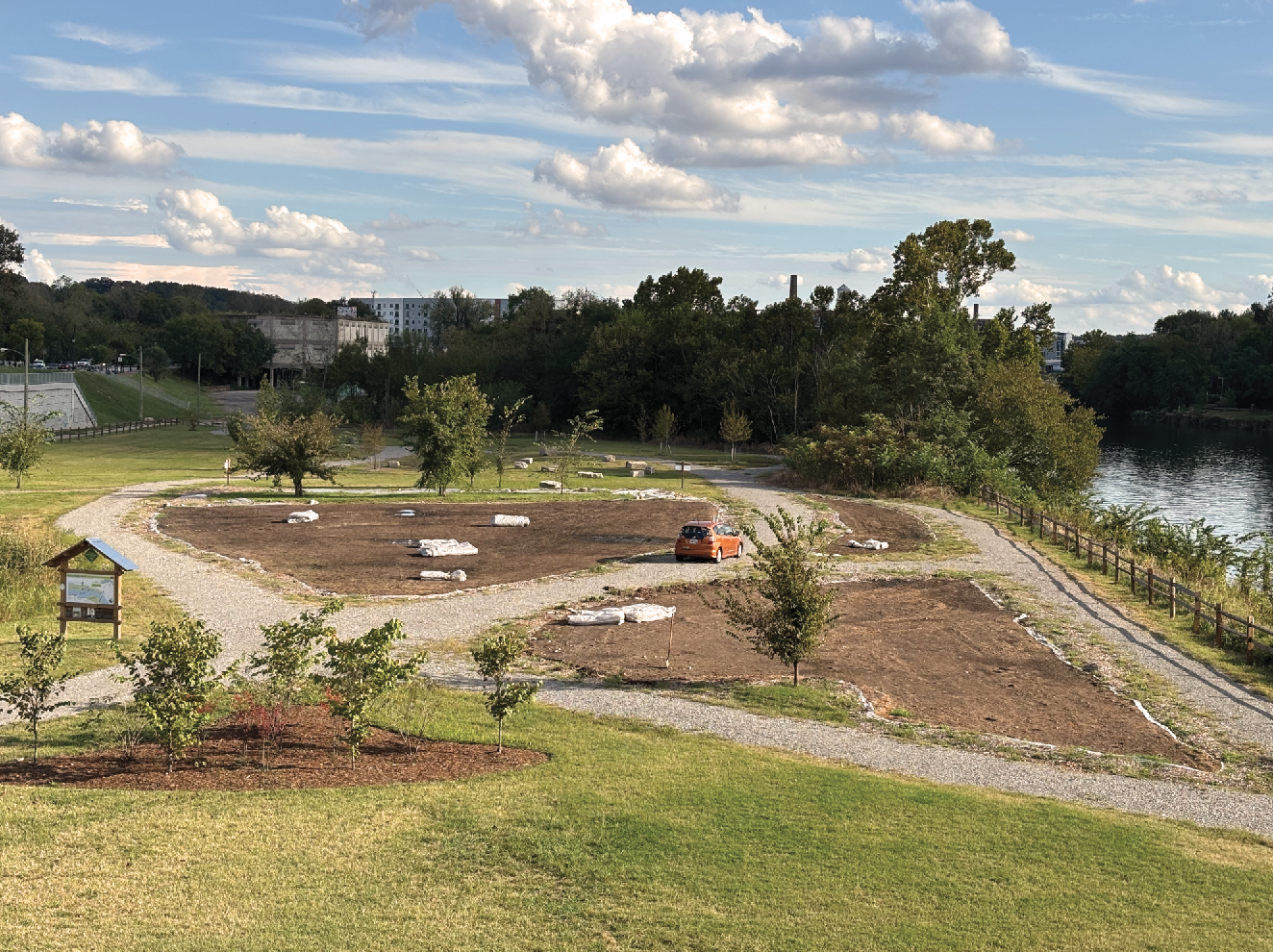
Last October, the plastic at Dock Street was removed to reveal bare ground.
INVASIVE REMOVAL
Of all the majestic spots of greenery in our fair city, some of the most breathtaking of all are those that flank the mighty James River. Unfortunately some sections of it are filled with invasive species that have suffocated the natives.
Catherine McGuigan, who has a lifelong love of our river and its adjacent parks, is now the invasive species management program coordinator for Friends of James River Park.
“I am in charge of overseeing a field staff of different invasive species specialists and technicians in the park,” Catherine said. “There are three people right now—one technician and two invasive specialists. I’m in charge of overseeing the program and determining where we’re going to be doing our work and what project areas we’re focusing on in the park.”
It’s a massive park, both sides of the river stretching from Huguenot Flatwater down to Ancarrow’s Landing, covering some 745 acres of park land.
Because its such a large greenspace, Catherine’s team has to be selective of the areas they focus on. Some areas are so overwhelmed by invasive species that it would be next to impossible for her team to tackle them. It would be best to start from scratch.
She mentions one section of the Buttermilk Trail on the south shore of the James. There a section just below Woodland Heights between Reedy Creek and the Belvidere Bridge is blanketed in wisteria. It is one of the hardest invasive vines to eradicate from a landscape.
Just across the river, below Hollywood Cemetery, are the strangling tresses of kudzu that would be futile for Catherine’s team to attempt restoring. “Those areas are so overgrown that you would need to raise it to the ground basically and start from scratch,” she said. “So we work in areas where it’s a little bit more in the middle. We work really closely with a lot of volunteer groups and because it’s such a big park, we’re working in very targeted areas where it makes sense to do the work.”
Last year Catherine and her team, along with volunteers and park Operations staff, converged on a section along the James just below Great Shiplock Park on the site of a former concrete factory. The land was terribly degraded. After removing massive chunks of concrete, the crew went to work removing the Johnson grass, a highly invasive species. They literally scraped the land clean with an excavator.
“So we had a clean slate,” said Catherine. Then to make sure the rhizomes and seeds of the Johnson grass were fully dead, they solarized the half-acre plot by laying out massive sheets of UV-treated 6 mm plastic, and let it bake in the sun from June until this past October.
“I went and removed all the plastic, all the grass was dead,” Catherine told me.
And the soil was ready to accept the seeds of native plants.
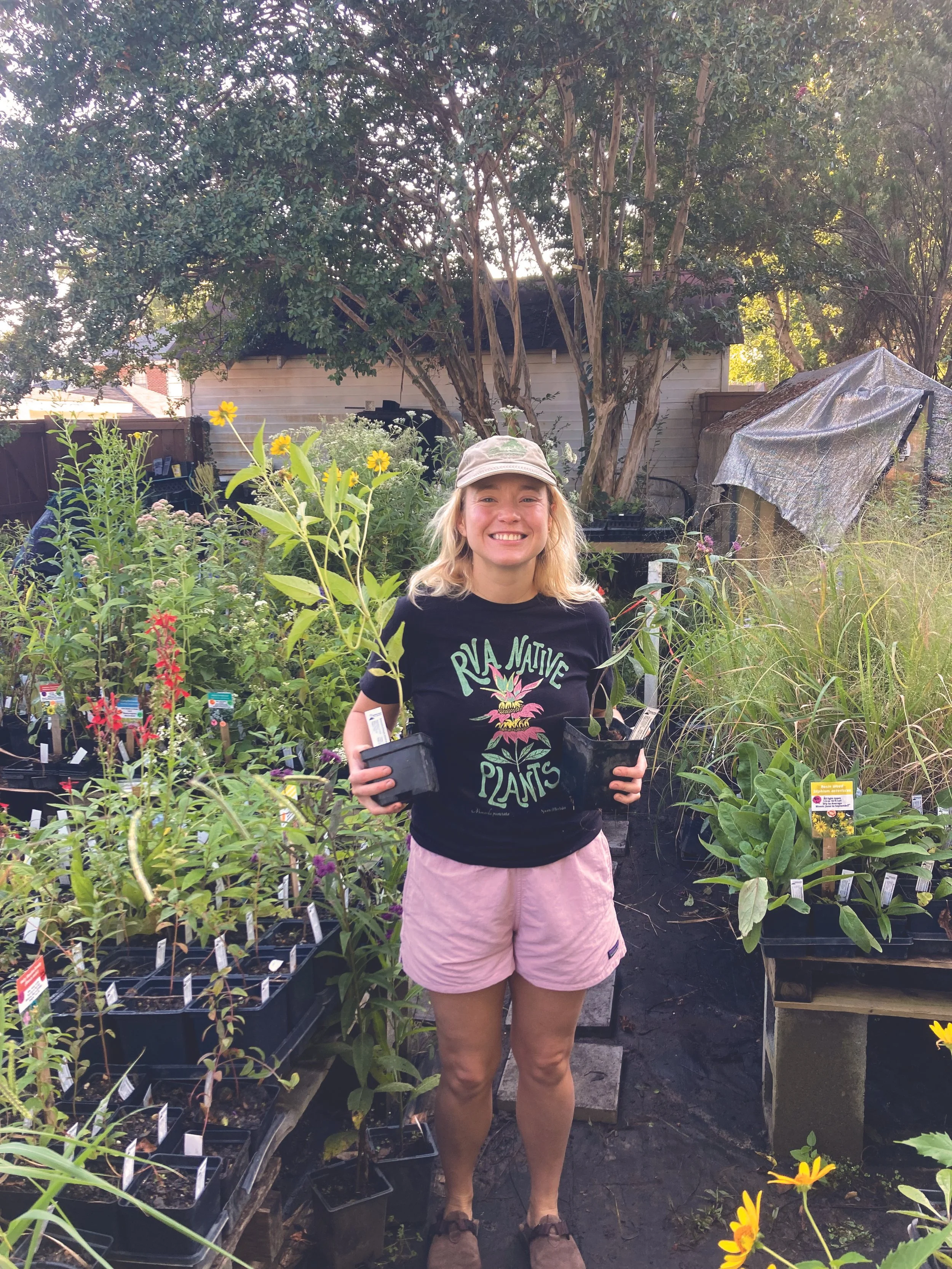
Going Native with Ashley Moulton.
GOING NATIVE
Whether in the front yard or the back, when planning a flower garden it’s best to stick with native species. The benefits are endless. For one thing, native plants are absolutely beautiful. And they’re great for the environment. They don’t need artificial fertilizers, or chemical pesticides and herbicides. Natives require little watering, and they provide vital habitat for all sorts of wildlife, from butterflies and moths, to pollinators like bees and hummingbirds. These small foot soldiers also combat climate change in a very real way. They reduce (if not eliminate) noise and carbon pollution from lawn mower exhaust, and many native plants, especially long-living trees like oaks and maples, are effective at storing carbon dioxide—the greenhouse gas.
And the best native plants to use are those grown from ecotype seeds. Several years ago I spoke with Bill Shanabruch who created the Reedy Creek Environmental nursery ten years ago. Here’s what he said: “A local ecotype plant that’s part of a local population has coevolved for thousands of years in this location. And those plants are going to have full ecosystem services. And what I mean by that is that it’s going to have all the interactions with all the other plants and the animals and the soil microbes and the fungi.”
Ashley Molton is owner and founder of Molton Hot Natives which specialize in ecotype native plant species. “I go out and collect native seed from from conserved land and also private land in the Richmond area, which I define as an hour radius from the city,” Ashley told me. “We use a sustainable seed collection protocol.”
In Virginia there are approximately 2,000 truly native species, with about another 700 species that are naturalized, but non-invasive. Ashley has 111 species that are seeded out in her growing area.
She doesn’t do much in the way of spring ephemerals. “I just think they’re too short-lived in the landscape,” she said.
But she has an abundance of perennials along with sedges and native grasses. “Something I’m excited about right now is the Carolina jessamine,” said Ashley.
She mentioned a number of other plants, including that summertime beauty—Joe Pye weed. “I love those plants so much,” she said. “We have two species of Joe-Pye that are common in our area—hollow Joe-Pye and three-nerve Joe-Pye.”
Ashley is particularly thrilled about a native bee balm. “I’m trying to market spotted Monarda,” she said. “It’s a beautiful plant. It looks like something out of Dr. Seuss and I think it has some medicinal values.”
Her nursery also houses a variety of sedges and grasses. “I studied grasslands from my master’s degree so I’m a grass nerd,” she said.
And there’s an app that anyone interested in native plants should consider getting. “I tell people to download the Flora Virginia app,” Ashley said. “ It’s just twenty dollars, but it’s basically our encyclopedia of Virginia flora.
You can order from Ashley online by visiting moultonhotnatives.square.site
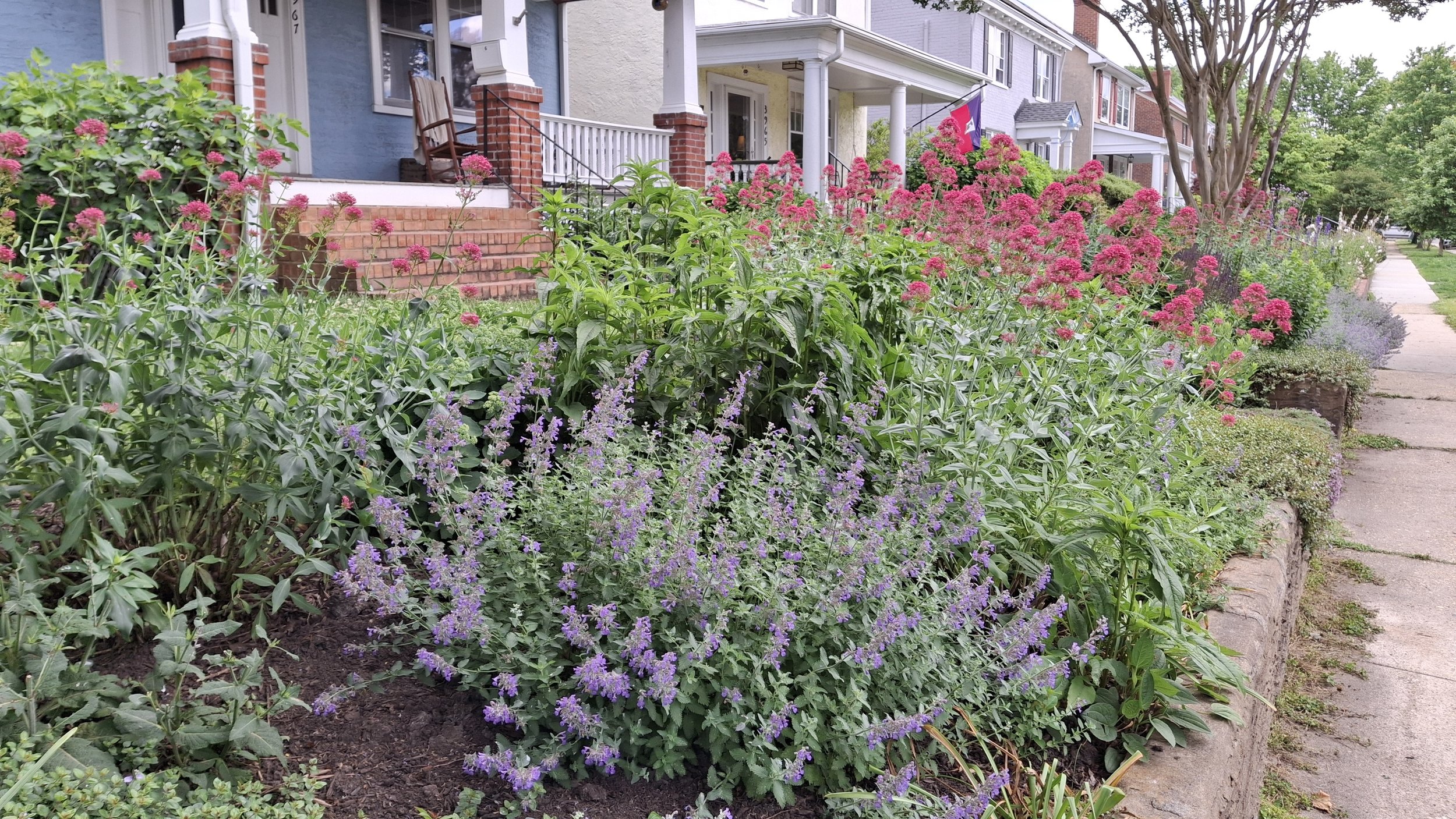
Liberating the lawn in Bellevue.
LIBERATING THE LAWN
Lush, emerald lawns cover over 40 million acres in the continental United States. That’s nearly fifty thousand square miles, roughly the size of New York State. It is the largest crop in the country, even edging out corn, and has absolutely no food value. These uniform swards of green, whether they blanket golf courses or the yards of residential homes, come at a dear cost to the environment.
In some states, turf grasses cover large portions of the ground. Ten percent of Delaware is devoted to lawns, and in Connecticut and Rhode Island the number soars to twenty percent.
Lawns in the United States require about 2.4 million metric tons of fertilizer annually, which contributes to increased nitrogen levels in runoff water, and in far too many instances herbicides and pesticides are used, which eventually end up in the Chesapeake Bay watershed. And consider this: each day, according to the Environmental Protection Agency, nearly nine billion gallons of fresh water are pissed away to keep a non-native species of grass ever-green.
Add to that, loss of habitat, and because manicured lawns do not flower, pollinators perish for lack of nectar. This, too: turf grass is a mono-culture: it offers no biodiversity and habitat for a multitude of organisms.
And though lawns do sequester carbon, they don’t do it nearly as well as a more bio-diverse ground cover.
During the last recession, Richmond had a bumper crop of abandoned properties, and Chris Gough, an associate professor of biology at VCU, seized the moment.
“We followed up by digging in the soils and quantifying the amount of carbon in the soils and how that changes over time after people leave,” says Chris. “And so the take home from that was lawns that were abandoned for a longer period of time actually accumulated more carbon because there was a recovery, a return, back to the prior ecosystem that existed before it was grass. You eventually get woody species, trees, shrubs, bushes and so it appears that as that plays out over time after abandonment there’s this accumulation of carbon in the soil.”
There is a national trend that has been gaining momentum for well over a decade. More and more people are allowing nature to take its course by introducing native plants into their yards and letting the cultivated grasses die out. I have witnessed its progress in Richmond, year by year, and when one front yard on a given block eliminates turf grass there is a sort of domino effect, with neighboring homes following suit. Many front yards in Bellevue and elsewhere in the city are now blanketed with perennials and native ground covers. They look natural, they celebrate their own diversity, they restore ecosystems, and unlike the boring conformity of a green lawn, these perennial landscapes—varied and colorful—possess an aesthetic that appeals to all five senses. What’s more they do not use pesticides or herbicides, and there is no reason to mow them. Also: native plants from this region—the ecotypes—do not require excessive watering like turf grasses, which guzzle it.
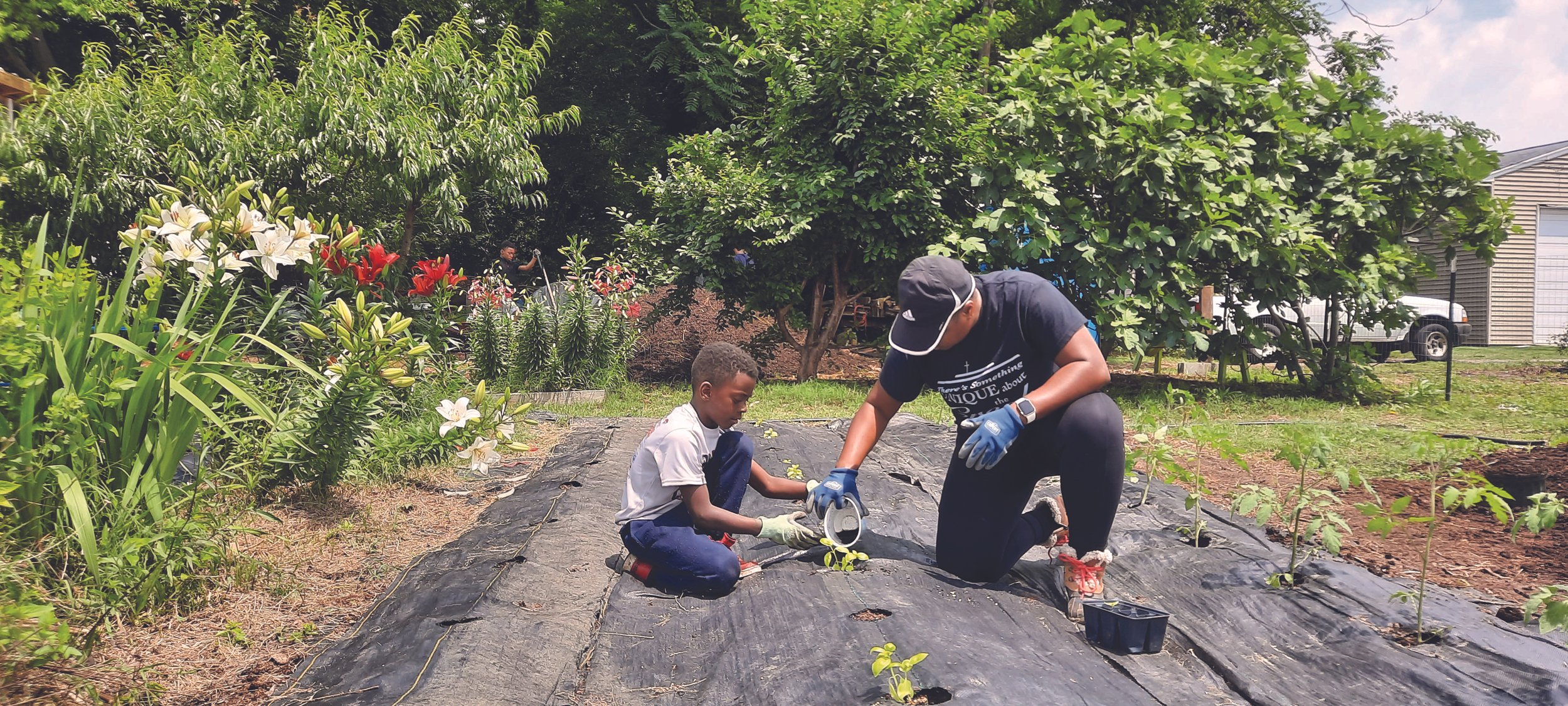
Mother and son watering plants at the Williams City Farms, a community garden in the Northside. PHOTO by Shana Williams.
COMMUNITY GARDENS
In the final chapter of “Candide,” the titular hero of the story, world-weary and worn, meets the Turk who says, “I have only twenty acres. I cultivate them with my children; work keeps away the three great evils: boredom, vice, and need.” And Voltaire ends his short but momentous work with these words: “Let us cultivate our garden.”
Wise advice to us all, and there is not a better feeling than working the soil, planting the seeds, witnessing the miracle of growth, and then harvesting the fruits of your labor all from a small plot of the good earth.
In Richmond there are 24 community gardens. These gardens provide economic benefits, increase social equity, strengthen communities, and promote environmental stewardship.
On the Northside there is a fabulous community garden called the Williams City Farms. Located on East Ladies Mile Road, it is the brainchild of Shana Williams and its tagline is “sowing seeds and growing community,” which is exactly what it does. More than a garden, this splendid spot of greenery is also a leaning center.
“As a school teacher and now an urban farmer, creating an educational farm is a wonderful opportunity to expose and educate students and adults about the many different varieties of fruits and vegetables and growing methods,” Shana said. “We share information, time, seeds, plants, and encouragement to inspire everyone to begin growing their own amazing fresh produce. We promote sweat equity on the farm through volunteering. We provide students with field trips and summer programs. We welcome families and individuals to learn about growing a variety of vegetables and getting their hands dirty experiencing gardening as we inspire them to become growers.”
It all began with a pair of overgrown vacant lots. “A small quiet voice in my spirit said, ‘Put a garden here and teach people how to grow food,’” Shana remembered. “We have been doing just that since April of 2019.”
In the intervening years, the Williams City Farms have taught youth and adults alike how to grow their own food. What’s more, much of the bounty produced here has ended up helping those who may be experiencing food insecurity. Since the first crop was harvested six years ago, Williams Farms has donates more than 11,000 pounds of fresh produce to the local community and food pantries, including the one hosted by St Thomas Episcopal Church. And the vegetables grown here are healthful—they are all pesticide-free.
“I love watching nature and enjoying how things grow,” said Shana Williams. “There is an awe about the process of a simple small seed having such a big impact through steady focused growth. Producing far beyond, what one can immediately consume, which leads to lovingly sharing the bounty of such a beautiful blessing.”
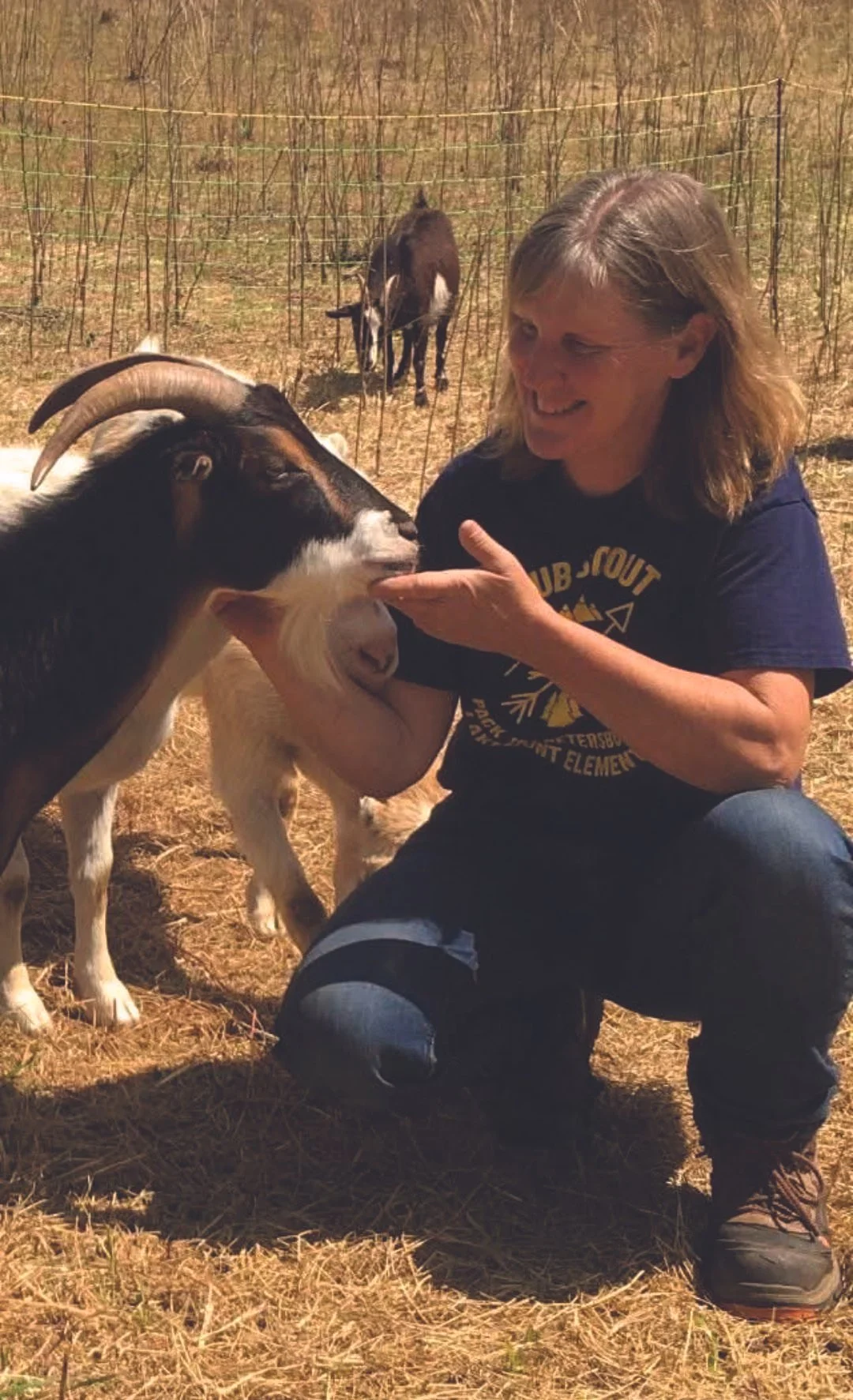
Kristi Orcutt and her goat Samoa.
DON’T SPRAY: GO WITH GOATS
Even the best maintained gardens will require vigilant weeding to extract unwelcome visitors that compete with your perennials or vegetables for water, nutrients, even sunlight. Whatever you do to control unwanted guests in your garden, steer clear of herbicides. They can leach into the soil and nearby water systems, causing widespread pollution. These substances can wreak havoc on plants and animals, not intended as targets, which can lead to a cascading effect on insects and other wildlife, even on the microorganisms in the soil itself.
You can control most weeds by getting down on your knees, grabbing a hand-weeder or trowel, thrusting it into the soil, and prying it out, roots and all.
Sometimes though, the jobs are massive with the viney nightmares of porcelain berry or English ivy. And, god forbid, kudzu. But don’t be tempted to spray it down with harmful chemicals. Instead do it the environmentally friendly way. Let nature’s weed eaters (and they actually eat them, even poison ivy, which they devour like candy) do the job for you. Bring in the “chew crew,” otherwise known as Kristi Orcutt’s RVAgoats.
Kristi picked up her first goats thirteen years ago, not long after watching the Goatbusters in action at Chimborazo Park up on Church Hill.
“I was so inspired by that project because as a beekeeper I quickly recognized that the use of herbicides and mosquito spray services are decimating local insect populations,” Kristi recalled. “That’s when I decided to launch my own grazing business.”
Her very first client was Friends of Bryan Park. The objective was to tackle the wooded area behind the soccer field. When Sue Ridd of Friends of Bryan Park showed Kristi the area she drew a deep breath.
“I was incredibly overwhelmed,” Sue said. “There were acres and acres of tall trees completely draped and smothered by porcelain berry and kudzu. And Japanese honeysuckle and so much more.”
But she took her dozen goats to the site, and standing before the jungle of vines, thought of this saying, “If you want to eat an elephant, you do it one bite at a time.”
Armed with a machete, she began chopping a path through the tangle of vines wide enough for a goat fence. Three days later that first area was completely cleared of weeds. She kept it up throughout the summer. “We got through almost all of that meadow north of the soccer fields,” Kristi recalled. “Of course those plants are so persistent that they grew back, but we had made inroads and built upon those first steps summer after summer and began to see native plants claiming more and more space previously smothered.”
Kristi now has a team of 150 sheep and goats, most of them rescues or adoptions. She also has a staff to manage it all, along with six livestock guardian dogs to protect her hard-working weed warriors.
“Here in Richmond we are regulars at University of Richmond, various places within James River Park,” Kristi said. “We have even grazed the governor’s mansion hillside and numerous yards around RVA.”
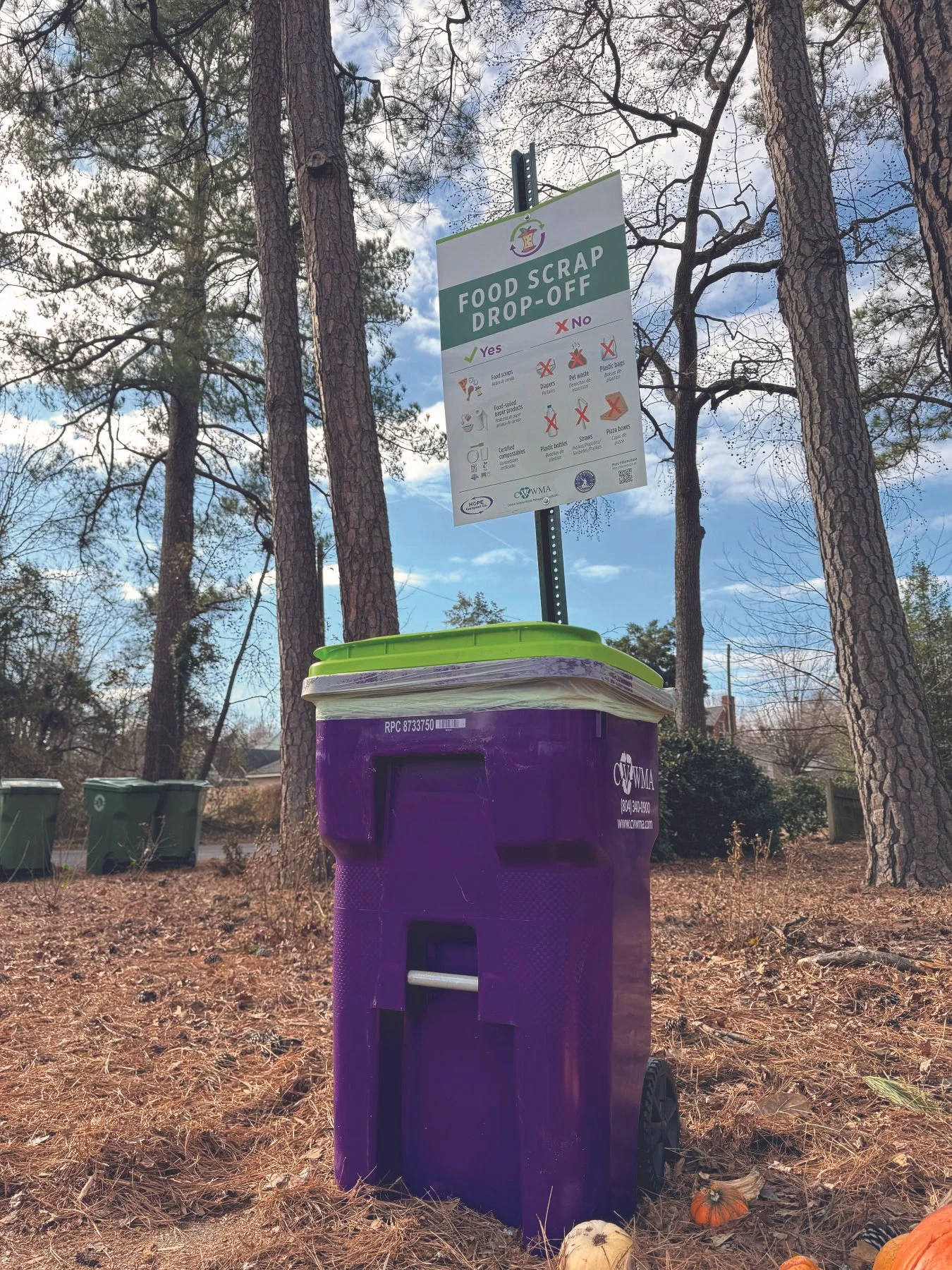
Purple cart composting has taken off in Richmond in the last few years. PHOTO by CVWMA.
REDUCE REUSE RECYCLE
One of the ways to wage war against solid waste is to follow these three simple verbs: Reduce. Reuse. Recycle.
Richmond has one of the most successful waste management authorities in the state. Founded 35 years ago, the Central Virginia Waste Management Authority (CVWMA), operating out of offices on the Northside, covers thirteen jurisdictions, including Petersburg, Hopewell, Colonial Heights, Richmond, Henrico, Chesterfield, Hanover, Ashland, and, of course, Richmond.
Over the years, CVWMA has recycled a veritable mountain of trash that would otherwise have ended up in a landfill, in yet another assault on our good Mother Earth. “We have recycled about three and a half million tons,” said Kim Hynes, CVWMA’s executive director. “And that’s not just paper, cans, and bottles, but that includes things like yard waste and tires and electronics.”
And despite what you might read, CVWMA also recycles many plastic items. “The national reports are misleading,” Kim told me. “We recycle plastics you can find in your kitchen, bathroom and laundry room. Things like water and soda bottles, plastic produce containers, yogurt cups, laundry detergent bottles.”
Even discarded household appliances and electronics can be recycled. “There are opportunities in the region for folks to recycle their old TVs, their computers, laptops, even cellphones, now,” Kim said. “So our program is anything with a plug, even microwaves and things like that.” And though CVWMA is not able to handle large appliances like washers, dryers, refrigerators, or stoves, those items can be carted off to Richmond’s transfer station over on Hopkins Road.
Not long ago CVWMA started a new initiative that will help reduce something that accounts for a good portion of what ends up in landfills. “We launched a food waste collection and composting program in July,” Kim said. “About a third of what’s going into landfills is organic and a good portion of that is food.”
Throughout Richmond there are 18 collection sites for this kind of refuse, many of them located near community gardens. “You’ll see purple cans with lime green lids,” Kim said. “All kinds of food wastes are accepted. This includes meats and proteins and other compostable products, even food-soiled napkins. The city started a program with just fruits and vegetables a couple years ago under a grant they received and then we transitioned it to accept the proteins and meats.” That means bones and all. Many restaurants and grocery stores are using this latest recycling program. Once collected, the organic waste is taken to a composting facility just off Route 460 in Waverly. Since the program began last November more than 17 tons of food waste has been diverted from area landfills.
“Our region is very diverse, ranging from urban to suburban to rural communities and one of the things that I’m most proud of is that all thirteen jurisdictions can come together to achieve their goals collectively,” Kim said. “It’s all for the common good.”

Peter and Sharon Francisco, founders of the Lakeside Farmers' Market.
FARMERS’ MARKET
In the Richmond metro area there are more than twenty farmers’ market, and each one offers an abundance of produce that is locally grown. On average, food travels over 1,000 miles from the point of production to a typical retail grocery store. By contrast the fresh produce you purchase at a farmers’ market generally comes from farms less than 20 miles away.
And farmers markets take sustainability a step further. They ensure that local farmers can make a living off sustainably grown food, while providing an outlet where communities can find and purchase their products.
Just north of the city limits is one of the region’s most popular farmers’ market. A little over twenty years ago Sharon and Peter Francisco had a vision to create a community gathering place that would act as a catalyst for the revitalization of the aging Lakeside Avenue business district. And because Lakeside no longer had a grocery store, the pair decided to build Henrico County’s first farmers’ market.
Two years later, after clearing zoning hurdles with the county, the Francisco’s dream of a farmers’ market became a reality. For the next two years, vendors operated from tents and under umbrellas. And then the Francisco’s built a massive, permanent pavilion.
Two of the farmers have been with the market since the first season: the Lopez Farm, offering fruit, vegetables, eggs and fresh-cut flowers; and Agriberry Farm and CSA (Community Supported Agriculture), selling fresh seasonal fruit and berries year-round.

Kyle Anderberg working the fields of Lakeside's Tiny Acre.
URBAN FARMING
One vendor at Lakeside Farmers’ Market has a zero carbon footprint for transporting produce from farm to market. It just requires about a few hundred footsteps.
Just behind the Lakeside Farmers’ Market, Kyle Anderberg works his magic with the soil on Lakeside’s Tiny Acre, which flourishes on a one-acre plot owned by the Franciscos.
“I started it in 2016 with the goal of providing the most nutritious and sustainably produced vegetables to the Lakeside area, and all my decisions are made with that in mind,” Kyle said. “The importance of sustainability became apparent to me while studying biology and environmental studies at Virginia Commonwealth University years prior to beginning my farming journey.”
“The foundation of the farm is healthy and living soil achieved by enriching the earth through composting and thoughtful growing practices,” Kyle explained. For instance, he utilizes spent grain donated by Final Gravity, a nearby brewery, to create a nutrient-rich compost that feeds the land.
“From the foundation of healthy soil I have developed a special focus on cut greens and tomatoes,” the urban farmer says. “But I also grow a wide variety of vegetables and flowers, from turnips and radishes to okra and squash, from cosmos to sunflowers and tons in between!”
And Kyle works with nature, not against it. “I select crops based on the season and their strengths in our climate,” he said. “To further this goal I never use chemical pesticides or synthetic fertilizers and I water primarily with collected rain water, allowing for insect ecosystems to thrive.”
You can’t get local produce any fresher than this in the city; minutes after its plucked from the vine it can rest in the palm of your hand.
The farm itself is a one-acre permanent raised bed system with two plastic tunnels sitting on land generously provided by the Franciscos.
“I live just half a block away, allowing me to tend to the land daily and refine my methods so that I can improve on infrastructure and soil quality year after year,” Kyle said.
To be more connected with Lakeside’s Tiny Acre you can find the farm’s produce at the Wednesday and Saturday farmers’ markets, or at the on-site farm stand. For those looking to get their hands dirty, Kyle welcomes volunteers, often sending them home with a few freshly harvested vegetables as a thank-you. If you’re interested in volunteering, please email Lakesidestinyacre@gmail.com
EPILOGUE
For more than a month now I have interviewed over two dozen people, each one of them committed to preserving our environment, to wrest its fate from amoral corporations that are driven solely by profit and by political leaders who bow before billionaires in subservience.
Every one of them I spoke with was filled with passion, and many of them were young--still in their twenties and thirties. It occurred to me on more than one occasion that these folks are like generals in a conflict of enormous proportions. They plan strategies. Rely on volunteers. Muster support wherever they can find it. They fully understand that we are engaged in a war for the survival of life on this planet. And each one of us, regardless of our age, must enlist and be willing to take orders.