
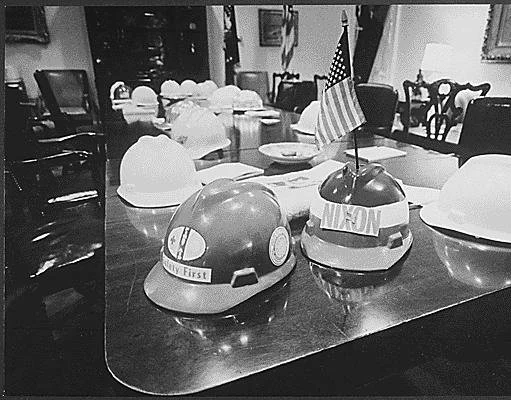
Hard hats on cabinet table after Nixon meeting with construction trades group (05/26/1970) less than three weeks after the New York City Hard Hat Riot
General Services Administration. National Archives and Records Service. Office of Presidential Libraries. Office of Presidential Papers. (01/20/1969 - ca. 12/1974)
The Hard Hat Riot
by Jack R Johnson 08.2026
The murder of four students at Kent State is a well-known national moment, captured in music and art, but the hard hat riot that occurred just four days later on May 8, 1970, marked a far larger cultural tipping point. Many historians have concluded that grievance politics began to take form at this pivotal moment, and the Democratic Party began the long, slow loss of its working class base.
Most unions were vehemently anti-communist during the early 1970s. AFL–CIO president George Meany supported the Vietnam War effort and Peter J. Brennan, president of the Building and Construction Trades Council of Greater New York, was also a strong supporter. According to historian David Paul Kuhn, New York City's building and construction unions were overwhelmingly white, Catholic, blue-collar and male. The anti-war movement was especially unpopular among blue-collar whites because of the flag burning within the anti-war movement and the “perceived rejection of returning veterans,” most of whom were blue-collar. One other reason for the animosity? The workers weren’t getting college deferments, like the college student “elites.”
When Jeffrey Glenn Miller was murdered at Kent State, New York Mayor John Lindsay, a liberal leaning Republican, ordered all flags at New York City Hall to be flown at half-staff on May 8 in respect for the Long Islander’s death.
That morning, hundreds of local students gathered for a memorial demonstration in Lower Manhattan, eventually moving towards Federal Hall. At that spot, in front of a statue of George Washington, the protesters reiterated their commitment to ending the war. Then, nearly 200 construction workers arrived at the protest bearing patriotic signs and, according to The New York Times, chanting “All The Way, U.S.A.” and “Love It or Leave It.”
The Times reported that the construction workers, “most of them wearing brown overalls and orange and yellow hard hats,” descended on Wall Street marching behind a cluster of American flags. They pushed past the policemen and moved on the students who scattered, trying to disappear into the lunch‐hour crowds.
“The workers sought them out, some selecting those youths with the most hair and swatting them with their helmets.”
“[W]ithin two minutes the workers had surged over the memorial's steps, planting American flags on the statue of George Washington. Then they outflanked the police, driving demonstrators before them and hitting the youths with their helmets.”
While union leaders like Peter J. Brennan publicly insisted the mobilization of construction workers was a spontaneous display of patriotism, contemporary observers and records suggest that local union shop stewards or organizers likely coordinated the sudden departure from lower Manhattan job sites.
For example, from his 32d‐floor office at 63 Wall Street, Edward Shufro of the brokerage firm of Shufro, Rose & Ehrman watched through binoculars as two men in gray suits and gray hats seemed to be directing the workers. “These guys were directing the construction workers with hand motions,” Mr. Shufro told The New York Times.
Near City Hall, a Wall Street lawyer, Michael Berknap, 29, a Democratic candidate for the State Senate, was beaten and kicked by a group of construction workers who were yelling, “Kill the Commie bastards.” He was treated at Beekman‐Downtown Hospital with his right eye completely closed, a large welt on his head and five bootmarks on his back.
According to The Times, “Mr. Berknap said the police had stood by and made no attempt to stop the assault.”
“These people are rampaging and the police are not arresting them,” he complained.
Uncertain whether they could contain the mob, the police asked city officials to raise the flag. As the flag went up, the workers began singing “The Star‐Spangled Banner.” A construction worker yelled to the police: “Get your helmets off.”
“Grinning sheepishly,” about seven of the fifteen police officers removed their helmets and complied.
It didn’t take long for the Nixon administration to take full advantage of the cultural fault line.
“Last week,” wrote conservative aide Pat Buchanan in a memo to President Nixon, “a group of construction workers came up Wall Street and beat the living hell out of some demonstrators who were desecrating the flag.” Buchanan observed that “probably half the living rooms in America were in standing applause at the spectacle.”
Two weeks after the violence, construction workers rallied around the country, but particularly in New York, to support the president and denounce the antiwar movement—the so-called “Workers’ Woodstock.” They marched claiming that Mayor Lindsay was a communist stooge and a “red.”
Nixon commenced courtship of building trade leaders, bringing them to the White House. He eventually appointed Peter J. Brennan as his secretary of labor.
Nixon won reelection in 1972, the only presidential race in which the AFL-CIO has declined to endorse the Democratic candidate. Ronald Reagan came along and solidified the majority in the 1980s, breaking the New Deal coalition, sweeping through Rust Belt towns, with a voting bloc of socially conservative, white, blue-collar workers who broke with their traditional Democratic party allegiance. Most Republicans, including Donald Trump, have made good use of such cultural fault lines ever since.