
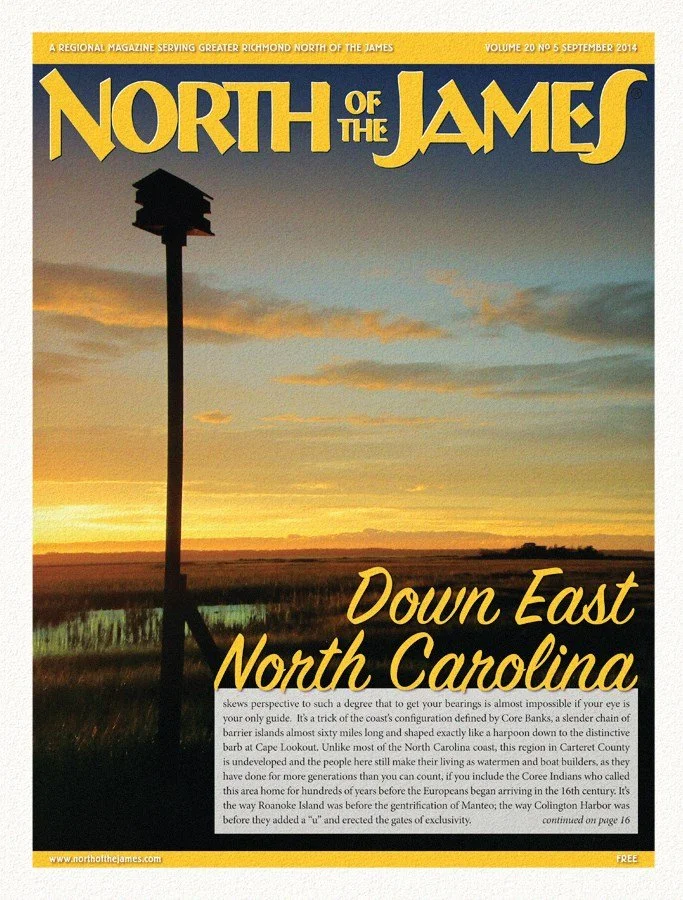
Down East North Carolina: No Direction Home
by Charles McGuigan, originally published 09.2014
Of all our favorite places on the Maine coast, Down East wins hands down. It starts just above Bar Harbor and continues up to the St. Croix River. It’s where the real Maine is; men and women still work the water and don’t compromise their lifestyle for the sake of tourists. So Down East North Carolina seemed like a good call when we were scoping out places for a vacation this summer. We couldn’t travel very far—not one of our odyssey trips hugging the shore up to Prince Edward Island or down to the Florida Keys and out the Gulf Coast. My daughter Catherine would start college in a couple weeks and Charles was getting ready for seventh grade.
We rented a gem of a cedar-clad house standing on stilts right next to the bridge over to Harkers Island. It fronts on The Straits, an arm of Core Sound, with a dock 200 feet long that ends in deep water. The owner had told me you can crab from that dock, and fish as well as shrimp, so along with the crab pot we brought rods and reels, and a cast net. I’d never shrimped before and looked forward to the prospect. “If you hit the tide just right,” the owner told me. “You can fill a gallon bucket in an hour.”
That’s a lot of shrimp.
It’s only a five-hour drive to Down East North Carolina, a straight shot south on I-95 and then southeast on Route 70. When you hit the Neuse River the air thickens with salt enticing you ever downward to the shore. We arrived shortly before dark, unloaded our gear and headed out to the dock with a menhaden-baited crab pot in hand. After dropping the crab pot off the dock and securing it to a piling, we took in a sunset that fairly took our breath away. Always in the evenings for the next seven days we would be on that dock at dusk, overlooking The Straits and salt marshes, looking westward to where the sun slipped over the horizon, to witness skies that could have been painted by John Constable, ever-changing from one day to the next, dramatically, as if we were on a different world every night of our stay. It was an active sky, pulsing with life and change, framed by wind-sculpted wax myrtles and live oaks. All the native grasses in the foreground were always wet with daily tides and nightly rains, and above this line of green that glowed yellow at the base as if there were light beneath the spongy soil, clouds would stratify, layered like the ancient sandstone bluffs of the Painted Desert. They were the most spectacular skies we had ever seen, each and every day, one rivaling the next for pure energy, inventiveness, and color.
That first night we ate dinner on Harkers Island, at one of only two restaurants there, a place called the Fish Hook Grill, a no-frills restaurant that serves all local seafood and specializes in soft-shell crabs, among the best I’ve ever eaten.
Early the next morning, before sunrise, I went down to the dock with the cast net and a five-gallon pail. Cast netting is an art that requires practice and patience, but once you get the hang of it you can cast that net so that it forms a perfect circle above the water every time. To do it right, you need to keep your body in one position, moving your torso at the waist in a clockwise motion, and then simply flinging the weighted net over the water. Cast nets are designed to spill out as a circle once you release it from your grip. Then you simply wait several seconds until the weights strike bottom. With a quick wrench you haul it in hand over hand and train it over the bucket, half-filled with water, and release the catch. By the time we’d left the island I’d become proficient at it, like a wrangler with a lasso always inscribing a perfect circle. I learned, too, that the best time to shrimp is on a low tide at dusk or dawn. That’s when you catch the big ones, four inches or better. They’re translucent, and through their flesh and chitin shell you can see a red dot, perhaps, their heart. I’m not sure. If some of them miss the bucket and end up on the deck you have to get a grip on them or they’ll snap their hinged bodies and flick themselves right back in the water. The second day there we hit the tide just right and I carried the bucket into the kitchen and poured the shrimp and sound water into a large pot and brought it to a rolling boil for two minutes, snapped the head, peeled them and we all ate. There is nothing like shrimp just out of the water. What you get in seafood stores locally, or at grocery stores, doesn’t begin to suggest what fresh shrimp really taste like. Fresh shrimp tastes just like the tail meat of a live Maine lobster. Seriously.
On our second day there we caught a small passenger ferry at the tip of Harkers Island and headed out to Cape Lookout which is on one of the two main barrier islands that make up Core Banks. We skirted Shackleford Banks and watched the wild Spanish mustangs there feed in fields of spartina and other marsh grasses. Through recent DNA testing, they now know that these horses are the offspring of the same mustangs brought to the barrier islands by Spaniards back in the 16th century. Several years ago I visited Shackleford Banks and it has one of the largest maritime forests on the East Coast, and down at the western tip there is a “ghost forest” an amazing thing to behold. The trees there are like the sun-bleached bones of giant animals, silver as the sand they rise up out of, the remnants of a maritime forest killed by migrating sands and the scalding salt of the Atlantic.
We made landfall just below the Cape Lookout Lighthouse. The captain on the ferry gave us a brief history of the lighthouse. He was a “hoi toider”, born and bred on Harkers Island, and spoke with the same rich brogue of a native Ocracoker. He told us the first lighthouse here was built in 1812 of wood and contained a single lantern made up of 13 oil lamps which warned seamen of the shoals that had grounded many a vessel. The current lighthouse was built in 1859 of brick, nine-feet thick at the base. Atop the tower there was lantern with a Fresnel lens that sent out a beacon that could be seen 18 miles offshore. It wasn’t until 1873 that the lighthouse was painted with its distinctive diamond pattern that acts as a navigational aid in daylight. When you see the black diamonds you’re running either north or south; when you see the white diamonds you are traveling east or west. It is the only lighthouse on North Carolina’s coast painted in this fashion. When I asked the captain where we might go fishing, he gestured to his left and said, “Right over on that point. There’s lots of feesh.” That’s just how he pronounced it.
So we headed to the point on the inlet and Catherine stripped out her own squid, baited the top-and-bottom rig and christened her brand new surf rod and reel, which she cast with ease a solid fifty yards into the shipping channel. No sooner did the weight hit the water than she had a strike, one after another, sometimes reeling in deuces. She’d hit into a school of white grunts who were gliding into the inlet on a running tide and she released every one of them.
We then moved to the beach where the sand was so white it blinded us momentarily. Charles, eyes blinking, broke out sand toys and began sculpting the willing sand. Catherine and I alternated on her surf stick and we caught a few flounder and two small black tip sharks. We combed the beach for awhile and left late in the afternoon.
The next morning, Charles and I rose at four-thirty and made our way out to the dock. We pulled up the crab pot and counted 20 blue crabs, Jimmies all, not a sook among them. Cobalt blue claws and sea green shells, underbellies whiter than rice. I flipped open the hatch on the underside of the crab pot, re-baited it with menhaden, and dropped it back in the water. That night we had two dozen, boiled them orange-red and coaxed meat from their bodies. Both my kids, I’m very proud to say, are skilled crab pickers.
I caught a dozen finger mullets in the cast net on one toss and hooked one through both lips then cast into the emergent grasses. Caught one puppy drum, about four pounds and released it. Charles found a spot on firm marshland near the water’s edge where he played with the fiddler crabs, luring them out of their muddy burrows.
“Why can’t I pick one up?” he asked.
“They’ll nip you with their claws.”
“Will it hurt, will I die?”
“It’ll hurt, but you won’t die. Not unless it’s a very large fiddler.”
Charles returned to the burrows and played contentedly until we made our way back to the house. Catherine had just gotten in from a run, sweating, and we sat down to breakfast then drove the ten miles over to Beaufort.
Beaufort, the third oldest town in North Carolina, is located on the Inner Banks, fronting Taylor Creek and buffered from Bogue Sound by Carrot Island, which runs parallel to the town’s entire waterfront.
This village looks just like a hundred towns in Down East Maine. It’s peppered with two hundred-year- old homes of clapboard that sport cupolas and widow walks. We walked the streets all morning and came across the Hammock House which is where Edward Teach, alias Blackbeard the pirate, lived, occasionally. In a little museum on Front Street we saw artifacts from Blackbeard’s Queen Anne’s Revenge, which was discovered in 1996 just below Beaufort off of Fort Macon. No gold, but lots of ammunition and canons.
Over the next couple days we would spend time down on Emerald lsle, shelling on the western tip near Fort Macon, fishing at Indian Beach and then discovering the broadest beach we’d ever seen, at least a half mile wide, facing Bogue Sound and the Atlantic. This beach is only accessible through a gated community, but we finagled our way in and a woman, who was renting a house there, let us park in her drive. She harbored us and told the security police we were guests. We all felt a little like pirates and then headed back to our sunsets over Harkers Island, up Down East.