
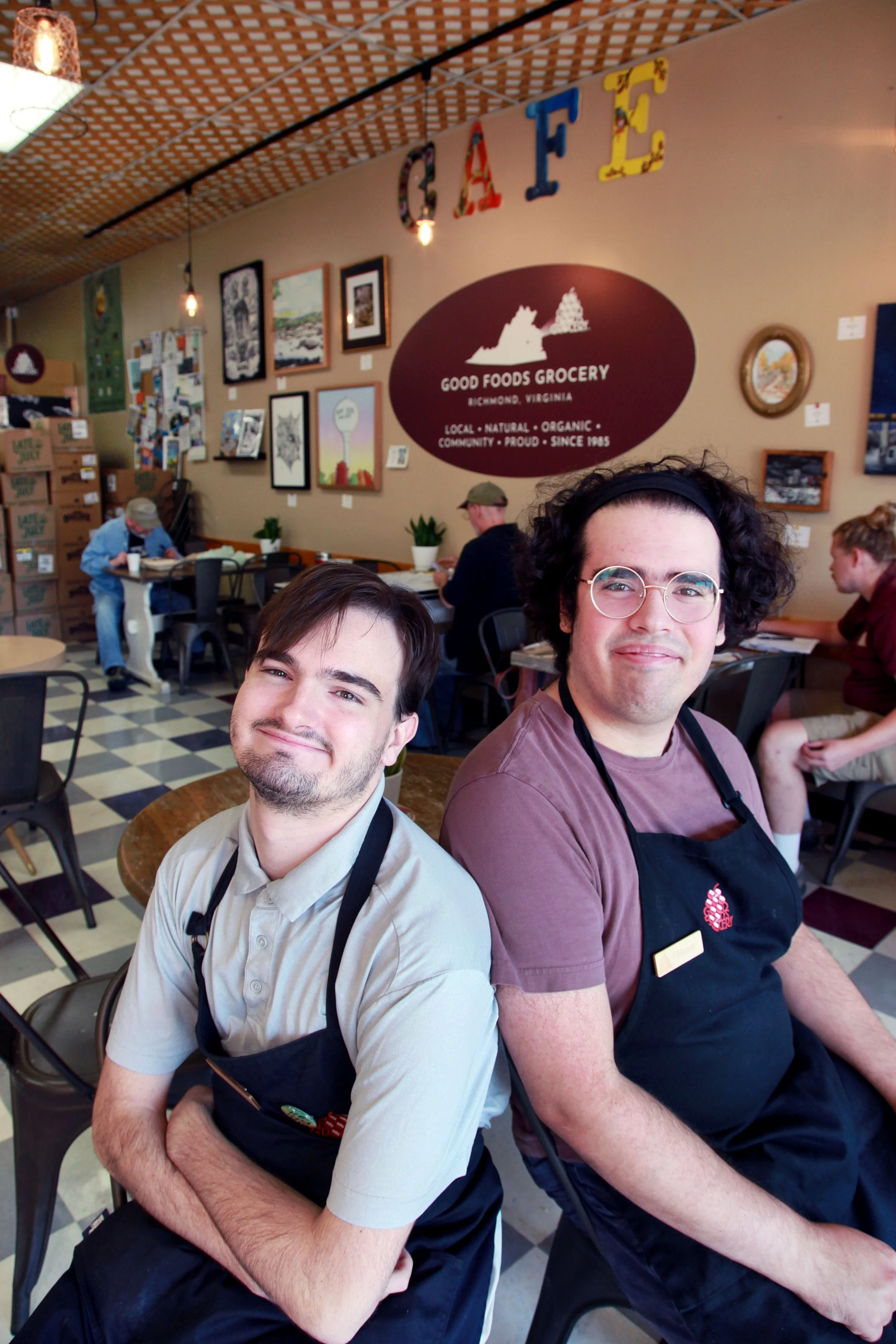
Loudon and Henry in the Good Foods Cafe.
Henry Johns & Loudoun Arthur: Success Stories
by Charles McGuigan 09.2026
Photos by Rebecca D’Angelo
One of the things I’ve learned over the years is that every truly original thinker—whether they’re artists or scientists, writers of fictions or philosophies, composers of symphonies or ballads, astrophysicists or astronomers, zoologists or paleontologists—every last one of them is neurodivergent in one way or other. They all possess the ability to sense things others might have missed, to observe details that normals might consider unimportant, and the uncanny power to synthesize disparate bits of information, creating something utterly unique.
Henry Johns and Loudoun Arthur are both on the autism spectrum, and I have had the good fortune of watching these two Northsiders grow into young men. Henry is 24 years old; Loudoun is four years younger. Here’s a curious thing. Henry and his family live one block to the east of our home in Bellevue. And Loudoun and his parents live less than a block to the northwest of our house. But until they both started working at Good Foods Grocery, Henry and Loudoun, separated by two short blocks, didn’t know one another.
Early in the afternoon, Loudoun and Henry each walk the one block from their respective homes for an extended interview. Through the course of our conversations, again and again, while listening to their experiences, I think of my son Charles, who is also on the spectrum and just a year older than Henry. All three of these young men exhibit the sort of compassion and quiet wisdom we generally ascribe to saints and ascetics. Would that there were more of them among us.
Loudoun’s parents, Charles and Sara, are musicians. Charles can play any instrument under the sun, even those not yet invented, and Sara’s vocal talents are unmatched with a set of pipes tuned just south of Norah Jones and north of Patsy Cline.
“I also have a sister named Josie, and she is also a musician, and she is currently working in Paris,” Loudoun tells me. “And her musician's name is Jobie.”
Loudoun, who I have known since he was an infant, remembers how he perceived the world even as a child.
“I saw things in a unique way, and sometimes I'd often get the wrong messages about things,” he says. “I just kept an open heart, and I stayed patient as much as I could, and that helped me get through it. And it helped me to understand so much that I never thought I could understand, which I am thankful for.”
The things that perplexed him, what he had the most trouble understanding, were the multitude of ways in which people express their emotions.
“I never thought I would understand the importance of other people's feelings,” says Loudoun. “When I was really young, I guess I didn't understand what people's feelings were. I learned how to be more accepting of other people's emotions and not judge them.”
His own feelings seemed like an alien presence in the core of his being. “Back then I didn't know what they were or why I had them or what I was supposed to do with them,” he says.
Through fourth grade, Loudoun attended Linwood Holton Elementary School. “Sometimes I'd get it wrong and other times I just wouldn't understand why I was at the school,” he says. “Sometimes if I hurt another kid's feelings because I didn't understand their feelings sometimes they'd hurt my feelings back. But I managed to get through it. I wanted to go to school at Linwood Holton for fifth grade, but unfortunately I couldn't do that because if I didn't leave Linwood Holton after fourth grade then I wouldn't have a spot at the next school of my choice.”
That next school was Riverside, a middle school. And from there Loudoun attended Lynnhaven where he received his high school diploma.
Henry Johns sits next to Loudoun, at the end of the table, and nods every now and then.
Like Loudoun, Henry has one other sibling, his sister Willa, who is doing graduate work in archaeology at William and Mary. His mother, Nancy, is a healer; his father Jim is a writer, a visual artist, and a communications specialist who has worked for Luck Stone and Capital One in the past and is currently the strategic communications manager for Sheltering Arms Institute.
Unlike Loudoun, Henry was home-schooled through high school.
“I had the option every year to attend public school,” he says. “My mom was always open to it, but I never wanted to. My sister had the option, too, but we both liked being home-schooled. And it really worked out well.”
He pauses for a moment. “The one issue was I never experienced another kid being upset toward me,” says Henry. “So, when I stepped into the real world when I was eighteen I was like, ‘Why are people so mean to me?’ It was not aggressive. It would be like someone saying, ‘Excuse me, you're in the way’ kind of thing. I didn't learn the skills how to deal with negative interactions. So it was really stressful. I wasn't reading social cues the way I can read them now. When you have autism it takes more time to learn the cues. Every year I'm getting more skills in my social toolbox.”
Henry has a broad, substantial smile, and a hearty laugh that is infectious as a pandemic. He emanates a joy even when he speaks about some of the obstacles he has overcome.
“Can I tell you more about the social cues?” he asks.
“Yeah, please do. I'm fascinated by it.” And then he tells me how his spectacular brain enables him to read a human face like a book.
“I'm able to pick up on the tiniest things about people, sometimes before they even notice that they're upset,” says Henry. “Like with my father. He can get tense sometimes over a barking dog or how the lawn didn't get mowed that day it rained. I'm noticing him acting differently and he hasn't even said anything. I'm like putting my finger on it and I say, ‘Hey what's going on?’ And he doesn’t want to talk about it quite yet.”
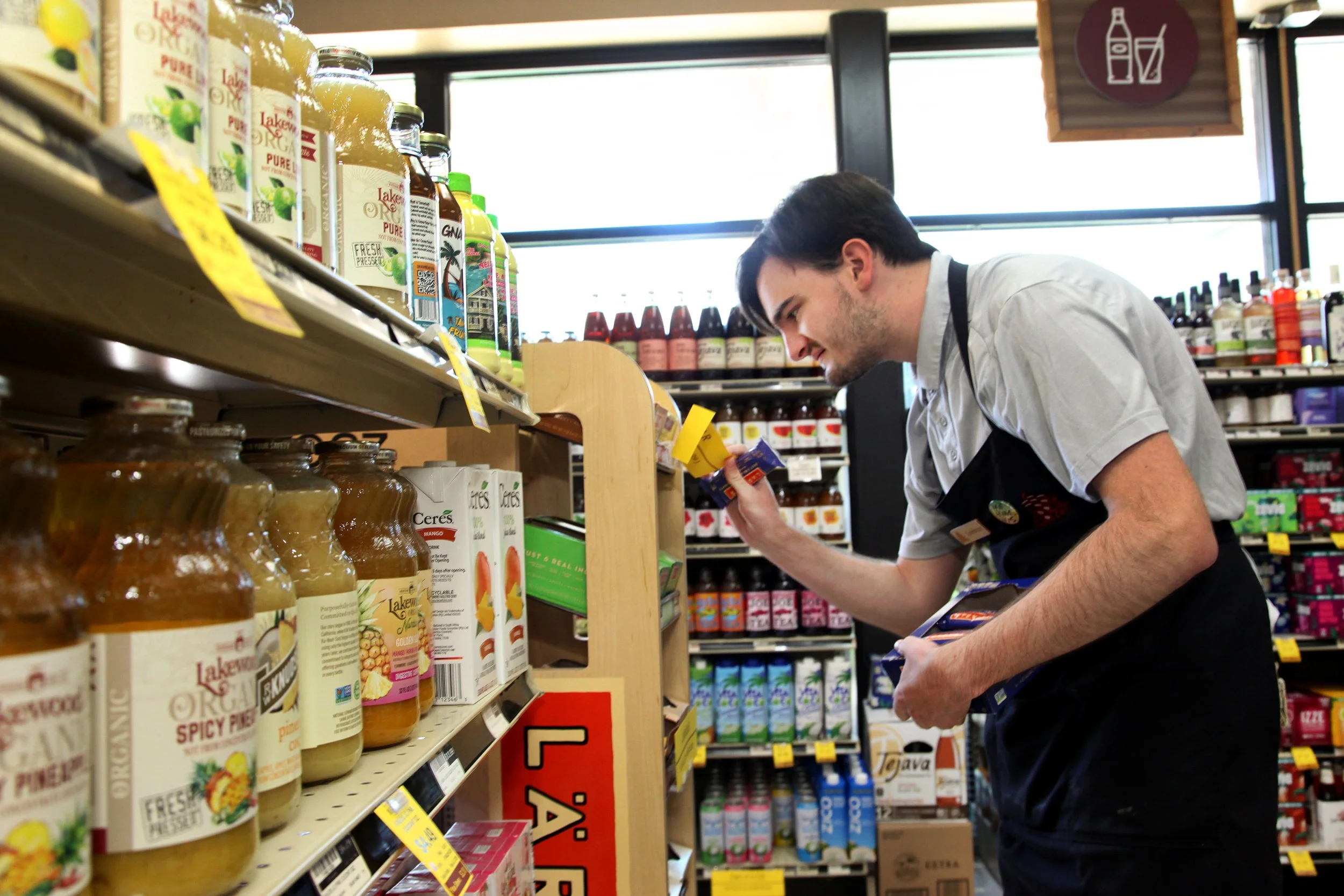
Loudoun restocking the shelves.
That unusual ability to read people before they’re even aware of their own emotional state resonates with Loudoun as well.
“That kind of follows with me too,” he says. “I can kind of sense that people are getting worked up, or I can see that they’ve got some tension building up, or that they're trying to keep something negative under control, but it's just so hard.” In situations like this, Loudoun becomes a blessed peacemaker. “I just remain patient with them and I just try not to provoke it in any way.”
Henry nods. “I wait for the storm to pass before I make my point.”
“Has it been difficult navigating in this world of neurotypicals?” I ask.
“Oh yeah, oh yeah,” says Henry. “Very much so.”
“Yes, yes, yes,” Loudoun says, and then elaborates. “My greatest fear is just running into somebody who seems okay but in the end it turns out they're nothing like how I expected them to be and I’m just left in an awkward situation. I'm afraid of encountering people who won't be able to like accept me for who I am, all because we don't have so much in common.”
Loudoun points out a sort of parable that was the thesis of the award-winning animated franchise, Zootopia.
“In the first movie and the sequel the two main characters, Nick and Judy, seem like they're too different to possibly work together,” he says. “But then as they recognize each other's talents they kind of mix them together. It’s sort of like say how you mix colors together in a work of art. The original colors are pretty great by themselves, but when you put them together they become a beautiful work of art but it's not perfect.”
Then Loudoun caps it off by bringing it all home. “It wasn't perfect for Nick and Judy at first,” he says. “It just took some time and it took some learning. And they both kept open hearts and they both stayed patient with each other and it was only then that they managed to find just what they needed to get along and work together. The one thing that Nick and Judy had in common in the movies was the one thing that they were probably both looking for—people who would support them. And they found that in each other.”
Henry nods assent. “And that's so much like finding another person who's neurodivergent.” he says. “Sometimes, even as a person who is neurodivergent you can meet another person and you're like, I don't really get this guy, they're a little different than me. They act really excited over something that I don't really get. But then you're like, ‘Wait a minute, there's some sort of commonality here—we both want to support each other.’”
For Henry it happened about a year ago; for Loudoun it was a year and a half back. For both of them it was a game changer that opened up the infinite doors of possibilities for futures never really dreamed of.
“I had so many moments where I was like, ‘I just wish I could just get rid of my emotions,’” he says. “I was dealing with depression. The change from school, which was all encompassing, to doing nothing made me feel very much like, ‘How am I ever going to get to be doing anything?’”
But then he heard about Commonwealth Autism. He had his reservations at first when he found out they train you to work in a grocery store. “And I'm like, ‘I don't want to work in a grocery store,’” Henry recalls. “I was just imagining working in a Walmart or something. I wasn't picturing the right thing.” He mulled it all over for awhile.
Seven months later he entered the program at Commonwealth Autism. “There's the one month of classes followed by two months training in Good Foods Grocery,” he says. “Over the course of the next year it was like a life-changing experience because it wasn't immediate. It took a lot of learning on my part, and a lot of cooperation with coworkers and customers. The Good Foods Grocery customers are some of the nicest people ever and I've made so many friends there.””
About six months before Henry started at Good Foods, Loudoun entered the program. “When my parents took me over to Commonwealth Autism, I thought, This place looks way better than any school I've ever been to,” Loudoun remembers. “I thought, I think it's where I will find out who I truly want to be. This is the first step of my journey into a future version of myself.”
Loudoun tells me about something that happened early today during his shift at Good Foods. “I always try to be polite at the cash register,” he says. “In fact, just today two people came up, a couple, and as I checked out their things, they said, ‘We can count on the man in charge.’ And they were saying this about me, because I was being so nice to them and at the same time I was being firm and formal. I was just being as thoughtful as I could be with those people and they viewed me as some sort of boss.” He beams when he tells me this.
Henry then relates a story from a few weeks ago when visited the chiropractor for a bit of neck pain. One of the other patients there recognized him from Good Foods. “She didn’t say anything to me, but she told the chiropractor, who my mom also sees. And then that chiropractor told my mom that patient who recognized me said, ‘Was that Henry from Good Foods? We love Henry.’”
They usually work between 20 to 25 hours a week, but recently Henry was hired full-time, which means he’ll now be working a minimum of 35 hours weekly.
“I don't think I'm entirely ready for full-time work yet,” says Loudoun. “But I think maybe one day I will be. I plan on working at Good Foods for a good long time.”
Loudoun and Henry do it all from unloading boxes to stocking shelves, from bagging groceries to running the registers.
This place called Good Foods Grocery is a portal to the future for both these GenZers who work so hard at everything they do.
* * *
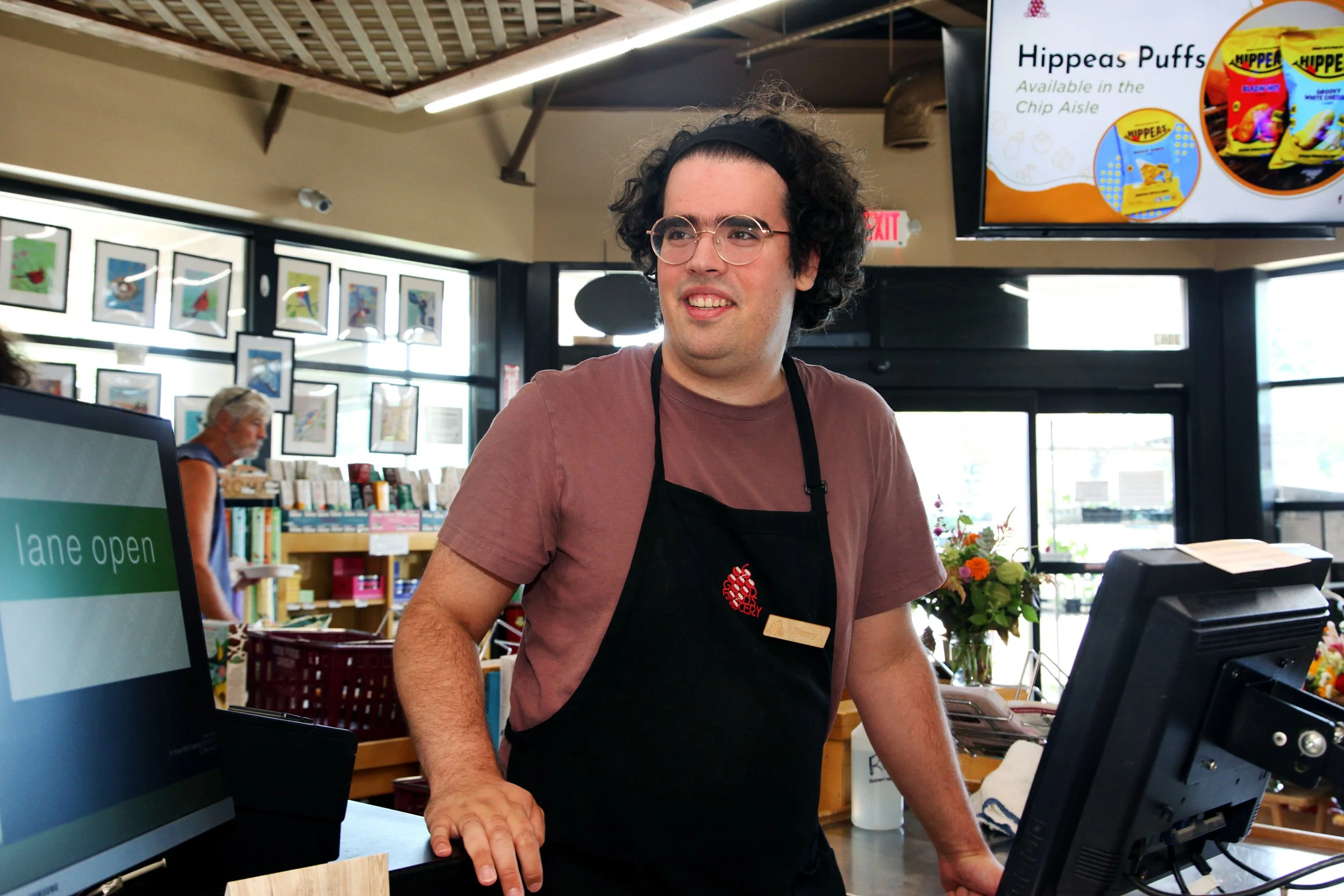
Henry manning the register.
Earlier in the week I had spoken at length with Tyler Hart, who is president and CEO of Commonwealth Autism and Good Foods Grocery, a position he has held for the past four years. Commonwealth Autism was founded about 30 years ago.
“At one point we ran a residence and had a school,” says Tyler. “And we also had a program where we did ABA (Applied Behavior Analysis) instruction in schools, and that was statewide. So we basically would contract with schools to provide ABA services to their students. Those were kind of the core programs prior to COVID. Coming out of COVID, we continued to do some of our adult programs as well as information and resources. We had a really strong balance sheet, but our revenue was limited. We had one grant from the state of Virginia that made up about 80% to 85% of our total revenue. So, they brought me in really to diversify our revenue.”
Tyler’s dissertation at Richard Bland College was on entrepreneurial practices in nonprofits, knowledge that would help him as he worked to diversify Commonwealth’s revenue stream.
“When I came to Commonwealth Autism, one of the largest gaps for transition-age students was employment,” he says. “It's 85% for the autistic population that are working age. So we began to research social enterprise and what that would look like.” He met with Garth Larsen, the man behind the Positive Vibe Cafe who retired and closed the popular restaurant after the COVID pandemic.
Commonwealth Autism was in the process of selling its residence for about half a million dollars. “So we had a strong balance sheet already,” Tyler says. They were considering opening up a coffee shop that would be neuro-inclusive.
And then Good Foods Grocery, which had been in operation for more than thirty years came on the market. “The store was doing about $5.2 million in sales a year, at the time, with about an 8% margin, which is very good for a grocery store,” Tyler tells me.
In August 2023, Commonwealth Autism closed on the deal. “And we launched our first training cohort in our career readiness and employment program in January of 2024,” Tyler says. “So we do a thirty-day classroom instruction where they work on resumes, they learn life skills, hygiene, everything you would need for employment.”
The classes are held in the All Abilities Innovation Center, just a stone’s throw away from Good Foods. “And then they move into a ninety-day paid internship,” says Tyler. “During that time, they work typically three to five hours a week.”
Student/employees can learn to do just about anything associated with a grocery store. “Tagging items, working the register, dishwashing in the deli, stocking shelves.” Tyler says.
It’s success has been enormous. More than 30% of the 60 employees at Good Foods graduated from Commonwealth Autism’s program. It’s also been an economic success. They will have done $8 million in sales by year’s end. “Our sales have been growing by over 10% per year,” says Tyler.
I had one final question for Tyler Hart.
“Have y’all ever thought about expanding your operation to this side of the river?”
“Absolutely,” he said. “We are in the process of figuring out what that looks like.”
* * *
As the interview with Loudoun and Henry draws to an end, they begin talking about their respective hobbies and ambitions for the future.
Then Henry Johns says this to Loudoun Arthur, the young man who has lived around the corner from him for more than a decade: “It's fun to see you outside of work.”
“Yeah, you too,” says Loudoun. “Maybe we ought to meet up sometime, we can play video games together.
“Let's do it,” Henry says.
And then they’re talking about Minecraft.