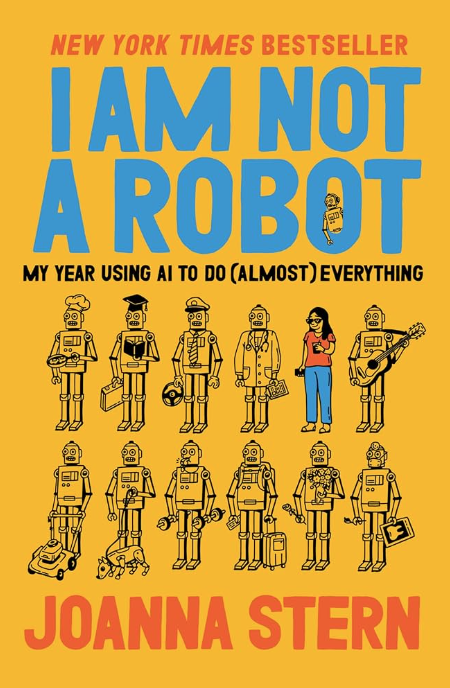
“I Am Not a Robot”
By Joanna Stern
$32.00
HarperCollins
320 pages
“I Am Not a Robot”
by Fran Withrow 07.2026
“I Am Not a Robot” is a timely look at a critical subject: artificial intelligence. Joanna Stern decided to use AI for as many things as possible for one year. What would she learn about this innovative technology that is increasingly affecting all our lives?
Stern starts with a brief history of AI and a quick glossary of its terms. (Now I know what AI “slop” is.) Then she jumps right in with how AI alters health care.
Stern has a family history of breast cancer, and she describes how AI can help radiologists determine what suspicious spots warrant further investigation. This type of cooperation between the medical community and AI makes a lot of sense. However, she also uses ChatGPT to ask generic medical questions and then rates their answers. Conclusion: ChatGPT’s diagnoses are currently inconsistent in accuracy.
We don’t just ask AI questions though. We wear smart watches and rings, AI glasses, and earbuds. These wearables are changing the way we interact with the world, but AI doesn’t stop there. Stern also takes her family for a ride in a driverless car. Her description of how the different AI controlled cars work is fascinating. However, she and her son do have one narrowly missed call when their Waymo almost swerves into a wall. Yikes.
Because we are live in Virginia, I eagerly read about her visit to Virginia’s “Data Center Alley,” which handles “an estimated 70 percent of the world’s internet traffic.” Data centers are HUGE, and as you may be aware, more of them are in the process of being built. They are power monsters: using insane amounts of water, requiring ear protection, and “reshaping America’s electrical grid.”
That’s pretty alarming, but so is how AI is changing the world for children. Take schools, for instance. The ease of using AI for class assignments is so prevalent that teachers are altering how they operate in the classroom. To encourage deeper, independent thinking, they are focusing on more interactive work and discussions in class, and having students write essays at their desks rather than at home.
AI is also changing the job market. AI may transform the world for customer service reps, interpreters, historians, and (gulp) writers. What will the future look like for these and other at-risk professions?
Stern says no one knows for sure how AI will ultimately change us and the world. How will it affect the lives of children growing up with this technology? How can we make sure that creativity, a connection to the real world, and our children’s safety are assured?
The answer, Stern asserts, is that we will quickly need laws passed to protect us, laying down boundaries now. And since it is tempting to use AI to make all things easier, her valuable suggestions for allowing children to fail, struggle, be bored, and experience hard work are crucial. Furthermore, we can use privacy controls to limit who sees our data. We can commune with the natural world. We can make mistakes, she says, surprise ourselves, and dream big. Because AI isn’t going anywhere.