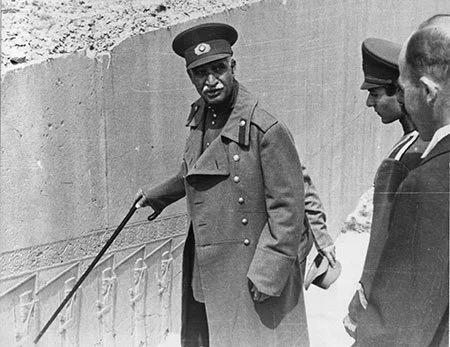
Reza Shah Pahlavi with Mohammad Reza Pahlavi at Persepolis, circa 1939. Photographer unknown.
Iran: Short History of a Revolution Interrupted
by Jack R Johnson 03.2026
In order to understand contemporary Iranian history (and the genesis of its revolutionary guard with whom we are currently at war), you need to understand the history of another entity: British Petroleum, or BP.
On May 28, 1901 Moẓaffar-al-dīn, Shah of Iran, sold exclusive rights to Iran's oil and natural gas to a London financier, named William Knox D'Arcy. According to journalist Stephen Kinzer, this was likely due to a modest £5,000 pound bribe. A group of British investors formed the Anglo-Persian Oil Company-- which would become British Petroleum-- to exploit what was called the D'Arcy concession. The terms of the D'Arcy concession were obscenely one-sided. Churchill called it "a prize from fairyland beyond our wildest dreams." Iran was promised a 16 percent royalty, but the British cheated on the calculation and in 1920 paid Iran a pitiful £47,000, while they made millions from its oil. "The standard of living that people in England enjoyed all during the 1920s and '30s and '40s was due to Iranian oil," writes Stephen Kinzer. "But at the same time, Iranians were living in some of the most miserable conditions of any people in the world."
Oil workers at the Abadan refinery – whose labor was largely responsible for Britain's prosperity – were paid 50 cents a day with no benefits. They lived in a shantytown called Kaghazabad (Persian for "Paper City") with no running water or electricity, surrounded by mud, stagnant water, and biting flies.
After the 1917 Bolshevik Revolution, Britain was the remaining power in the region and British Foreign Secretary, Lord Curzon hoped to make Iran a client state of Britain excluding any other great power, by having the Iranians sign onto a so called Anglo-Persian accord. This document gave a guarantee of British access to all Iranian oil fields. In return the British would help maintain the Iranian army, provide a two million pound loan (approximately 2.6 million USD) for necessary ‘reforms’ and survey and build railroads. This arrangement was so lopsided even the United States said it was unfair or ‘hegemonic.’ Eventually, the Anglo-Persian Accord was formally denounced by Iranian Parliament (the Majlis) on June 22, 1921 and they replaced the deeply unpopular Ahmad Shah with an uneducated, but ruthless military officer named Reza Pahlavi.
After World War II began, Reza's pro-Nazi sympathies led the British to overthrow him in 1941, placing his 21-year-old son, Mohammad Reza Pahlavi on the throne. Although, not a Nazi sympathizer, Mohammed Pahlavi still ruled with an iron fist. By March 1946, oil workers at the Abadan refinery had enough. They rose in a nationwide strike, demanding better housing, healthcare, and APOC’s (renamed Anglo Iranian Oil Company, or AIOC) compliance with Iran's labor laws. The British refused to negotiate, and instead arranged for two British warships to show up just off shore.
That action quieted the strike, but not the underlying movement to be freed from British domination. In March 1951, an eloquent member of the Majlis, Mohammad Mossadegh, secured passage of a bill to nationalize the vast British petroleum interests in Iran. Then, on April 28, the Majlis overwhelmingly elected Mossadegh – Anglo-Iranian's strongest opponent– as prime minister.
From the British perspective, this was an earthquake.
They sought revenge. Anglo-Iranians removed all of its managers and technicians (it had refused to train Iranians for such positions.) It refused to ship Iran's oil in its tankers (Iran owned none) and organized a global boycott of Iran's oil. The British navy even seized an Italian tanker carrying Iranian oil. The British position was that Iran had "stolen" its oil. Winston Churchill, the British Prime Minister wanted U.S. help in overthrowing Mossadegh, but President Harry Truman was sympathetic to Iran and demanded that the British negotiate with Mossadegh – something they had no intention of doing.
With Truman’s approval, Mossadegh came to New York in October 1951 for a UN Security Council debate on a British resolution condemning Iran's oil nationalization. Contemporary observers say Mossadegh dominated the debate. Time magazine put him on its cover as "Man of the Year," calling him "the Iranian George Washington."
But his ascendancy didn’t last long. In 1952 Republican President Dwight Eisenhower became U.S. president and the two brothers chosen to run Eisenhower's foreign policy – John Foster Dulles as secretary of state and Allen Dulles as CIA director – signed on to Churchill’s coup plans even before the new administration took office. President Eisenhower resisted, but the Dulles brothers won him over not on the basis of British oil interests, but with Cold War fears of an imagined Soviet takeover of Iran.
Kermit Roosevelt, a top CIA operative and grandson of Theodore Roosevelt, ran "Operation Ajax" from the U.S. embassy in Teheran. He took up where the British left off, bribing generals, newspaper publishers, street gang leaders and Muslim clergy. Stories planted in newspapers and riots by hired mobs painted a false picture of Mossadegh as an ally of Russia and an enemy of Islam. The operation took less than a month in the summer of 1953. According to Stephen Kinzer, it was the first time the CIA had ever overthrown a government.
The U.S. government and the British split their booty. AIOC – renamed British Petroleum or BP in 1954 – got 40 percent control of Iran's oil. Another 40 percent went to the five major American oil companies, and the remaining 20 percent to Royal Dutch Shell and the French petroleum company now known as Total. The 20th century version of the Great Game.
The Shah eventually returned to power with the blessings of the U.S. and Great Britain. Military officers loyal to Mossadegh were shot, as were other democrats and dissidents, and for the next 26 years the Shah ruled through the terror of his secret police, the Savak. His increasing repression set off the Islamic revolution of the late 1970s, which brought to power Ayatollah Khomeini and the bitterly anti-Western regime that has been in control ever since.
According to Al Hart, writing for EU News, “The 1979 Iranian Revolution that overthrew the Shah included much more than Islamic fundamentalists. In the mass demonstrations of 1978 and '79, many carried pictures of Mossadegh. This was both a protest against his overthrow and a call for the kind of secular democracy he had represented.”
Whether the U.S. bombing of Iran actually results in a flourishing democracy has yet to be seen. But calls for the exiled son of the former Iranian Shah, Reza Pahlavi, to take the lead in Iran seem historically obtuse.
Footnote: Mosaddegh was kept under house arrest at his Ahmadabad residence, until his death on March 5th, 1967 from cancer. Despite Mossadegh’s request for a public graveyard, beside the victims of the political violence from the 1953 coup, he was buried under the dining room floor of his two-story home. For years, the burial site was difficult to access due to government restrictions, and merely speaking his name in Iranian political circles was considered taboo.