
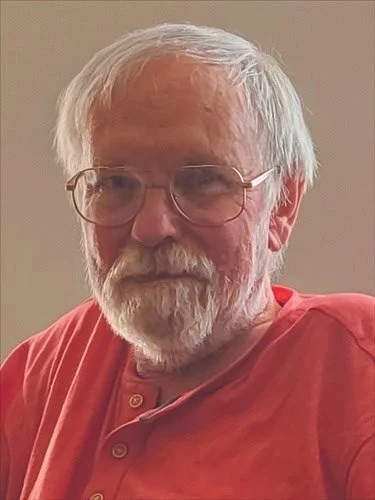
Jerry Carpenter
Jerry Carpenter, 1940-2026
by Daniel Payne 10.2026
Jerry Carpenter died on August 27. He was 86 years old. I had known Jerry as a fellow Bellevue neighbor for my entire life. I knew a number of things about him. He liked a good joke. He was a big fan of Indian food. He was a devoted reader of the Richmond Times-Dispatch and would always mention when he saw one of my letters to the editor in print. Well into his old age he would stop to pick up a loose penny if he saw one on the sidewalk.
Jerry and his wife Virginia lived in Bellevue for decades — Gina first, and then Jerry, after they married. In their own way they were neighborhood institutions. They often took long, meandering walks, and could be recognized at a distance; Jerry in his trademark high socks and wide-brimmed hat, Gina in a large coat and scarf, often even in warm weather.
Jerry’s obituary described him as “quirky,” and that he was. Years ago he would sometimes call up Zorba’s to order a Greek salad and inform us that he would be in to pick it up at a bracingly specific time: “6:12,” say, or “7:33.” We would dutifully have it ready for him at the appointed minute.
He and Gina would clip articles from the newspaper and bring them to you if they thought you’d enjoy them. He was devoted to a succession of awful hissing cats — cats, as his obituary put it, “that other people found difficult to love.”
We knew both Jerry and Gina as kind, interesting, personable people. Above all else, they were indelibly part of Bellevue. Both of them loved the neighborhood and seemed fixed within it as much as any street or landmark.
That is the special thing about real neighborhoods — they frequently accommodate unconventional people, people whose personalities are singular and whose presence makes your life richer and more interesting. As Robert Frost noted, "A civilized society is one which tolerates eccentricity to the point of doubtful sanity."
Each one of us, of course, has our own personality— our own characteristics — and in a neighborhood like Bellevue those signature idiosyncrasies that make us who we are, are not merely accepted, they are often encouraged and nurtured.
Richmond has a great many neighborhoods that are conducive to that kind of happy communal living. Indeed, many, if not most, neighborhoods built prior to the mid-20th century were like that. But the way we build our living spaces today isn’t the same. Instead of intimate, interesting spaces in which a broad variety of people can happily live and thrive together, we all too often build communities where everything feels so isolated. Suburban or rural “subdivisions,” say, with no sidewalks, no local economy, no place to walk to and nothing to walk on anyway. Or too-tall apartment buildings on busy corridors with little if any shared spaces.
Housing advocates might argue that we need denser apartment buildings to make up for our housing shortage; builders might argue that subdivisions are what homeowners want. Maybe. But it seems to me it wouldn’t be hard to build more of the sorts of neighborhoods we used to build — walkable, relatively dense, communally oriented, public, interesting. Lots of people seem to want that. And the added bonus is that living in such a neighborhood means you’ll be exposed to a lot more personalities and dispositions, which is never a bad thing. Characters like the Carpenters have always thrived in neighborhoods like Bellevue, and always will; there is no reason we can’t have more of it.
We’ll miss Jerry and Gina; they were friendly faces, nice to see and pleasant and enjoyable to speak with. And yet it is interesting how sometimes the dead still seem so near. One night shortly after Jerry passed, our power went out. We sleep with a box fan for white noise, and the sudden disappearance of that noise was jarring, as was the comprehensive silence that followed. We tossed and turned for a bit in the quiet until my wife said sleepily: “Open the window, we can hear Mr. Carpenter’s generator.”
It was true: Years ago Jerry and Gina had had a Generac installed, the kind that kicks in automatically when the power goes out. I opened the window, and sure enough, through the darkness and the absolute silence of a neighborhood without power, we could hear the Carpenter’s generator down the block, audible and pleasantly loud in the stillness, loud enough to help us get back to sleep. It was bittersweet: For a little while it felt like Jerry was still there, still in his house, still close by. In a neighborhood like ours, everyone always is.