
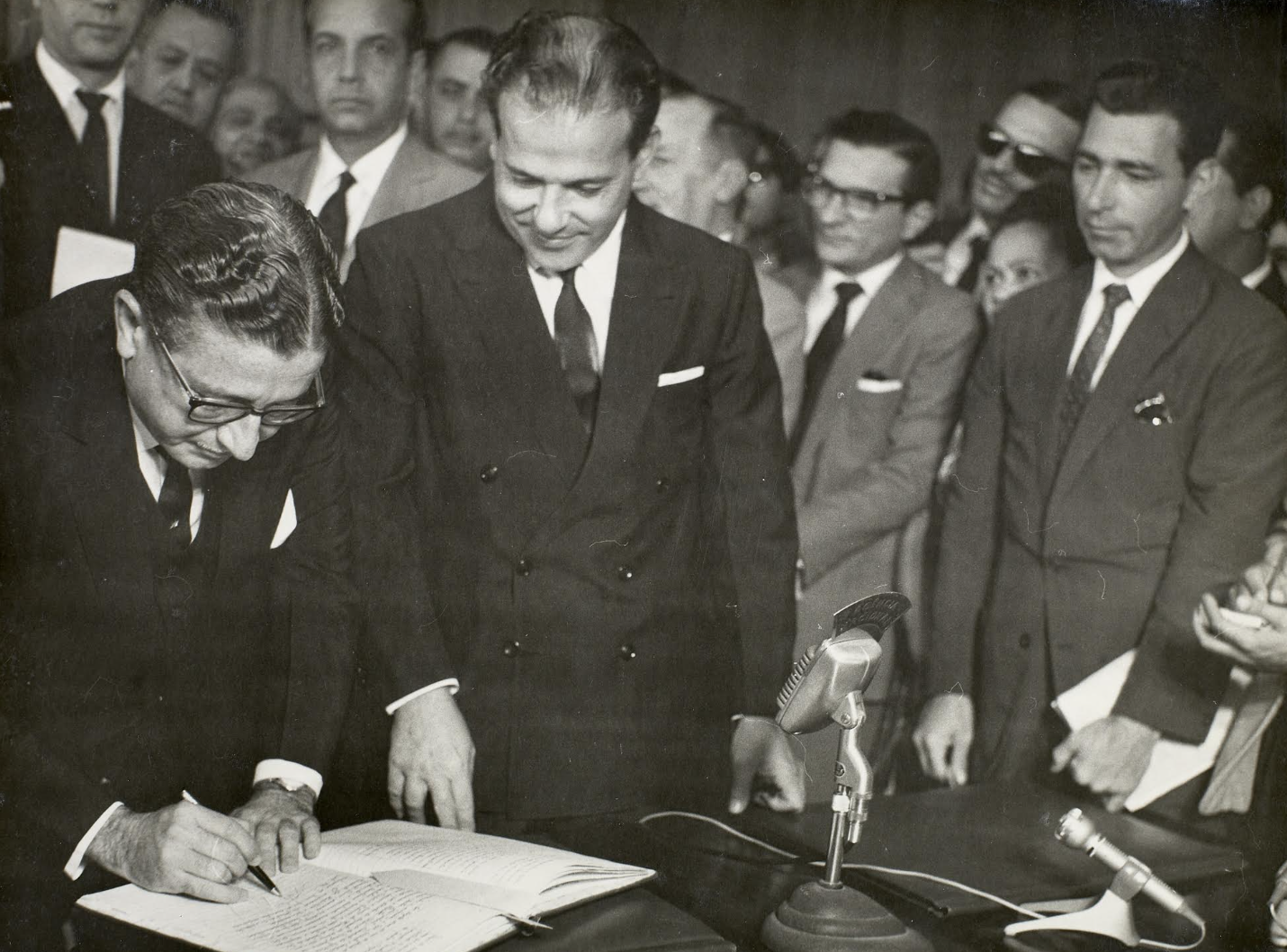
President João Goulart takes office (1963)
Lessons from Brazil
by Jack R Johnson 11.2026
In the wake of President Luiz Inácio Lula da Silva’s massive election come back in Brazil, and our own sweeping midterms, it might be good to remember Brazil’s history of not so successful elections. On March 29th of this year hundreds of people in the city of São Paulo, Brazil walked to a former government detention and torture center in an event known as the “Walk of Silence.”
They were there to remember the anniversary of the 1964 coup and victims of the Brazilian military dictatorship, with many carrying large, black-and-white pictures of the victims. The coup 62 years ago sunk Brazil into a brutal 21-year-long dictatorship that would last until 1985. Hundreds of Brazilians were murdered during the dictatorship and an estimated 20,000 people were subjected to torture. Tens of thousands more were illegally arrested or detained.
The coup began on March 31, 1964, when Brazilian military tanks rolled on the streets of Brasilia to overthrow President João Goulart, a member of Brazil’s Labor Party.
Without evidence, the Brazilian generals said that Goulart was a communist and had to go. They called the coup “a revolution.” This was by design. Despite no contemporary or historical evidence, they argued that a serious communist threat loomed over Brazil, justifying military intervention. In truth, the President João Goulart (popularly known as “Jango”), whose father was a wealthy land owner, was interested in helping the working poor achieve a livable wage in an economy which was threatened with run away inflation. In 1964 he announced his plan for Reformas Basicas (Basic Reforms), which involved agricultural, financial, electoral, and educational reforms, among others. These reforms were geared toward the plight of the poor and were received very negatively by the armed forces and other conservative sectors of society. On March 13, 1964, Goulart participated in a rally in Rio’s Central do Brasil, appearing with fellow populist Leonel Brizola before a crowd of 150,000 people including union members, students, and public servants. In his speech, he announced several leftist measures that he would institute by presidential decree, including the granting of voting rights to the illiterate, the nationalization of foreign oil refineries, and the seizure of agricultural land bordering railways and highways.
There was significant upper- and middle-class backlash against the measures, as well as criticism from the conservative Catholic community. The army saw this as an opportunity. The military coup began on March 31, while Goulart was in Rio. The president flew to Brasilia in an attempt to maintain control of the government, without success. Goulart fled to Uruguay, where he went into exile. Efforts to defend his presidency, such as a call for a general strike, were insufficient. While some sectors of society welcomed the self-proclaimed "revolution" by the military, others faced severe repression. The political class anticipated a swift return to civilian rule, but in the following years an authoritarian, nationalist, and pro-American dictatorship took hold. The military regime swiftly enacted Atos Institucionais (Institutional Acts), granting unchecked power to dissolve political parties, censor the media, and arrest dissenters. The infamous AI-5 law, passed in 1968, suspended habeas corpus, shut down Congress, and legalized torture.
At the time, the United States denied any involvement in the military coup, but after 1976 when the Church Committee released a trough of Cold War documents, it became clear that the US was involved both diplomatically and militarily.
Here is a snippet of the communications between the American ambassador to Brazil, Lincoln Gordon, and the US government: “Both I and my advisors believe that our support may be given to plotters to prevent a disaster here, one that could turn Brazil into the [communist] China of the 1960s.”
This communication evolved into so called “Operation Brother Sam.” A meeting at the White House on March 20th and another at the Embassy shortly thereafter established that a US aircraft carrier and tankers would be sent to support the junta.
According to historian James Green, "When events came to a head on March 31, Gordon intervened so that the then US president, Lyndon Johnson, would immediately recognize the legitimacy of the new [military] government. The US was going to send a military force to support the plotters in the event of resistance or civil war. But it wasn't necessary and so the US began to deny any involvement."
The US then opened their financial taps to Brazil's military regime, helping to build major projects such as the Transamazon highway and the Rio-Niterói bridge, leading to an increase in foreign debt.
At the same time, the CIA was helping to depose countless governments in Latin America and improve the repressive apparatus in those countries under the justification of fighting communism across the Southern Hemisphere, a sweeping process referred to as “Operation Condor.”
What many Brazilians thought would be a momentary political aberration, turned into a twenty year-long military dictatorship, with hundreds killed and thousands imprisoned and tortured.
Beginning in 1974, the Brazilian military government under President General Ernesto Geisel initiated the gradual process of re-democratization (called abertura or "opening" in Portuguese).
Initially, this was something of a fig leaf, but a series of protests against the dictatorship and its economic policies evolved into a political movement that called for a direct democracy, allowing citizens to vote in presidential elections. The movement, which eventually led to the largest political rally in Brazilian history in 1984, emphasized the extent to which there was mass support for democracy and a willingness to oppose the current politicians that supported the conservative military rule.
On April 10, 1984 over 1 million protesters gathered in front of the Candelaria Church in Rio de Janiero demanding that direct elections be put into effect immediately, chanting “Diretas Já” (Direct Elections Now!). Finally, in 1988 a new democratic Constitution was passed that included direct elections, and in 1989 Brazil held its first popular elections for President. The success of the Diretas Já campaign was not felt for 4 years, but contemporary Brazil, with Lula Di Silva as its President, would not have been possible without it, calling to mind a popular anthem in the US relevant to this day: “people have the power.”