
Life out of Balance: Cinema and the Environment
by Chris Stewart 04.2026
In the spring of 1985, the Best Leading actress contenders at the Oscars had one thing in common. Sometimes referred to as the “save the farm” year, three of the five women nominated portrayed people – real and fictitious – defending their land. There was the depression-era Places in The Heart, for which Sally Field would win her second Oscar. The River, with Sissy Spacek protective of the family homestead. And Jessica Lange continued her decade streak with Country.
President Reagan, in March of 1984, wrote in the New York Times: “I have seen the movie [Country], and it is not an accurate portrayal of what is taking place in the farm community today.” In The Reagan Diaries, published in 2007, we see that in journals he called it “blatant propaganda”. Eventually, Jessica Lange would speak before Congress regarding the plight of farms as larger agri-industry grew, supply prices rose, and foreclosures surged.
In 2020, Steven Yeun made history as the first Asian-American to be nominated for Best Actor, in a role not dissimilar from these. In the beautiful, placid Minari, he plays a role Clark Gable or Gregory Peck might have: pursuant of the American dream, with land and commerce as the assumed route to this end. This familiar, sturdy theme was no doubt helpful in removing any barrier for the film with viewers.
From George Mielles' rocket piercing the eye of the moon to Bambi's burning heritage; the early days of cinema captured, commented on, and in production, frequently itself transgressed the natural world.
Since then, one finds themes of the earth and our relationship to her in every genre, tone, and degree of brow (as in high: Gorillas in the Mist and low: Swamp Thing). Comedies like Pixar's current hit Choppers or dramedies like Wall-E include their environmental subtext, not to mention Pocahontas. In the world of decidedly less earnest films that no child should see – there's The Toxic Avenger and The Ruins. Recently, the UK-originating subgenre of Folk Horror, which often includes its warnings (sometimes explicit, sometimes oblique) had a moment with Ben Wheatley's work (In The Earth, a Field in England) as well as Ari Aster's Midsommar. More reputably, a few white Australian directors have wrestled with colonialism's legacy and the unknowability of an Aboriginal land and culture. In Peter Weir's Picnic at Hanging Rock (1975), a group of posh school girls are seemingly simply swallowed up by the earth. In his The Last Wave (1977) apocalyptic visions, and Aboriginal warnings, torment a white man in Sydney.
Massive blockbusters saw opportunity as well. The 2000s resurgence of disaster films included Roland Emmerich's The Day After Tomorrow with its frozen-over Statue of Liberty poster, and his 2012 (2012) which is more or less an all-star game as every possible climate disaster compete to wipe out humankind. Arguably more impactful on the actual public conscience was the 90s tradition of family films with mild messaging, particularly about animals. Free Willy, Babe, Fly Away Home, Fern Gully, and more, are touchstones for millennial Americans. The Vegetarian Resource Group notes an increase from .3% - 1% of the population likely practicing vegetarianism in 1994 to some 3% in 2022; an estimated rise from 700,000 or so to nearly 10,000,000. What impact M. Night Shyamalan's The Happening had on young people's respect for, er, trees, remains, sadly, unresearched.
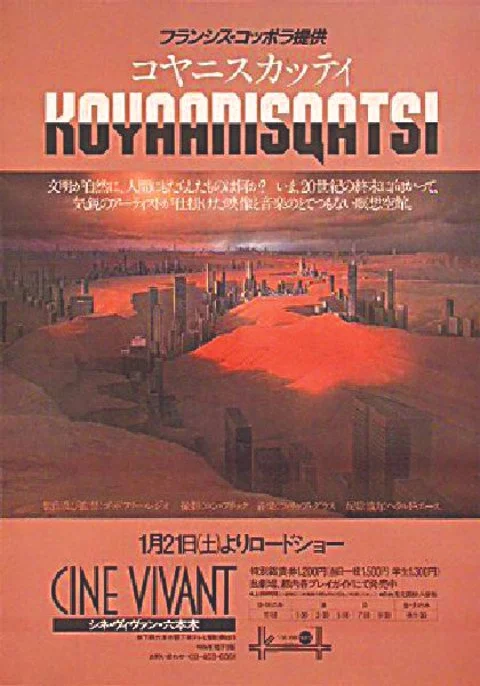
Soberest of all, and perhaps most impactful for a certain generation, there are the movies watched on a TV wheeled in on top of a cart by your teacher. One such is Godfrey Reggio's Koyaanisqatsi. Released in 1982, it is a series of wordless, juxtaposed pieces of footage scored hypnotically by Phillip Glass's famous arpeggiating rolls.
When I think of film and nature, I am often, for some reason, brought back to Charles Laughton's Night of the Hunter. It is a fairy tale, and a work of timeless, haunted beauty. An inversion of Twain, in which two innocents are moved along the water and its banks, overwhelmed, but also protected by the stark, moonlit foliage around them. Pursued by an evil minister, they are watched over by the land itself. In 1955, the year of that film's release, NOAA began tracking ocean heat and acidification. The latter has increased 30% since then. In 2012, Beasts of the Southern Wild proposed a similar journey undertaken by a similarly beset-upon child. But by then, nature was both a caring, overwhelming figure in its cinematic language, and one full of menace, decay, and human blight.