
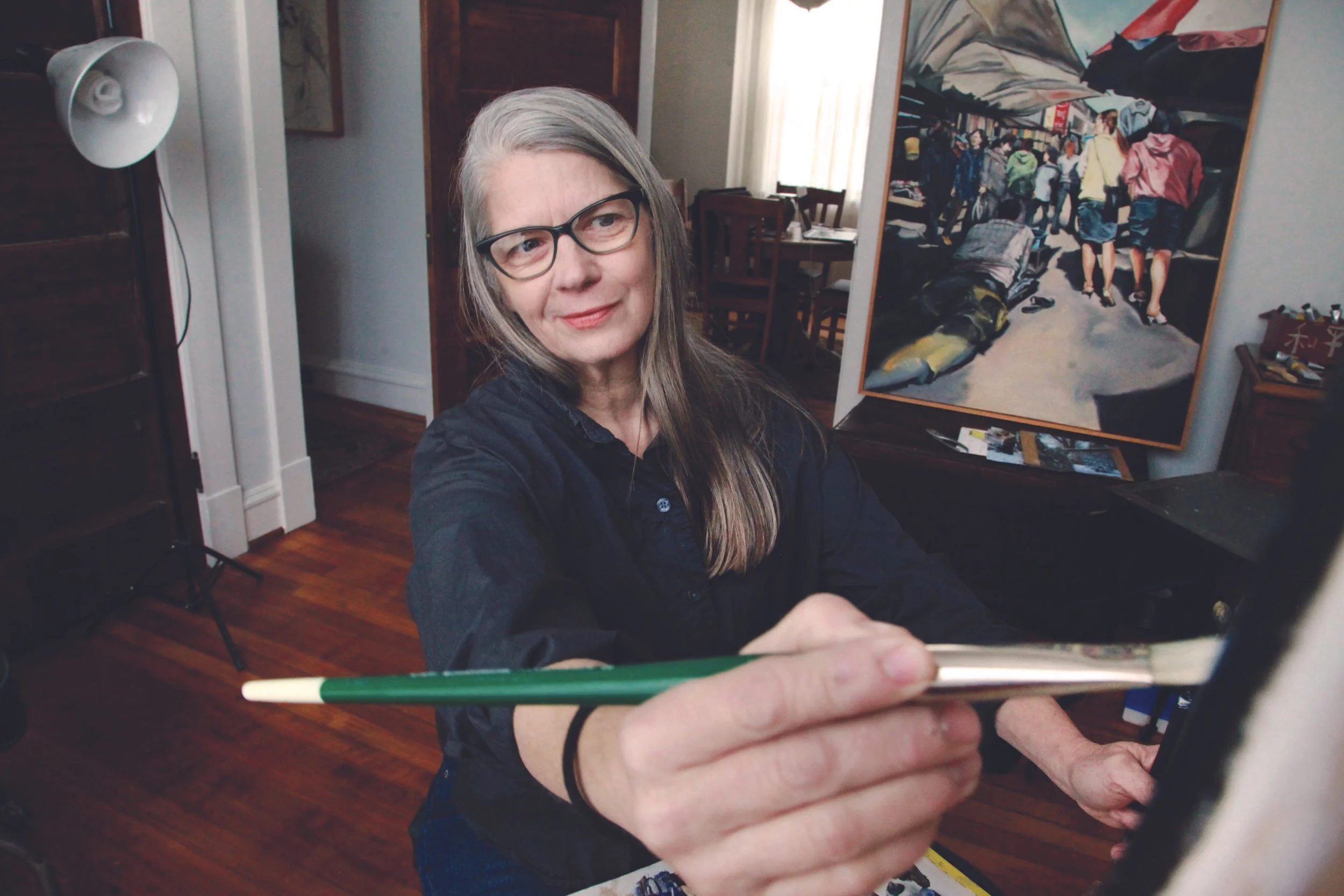
Melissa Burgess, photo by Rebecca D’Angelo
Melissa Burgess: Preserving Time and Space
by Charles McGuigan 03.2026
It seems more akin to alchemy than to the hard science of chemistry. And it’s not just about the different elements that make up the compounds used in these acts of creations. There’s something that happens to a birch wood panel when colored oils are smeared and dappled across its surface, restructuring, in two dimensions, a singular image scooped from the world. In essence, this preserves that slender slice of spacetime in perpetuity, outlasting even its creator. These paintings fairly glow with a gently pulsing light that seems to radiate from beneath the thin layers of oil. But there is no hidden beacon there. It’s inexplicable. This is the magic of the paintings by Melissa Burgess.
When I ask her about that glow, Melissa smiles.“Somebody said, ‘How do you do that, how do you get that glow coming out?’” she says. “And I say, ‘I don’t know. I just do it.’ I know how it’s gonna look.”
Melissa Burgess was born on the Northside at Richmond Memorial Hospital (now Ginter Place Condominiums on Westwood Avenue) beneath a waxing crescent during a rip-roaring thunderstorm. She grew up in a house on the 3100 block of Floyd Avenue that had a one-armed ghost who made nightly visits.
As a girl, she and her friends would spend entire afternoons riding their bikes through the neighborhood, up alleyways, exploring dilapidated garages and empty houses. And these structures, or portions of them, fascinated her.
From the time she was a child Melissa expressed herself through two-dimensional art of one kind or another. “I was drawing all the time,” she says. “I had pastels, I had colored pencils. I would save up as a child for Rapidograph pens. They were my favorite.” She worked tirelessly in pen-and-ink, making intricate drawings of old buildings. Her father, Robert Bruce Burgess, was an architect, and that may have been one of her earliest influences. But it was another family member, from a more distant generation, that was probably her deepest familial influence. More of that later.
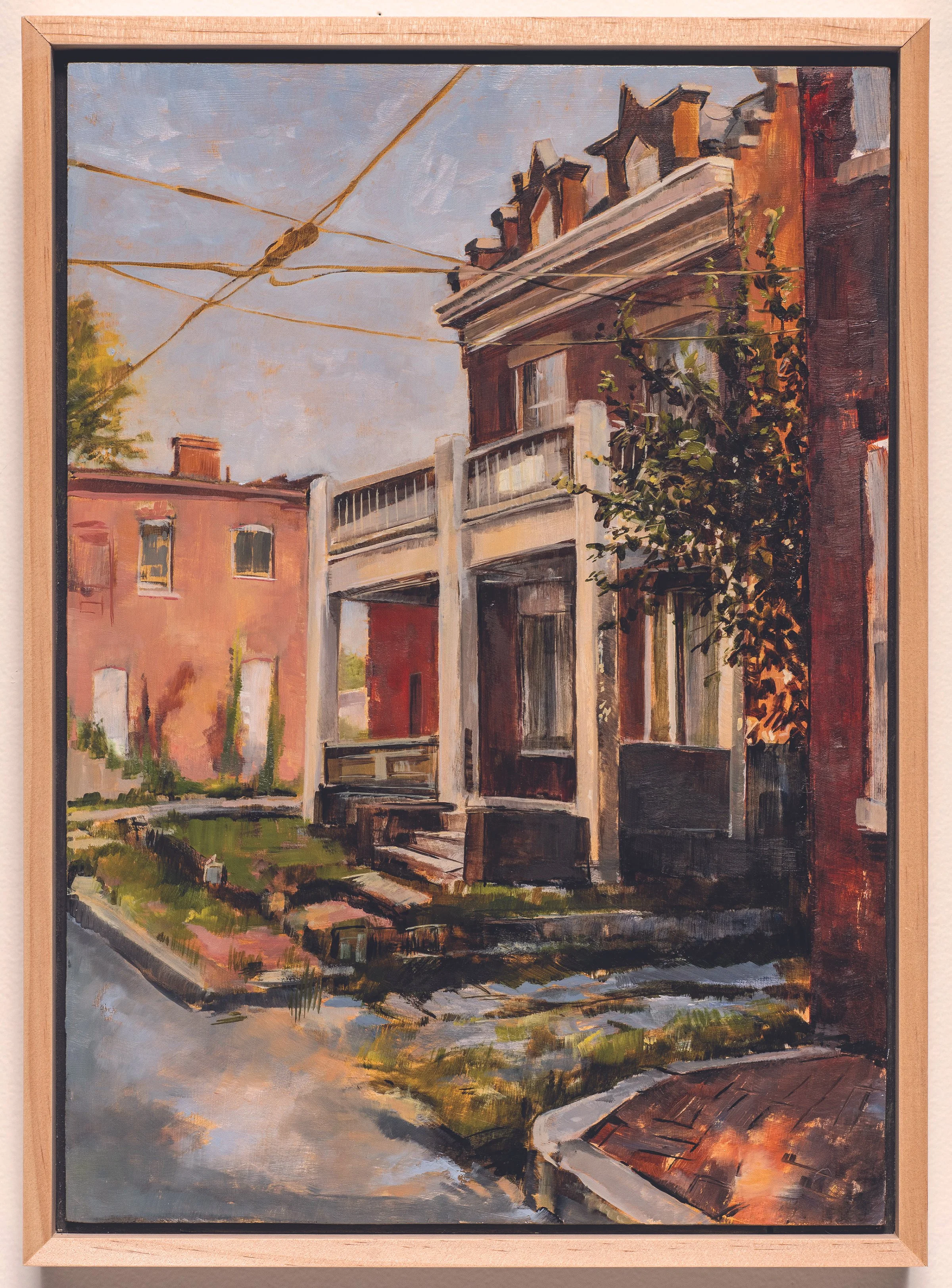
13th and Perry, by Melissa Burgess.
While attending Open High in her early teens, Melissa took a few tubes of acrylic paint and several brushes from an art class. “That’s when I actually started to paint,” she says. “I started with doing little tiny portraits on cardboard of people I knew.”
Within a year her life was about to change radically. Her father moved the family to a rural part of Vermont where he took a job leading bicycle tours. “It was pretty horrible,” Melissa recalls. “It wasn’t the scenic places you see in magazines. This was right where the road went from being paved to becoming dirt, and there were trailers over here, and over there you were surrounded by bales of straw.”
She had just turned fifteen and the school she attended was abysmal. Melissa struggled with basic math and one of her teachers told her this: “You can be in my class, but I will not help you.”
“I did one of two things,” she remembers. “I either stayed in my room and painted in acrylics, or I’d hop on the bus or train and go to New York City. I had some friends in New York and I would go visit. I did go to school, but I would take vacations, we’ll say. I would be gone a week or so to Brooklyn or Manhattan.”
Melissa had her heart set on studying art in college at either the Corcoran School of Arts & Design in DC or the School of the Museum of Fine Arts in Boston. But her guidance counselor at that high school in Vermont told her she was not college material. He had her come to his office and as she sat down she noticed an Army recruiter sitting in the chair next to her.
“I said, ‘This is absolutely insulting,’” Melissa says. “And I walked out of that meeting. I wanted to go to art school, but it didn’t work out. I knew, though, that I wanted to paint anyway.”
She ultimately received her high school diploma, and left the Green Mountain State with all deliberate speed for good and all. “So my dad gave me a one-way ticket on People’s Express back to Richmond,” says Melissa.
Arriving in Richmond, she had a bag of clothes and a few pieces of artwork she kept in a makeshift portfolio. She had very little money and no job or even a prospect of one. Melissa stayed for a time with a friend’s mother, and then one day, as she wandered through the Fan, she saw a man on a ladder at the corner of Grace and Harrison Streets. His hair was a flaming red cloud of curls and the vest he wore was spattered with paint like a de Kooning canvas. He held a brush in his hand and was painting a mural on the side of The Village Restaurant.
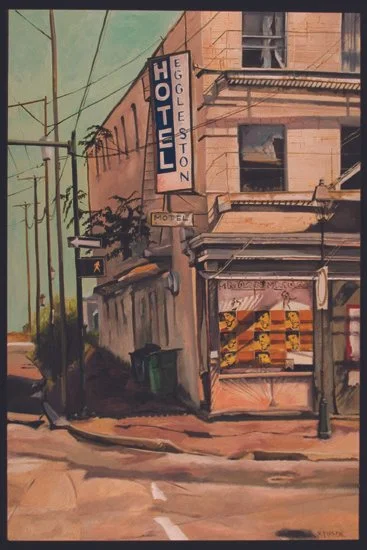
Hotel Eggleston, by Melissa Burgess.
Melissa stood for several minutes just watching him. She kept her distance so as not to disturb him, and when he turned around, she started talking with this man—Richard Lee Bland. He asked her what she did and if she had a place to live.
“I told him I was staying with a friend’s mother for a few days but didn’t feel really comfortable there,” Melissa tells me. “So Richard said the house he was renting had a vacant upstairs and asked if I’d be interested.”
So Melissa moved into 1911 West Cary Street, a vagrant sort of building owned by a slumlord. “What a s*** hole,” says Melissa. “It was a wild place.” Where the downstairs was livable with windows and a wood stove, the upstairs was really nothing more than a brick shell. “There are no windows, no window frames, no walls,” Melissa says. “I found a mattress and slept in the rafters because the rats were huge that came up in the night. They were big as cats.”
But she would make it livable. She fashioned window frames out of two-by-eights and sheathed them in thick plastic that let in diffused light. She bought a kerosene heater and ran an extension cord down to a wall socket on the first floor so she had light and music.
At the time she was still using acrylics and pastel in her artwork, and then one day Richard gave her his old brushes along with a few crimped tubes of oil paint. And a Mason jar, half-filled with turpentine.
“So I started using those oils and that was it for me,” Melissa says. “I never went back to anything else.”
She would scavenge along the alley, and rip out panels from doors, and paint on them. And then one evening Richard showed her how to build stretchers and stretch canvas, and then prep them with rabbit skin glue and lead white.
“I did learn that from Richard, and I painted on canvas for years,” says Melissa.
But then she discovered an even better surface to paint on. “I started going to Masonite, but I didn’t like the darkness or the weight of it,” she says. “I wanted something lighter, so I got the cleanest, clearest plywood which is birch, and it’s lightweight, it doesn’t bend.”
It also does something remarkable that canvas cannot do. “When you paint on it you can actually make things more translucent,” Melissa says. “You can take some paint, cut a really thin line, take some of the line out, where with canvas you just have this staccato of your brush hitting the weave of the fabric. Something about the quality of light, the way I paint, works better for me on the birch.”

House on a Hill, by Melissa Burgess.
Many of her paintings embody what amounts to the soul of a particular place at a particular time. These can be old houses or screened-in porches, ancient industrial tanks or the rear entrance to a vacant home. And they all tremble with their own pasts.
“I like taking what we’re seeing and preserving it into an image,” says Melissa. “Preserving what is before us, before it slips away. It’s a sense of time, I suppose, too. I’ve realized in the last few weeks that I’m not just painting a place or a story, it’s also a sense of time and time is slipping and passing so much faster as we get older. We don’t know what’s going to happen. I care about architecture, I care about people. I care about where we’ve been, how we’ve lived, what we’ve made. It all interests me.”
And her artistic antennae flicker to life when her eyes behold an image she knows she must preserve.
“I might be walking down the street and it’s the way the sun is hitting the power lines,” Melissa says. “I’m very intuitive. A lot of places I can just stand there and feel some sense of a little bit of what may have been. I sense the past, and I don’t even know what to call it. Say you’re standing in the river and then you feel this cold current pass. That’s what it’s like. It’s a current. And I preserve it.”
We talk about one of the basic things all art has in common. Whether it’s written on paper or composed of musical notes or stroked out on the flat plane of a birch panel.
“So much of what we do is documenting,” Melissa says. “And as I get older I see that the documentarian aspect of me kind of goes hand-in-hand with what my grandfather was doing.” This is the other family member who influenced Melissa. His name was Robert H. Burgess and he lived in the Northern Neck and was a remarkable photographer who created more than a dozen books all about our Mother of Waters—the Chesapeake Bay.
“I loved him,” says his granddaughter. “He documented the Chesapeake Bay from the teens into early nineties of the last century. He documented the steamships, the workboats, the schooners, the deadrises, the wharfs. He was, like me, also doing documentation of a time, of a place. Not of buildings, but of wharfs, vessels that had a history and were useful to our existence. He documented just like me.”
She considers the places she has documented and how many of them are disappearing at an alarming rate. “Richmond’s different now,” she says. “There were pockets and streets that had been left untouched and it was easy to get purposefully lost under the surface of society, but at that same time immerse yourself in life. That’s how Richmond felt then. It feels different now.”
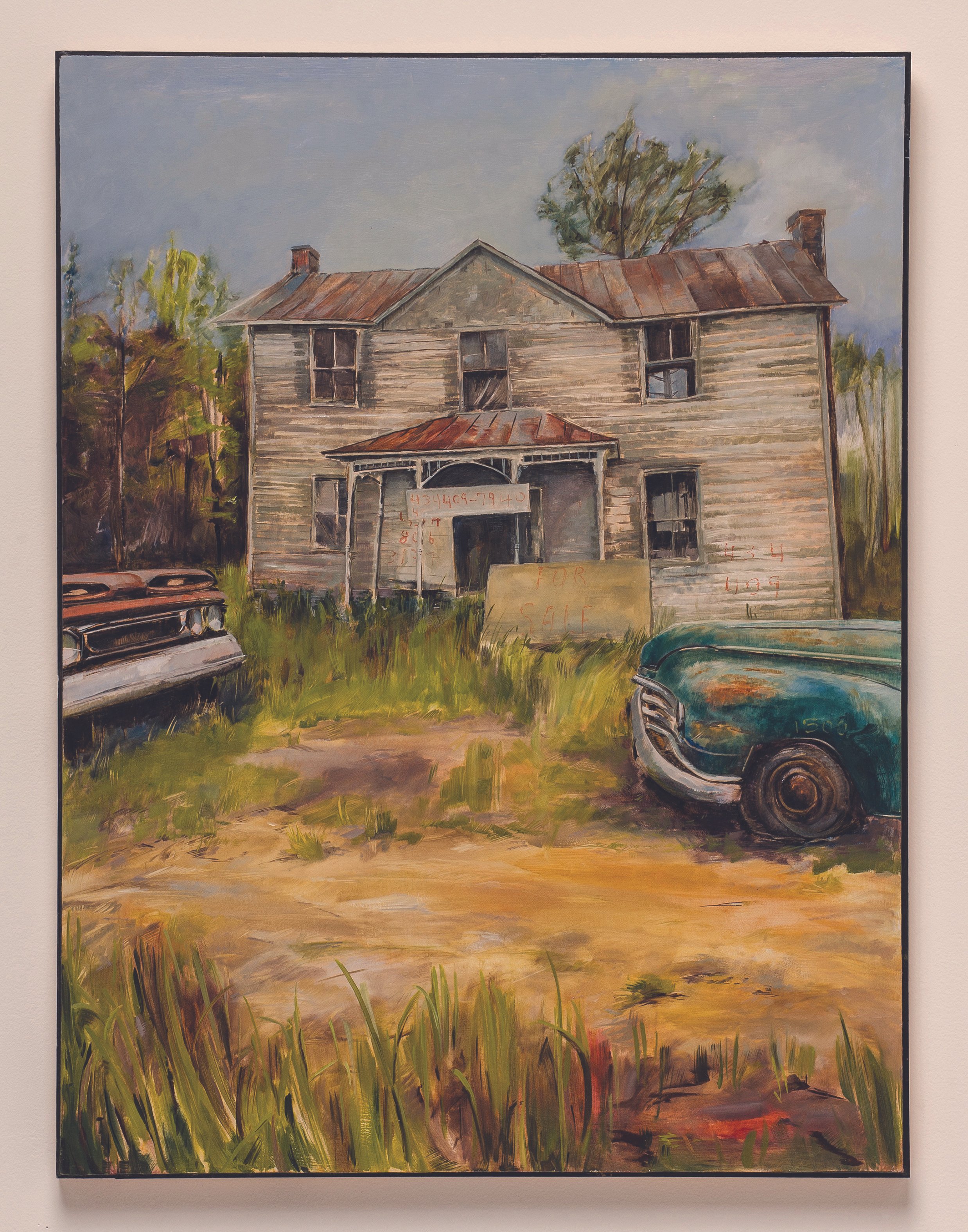
House on Route 33, by Melissa Burgess.
Part of that change has been brought about by developers, Melissa believes. “A lot of it is because of developers and development. Developers are coming in and just bulldozing places and just letting the ground stay fallow and empty for their next big investment. It’s very destructive.”
She wonders, too, about the powers that be. “The people that are making these changes don’t live in the city, and if they live in the city, they don’t know the neighborhoods,” she says. “They’re paying a consulting firm from out of state to come make us look like that place over there, that place over there, that place over there. Richmond has so much potential and there’s no vision with people who are in charge of the city.”
And about the myth of creating affordable housing. “They try to get people on their side by saying, ‘It’s affordable housing,’ but they’re making it less affordable,” says Melissa. “They’re taking the things that are affordable, taking them out, and putting up their crap that’s gonna be three times more than what you’re paying now for a decent house.”
But the eyes of Melissa Burgess are trained on the things and the places that make Richmond what it is. The things that have stories and have lived long lives, lives that continue beyond our own in that perpetuity embraced by artists and poets and their need to stop time.
“I started to document everything, and I’m nowhere near done,” she says.