
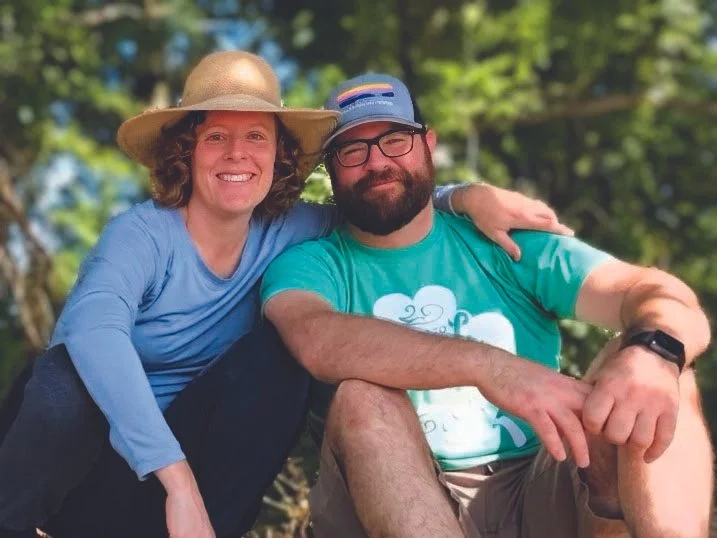
Mary Catherine and Micah Berry.
Micah Berry: Trailblazer
by Charles McGuigan 10.2026
A succession of musical tones when combined artfully with a procession of words can create entire slices of reality, stories with universal implications, that resonate with millions, even billions, of people. And these songs, when recorded or performed with the right vocals and the appropriate instrumentation, can indelibly stamp the memory banks within the human skull for a lifetime. So even long years after they were first heard, they have the ability to transport the listener back in time.
A few weeks back, on a warm October evening, Micah Berry sat with his former bandmates from Three Sheets to the Wind in the pit of Allianz Amphitheater on the banks of the James River. They were there to hear and see Phish, the first time in more than 30 years the band had played in Richmond. And as Micah listened and watched, he tripped back through time to a little over three decades ago when he had heard Phish for the first time in another Richmond venue.
“That changed my life,” says Micah. “I just had never seen that scale of lighting and music and sound before. And the drummer and the guitar player in that band are phenomenal. And so I just got obsessed with trying to learn how to play like those guys.”
Artists, whether they write stories or create songs or paint pictures, are sponges that absorb every drop of reality.
“I've always been hyper aware of people around me and how people react to things,” Micah says. “I pay a lot of attention to that and that was a moment (at that Phish concert when he was a teenager) for me. I looked at this culture that this band had created. I just like that they created a whole world, these dorks from a basement in Vermont. They created a whole world and brand and operation.”
When his family moved to Lorraine Avenue on the north end of Bellevue, Micah made quick friends with their next door neighbors—a young couple in their early thirties. The husband worked as a rep for PolyGram Records and was an avid collector of music. In one room of their house, with low lighting and a CD player, the walls, from floor to ceiling, were lined with CDs from every conceivable music genre. For Micah, it became a sort of lending library.
“I got to know him and he realized that I was this twelve-year-old that loved music,” says Micah. So the neighbor allowed him to borrow three CDs at a time. When he returned them in good condition, he was permitted to borrow another three. What’s more, he was also allowed to just sit in the music room for hours, headphones clamped to his ears, and listen to his heart’s content.
“That's how I discovered the Grateful Dead,” Micah remembers. “I was a twelve-year-old listening to Wilco before anyone knew who Wilco was. All of these bands that were the biggest influences in my life. I remember the first time I heard Greetings from Asbury Park by Springsteen. It was sitting on the floor in that guy's house in Bellevue.”
And he shared his musical wealth with his friends. “I'd make mixes from his CDs,” Micah says. “And I’d give them to all my friends and that's how we would discover bands. I never would have known who the Crash Test Dummies were, or Hootie and the Blowfish. I remember I had their first album before anybody knew who they were because of this guy who lived next to us on Lorraine.”
At that time, he was attending Luther Memorial, which had occupied the building that now houses Richmond Waldorf School. Previously he had been enrolled at Binford Middle School. But then there was an extremely severe bullying incident, and school’s inept response.
“I got my arm broken at school by a bully,” says Micah. “I was swinging on the monkey bars and this kid just came from behind me and shoved me as hard as he could and I fell six feet. And I remember the teacher pulled me off the ground with my broken arm.” He was in extreme pain. “And the school wouldn't believe me that my arm was broken.” he says.
So, Micah simply ran off the school grounds. He made his way east along Floyd Avenue, and at Manuel Laundry he found a pay phone and called his mother, who was at work at the time. “Hey, kid broke my arm,” he said into the receiver. “I'm walking to Stuart Circle Hospital.” He headed north, up Lombardy to Monument and entered the emergency room at the hospital.
“The next week I was at Luther Memorial School,” Micah tells me.
He made a lot of friends at Luther, and many of them were planning to go to Benedictine High School after graduating from eighth grade. Micah decided he wanted to go there, too, but the tuition there was prohibitively high.
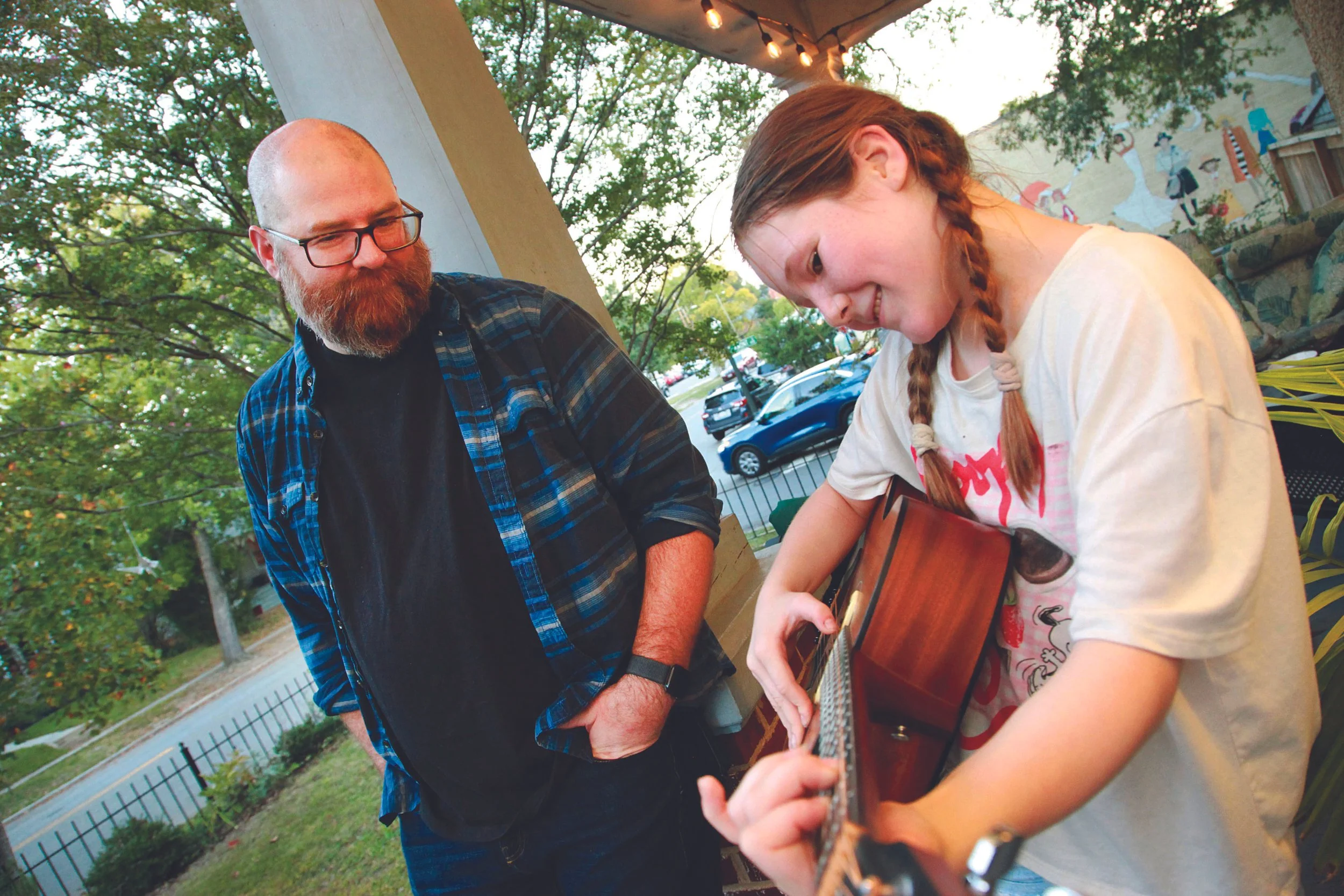
Micah with Magnolia.
At the last minute there was a sort of “Great Expectations” moment when a nameless donor came forward. Turns out Micah’s grandparents were close friends with a doctor who was a colonel in the US Army. “He never got married, never had kids,” says Micah. “He was very passionate about family and community. And when he found out that I was interested in going to Benedictine he said, ‘I'll pay for his whole tuition if he's serious about going. And I don't want him to know that it's me paying for it.’”
Micah didn’t find out about his benefactor until the man’s death. In remembering this generosity, his right index finger briefly brushes cheek. “I always tear up when I think about that.” he says.
It would prove to be a game changer for Micah, laying ground work for what it seemed he was destined to become.
“Benedictine was great,” he says. “It was hard. Coach Arnold was one of the smartest guys I've ever met. One of the best read guys I've ever met. He taught AP English and was a football coach.”
Sometimes people assume that Micah learned discipline at Benedictine. To which he’ll shake his head, and say, "Nah, I think what I learned was how to be clever and how to break the rules without getting caught.”
“And that has served me so well for my entire life,” he says to me. “More than almost any other skill—how to be mischievous and clever about it. I think as long as I can stay curious and then turn that into being mischievous about something in a way that doesn't hurt anybody, it's the best thing in the world. And it gets me into the best trouble all the time.”
It was during his high school years that Micah’s passion for music grew exponentially.
“So I was in band, which immediately puts like a dork target on your back at a school like Benedictine,” says Micah. He played guitar with the jazz band, and drums with the marching band.
And during his second week there, he formed his very first rock band. “Kerosene was the name of the band,” says Micah. “We had it all four years. The first public gig we ever played was in the Willow Lawn parking lot for Battle of the Bands at Tower Records. And the biggest club we ever played as a band was Twisters where we headlined in our senior year.”
Their music was all original, highly influenced by the Spin Doctors and the Red Hot Chili Peppers. “Everything was funky,” Micah remembers. “I listen back to it now and it's the funniest thing. I say the word funky so many times. Keep it funky. Make it funky.”
It was during this period that he met and became friends with another local rising star.
“So Prabir (Mehta) was in a band called Murfreesboro in high school,” says Micah. “This sounds like a conceited statement, but it felt like we were the only two good bands. So we were always competing against each other at these battles of the bands and that's how I got to know Prabir.”
Prabir would later serve as Kerosene’s first manager as well as its booking agent.
Micah also tried his hand at theatre. At SPARC he was in “Guys and Dolls” and he played a brother to the titular character in “Joseph and the Amazing Technicolor Dreamcoat.” Playing the lead in that production was none other than Jason Miraz. “That was the summer I got to know Jason who’s now an avocado farmer,” Micah says.
Because Benedictine didn’t have its own theatre department, they had an arrangement with Saint Gertrude High School for their cadets who were interested in stage productions. Of course, Micah joined that program, which opened him up for ridicule by jocks.
“I would get out of school and I would walk the block down to Saint Gertrude and do theatre,” he says. “I would get bullied about that and I'd be like, ‘Great, bully me. I'm going to go down and hang out with the girls. Y'all have fun slapping ass at football practice.”
Micah had a predilection for theatre and an innate ability to perform. In high school he landed lead roles, and to this day one performance remains one of the most difficult things he ever attempted.
He played Jesus Christ in the musical “Godspell.”
“It was one of the hardest things I've ever done in my entire life,” says Micah. “I had to memorize all the red text in the New Testament. I had to memorize the New Testament. Think about how that changes a person.”
He so enjoyed theatre and performance, that after high school he went to Radford University where he studied musical theatre for a short time. He soon realized a career in theatre was not for him.
After returning to Richmond Micah transferred to VCU where he studied anthropology, religious studies and music.
“I felt like that's the stuff that could inform whatever creative thing I wanted to do next,” he says. “I knew that it was going to have to be rooted in humanity. And so I was like, ‘Well, anthropology's studying cultures and, religion is the core of everybody whether they know it or not.’”
Not long after returning to Richmond he met two fellow musicians and they formed a band they christened Cosmos Mariner. The name comes from the inscription on a gravestone of granite that’s shaped like a simple bench. Situated in Savannah’s Bonaventure Cemetery (think “Midnight in the Garden of Good and Evil”) it marks the spot where the writer Conrad Aiken is buried. Inscribed next to Cosmos Mariner are the words Destination Unknown. The inscription was inspired by the ship’s log of a vessel Conrad had seen heading seaward down the Wilmington River. It read, Cosmos Mariner—Destination Unknown. His hope was that folks would take a seat by his grave and watch the working riverfront while nursing a beverage. Aiken himself had done just that on numerous occasions at his parents’ nearby gravesite. His drink was always a dry martini.
“We were a trio and I played drums,” Micah says. “We were a jam band, kind of in the Phish vein. Just guitar, bass, and drums. It was great. That was probably my primary focus when I was at VCU. We had some success and toured a little bit with this band the Disco Biscuits.”
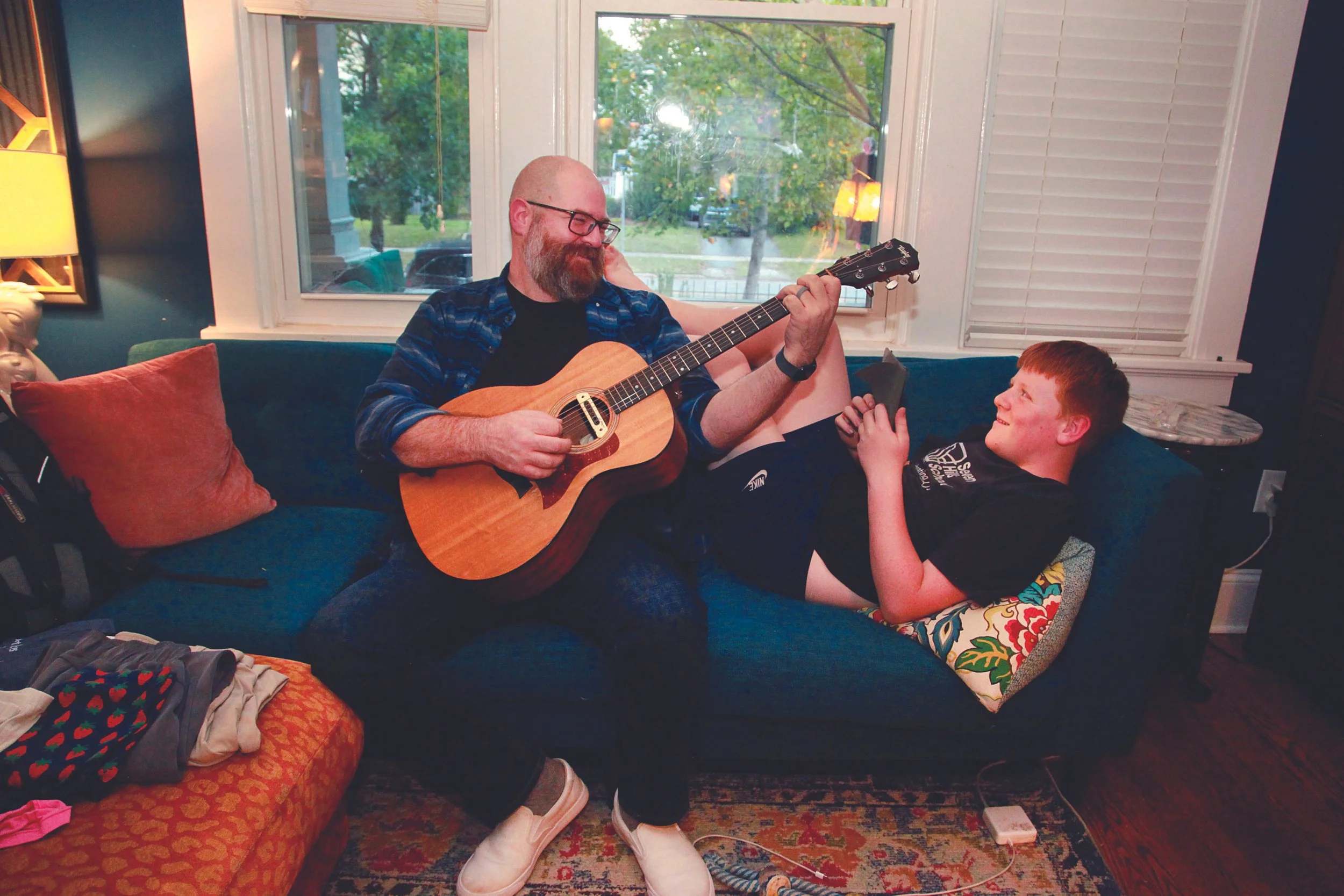
Micah with Jonah.
After Cosmos Mariner dissolved, Micah received a call and was invited to be the drummer for a new band called Thread. “That band was very Crosby, Stills, Nash, and Grateful Dead sounding.” says Micah. “That was probably one of the better bands I've been in.” They even produced a vinyl album.
In fairly short order Micah understood that a degree in music or anthropology was not for him. “It was not what I wanted in life,” he says.
Micah would later attend Full Sail University in Orlando, Florida.
“It was really cool,” he recalls. “It was like a Hollywood film studio with a huge recording studio. I got a degree in studio production.”
And while he was there he started another band. It was called the South Orange All Stars. The name came from a bowling league shirt Micah found in a thrift store. “We played jammy funky rock kind of stuff,” he says.
After leaving Florida, and a brief ill-fated detour in New Orleans, Micah got a job at Crystalphonic Recording Studios in Charlottesville. It was a professional studio, owned in part by Dave Matthews. He worked and lived in C’ville for about a year and a half, and during that time he played lead guitar with Chris Jamison and the Secret Circus. “Chris is an amazing songwriter who is still putting out records. He's a very politically conscious songwriter, kind of Paul Simon-ish.”
Chris later asked Micah if he would consider producing a record for him. “And this was the first time anybody asked me to produce a record,” he says. So he jumped on the opportunity.
“We recorded the rhythm tracks at the Minimum Wage Studios on Oregon Hill,” says Micah. “And then we went to Oxfordshire, England and recorded everything else at the studio with an old thatched roof. It was the Fairport Convention Studio.”
Then as a cherry to top it all off, they did the mixing and the mastering at Abbey Road.
* * *
About twenty years ago something extraordinary happened in the life of Micah Berry.
It was during one of the early Folk Festivals. He was scrolling through MySpace, the precursor of Facebook, looking for someone to hangout with at the festival. And he came across an old friend of his, a woman named Mary Catherine. They had been very close through high school and sort of drifted apart in their college years. “And I was like, ‘Let's hang out at the folk festival this weekend,’” Micah says. “That was our first date and I think I've spent every night with her since that day. I think I moved in with her that same week, and we just had our sixteenth wedding anniversary.”
He fairly gushes about Mary Catherine. “I got lucky with her,” he says. “I've never met another person in my life like Mary Catherine.” And he talks about their two children, Magnolia and Jonah. And then his father and mother, Kathy and Willie Berry, both of whom hold a master of divinity degree from the Southern Baptist Theological Seminary in Louisville.
A couple years after reconnecting with Mary Catherine, Micah formed a band that he would work with for the next fifteen years. It is called Three Sheets to the Wind, a yacht rock band.
“It is by far the most successful musical project I've ever had,” he says. Along with Micah it includes Jack Shannon, a multi-instrumentalist. “We were looking to do a cover band cause we really needed extra money at the time. I was Captain Max Power and Jack was Topper Dandy.”
They started playing every third Thursday night at the Republic. “It just turned into a thing where it'd be a line down the block to get in,” says Micah. “It became that popular.” They began doing weddings and each band member would walk away with $400. “This is a long time ago and that was good money,” he says. “I was over the moon. Totally, completely over the moon. I was like, ‘This is going to be my job.’”
Within a few years they had become Richmond’s most popular band, a title they would retain year after year. “We would be consistently voted in these magazines as the number one band in town,” according to Micah.
And because of Jack’s expertise as a booking agent, and Micah’s advertising. production and recording experience they would get gigs that paid extremely well. “We would do corporate parties at country clubs or big yacht clubs, or at huge hotel convention centers on the beach,” says Micah. Some of the gigs would pay as much as twenty grand. “Three Sheets in the last few years has been making a lot of money,” Micah adds.
Though he played two gigs with them this past summer, Micah formally left Three Sheets to the Wind this past April.
“I think I just had too much going on in general in life and felt like it had run its course to me personally,” says Micah. “And I know it's still viable as a band. I wasn't enjoying it in the way I used to.”
He’s got a full platter. Along with professorial duties at VCU’s Brandcenter, Micah also has a business called FieldPattern that requires a lot of time. But there’s more to it than that.
For first and foremost, Micah is a singer-songwriter. In the band King Hollow, he and one of his oldest friends, Alex McCallum, have written and performed a lot of songs together. “Alex is also a prolific and phenomenal writer,” says Micah. “And when Alex and I write together we write really, really good songs. But I think he wants something a little different than what I want. He feels the bluegrass thing real strongly, and I don't.”
He mentions a number of songwriters he admires and those who influenced him. “When I just sit and write songs, I think it's probably closest to Van Morrison,” says Micah. “I'm super influenced by Van as a musician, not as a human being. And there’s Bruce Springsteen, Jackson Browne and maybe the most formative of all in my life is James Taylor.”
Micah tells me how a song evolves in his head, from something he witnessed or saw in a film.
“I was watching some movie and there was a truck driver character in it and he had married above his station,” he says. “And I just wrote a whole song about that.”
It’s just two verses long. And he sings it for me.
“Daddy was a truck driving man,
the blood in the veins of this great land.
Mama came from way down south,
chip on her shoulder, silver spoon in her mouth.
They met in the middle somewhere in the Old Dominion.
He drank too much whiskey and she had too many opinions.”
Michah Berry doesn’t remember the name of the movie or its plot.
But the songwriter in him noticed something. “You just start riffing on some little thing, like a random moment,” he says.
We had talked earlier about how William Butler Yeats always heard music with his inner ear whenever he penned a poem.
“I hear a melody when I write,” says Micah Berry, a trailblazer in the art of songwriting. “And whether it's conventional or unconventional, I'm bending the lyric to that melody. I have the melody in my head and the melody is the thing that informs everything else in the song.”
And it informs us as well.