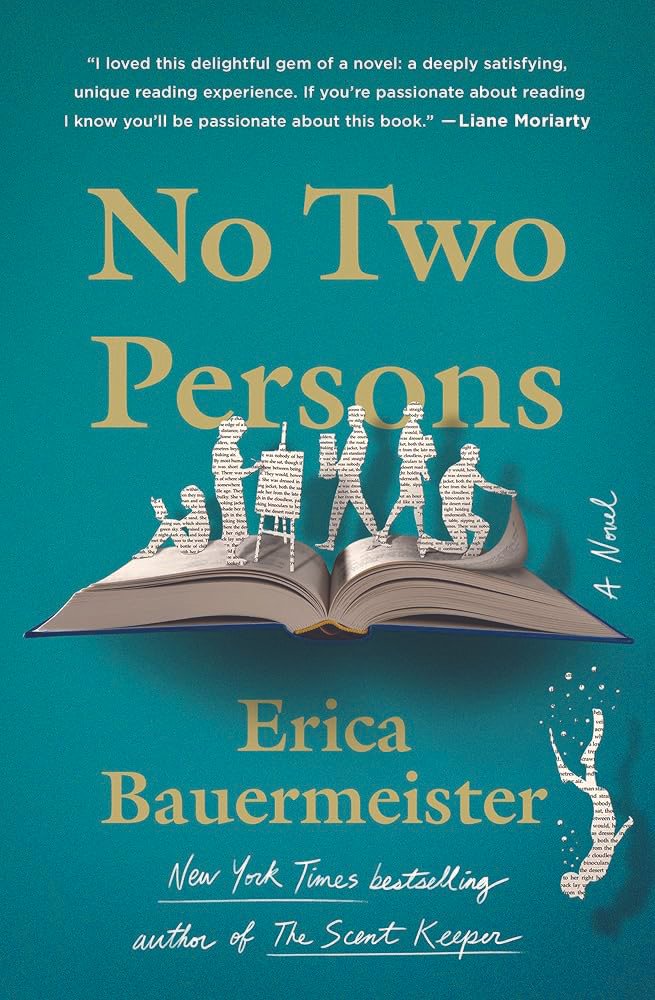
“No Two Persons”
By Erica Bauermeister
St. Martin’s Press
314 pages
$29.95
“No Two Persons”
by Fran Withrow 12.2025
If you are a book lover, as I am, you will enjoy Erica Bauermeister’s lovely novel, “No Two Persons.” This beautiful book exemplifies the adage that no two people ever read the same book, for everyone will glean something different from it. In addition, “No Two Persons” deftly demonstrates the power of stories to change lives and to connect us to one other.
The tale begins with Alice, an old soul from childhood on, who always knew she had a story inside her. It takes a catastrophic event to finally tease that story out of her, and her book, “Theo,” is the common thread that ties the rest of this novel together. Each character encounters Alice’s work in the subsequent chapters and responds in vastly different ways.
As the pages turn, we meet the readers of “Theo” whose lives have been altered by Alice’s book. The publisher’s assistant, a stay-at-home mom who just happened to read the manuscript and realized it was “the one.” The handsome actor who develops a skin disorder and becomes a recluse, but who realizes after reading “Theo” that he can still contribute to the arts. Nola, a homeless teenager; Kit, a bookseller; and William, a widower who is looking for hope and meaning after his wife dies. “Theo” is a catalyst of change for all of them, and Alice’s story, unbeknownst to her, causes the arc of her readers’ lives to veer off in new directions.
We catch little snippets of Theo’s story in each chapter, learning about his challenging childhood, his resilience and courage. We discover the trauma that haunts his adult life. Ordinarily I would feel cheated not to know everything about this character, but here it makes sense. His story is not the meat of the book. Rather, the theme is how people respond to “Theo," and then, to the world around them.
Some characters show up again in ensuing chapters, but not all, which I rather liked. “No Two Persons” also spans from 2010 to 2019; therefore some characters, like teenaged Nola, are older when they appear again. The characters who connect with each other do so in delightful ways. It’s skillfully done.
The ending is sublime. The author, Alice, reappears. She has been plagued with an inability to write another book for years. What happens to her in the final chapter will fill you with joy.
The writing is lyrical and poetic, making this book a pleasure to read. I savored the clever pacing, as well as the beautiful way the characters find freedom, peace, and hope as they are touched by “Theo.”
The author’s note includes this quote by Edmund Wilson. “In a sense, one can never read the book the author wrote, and one can never read the same book twice.” How true. When you read “No Two Persons,” may you find it as uplifting and heartening as I did. And may it cause you, too, to mull over how wonderful it is that books affect us all in such rich and profound ways.