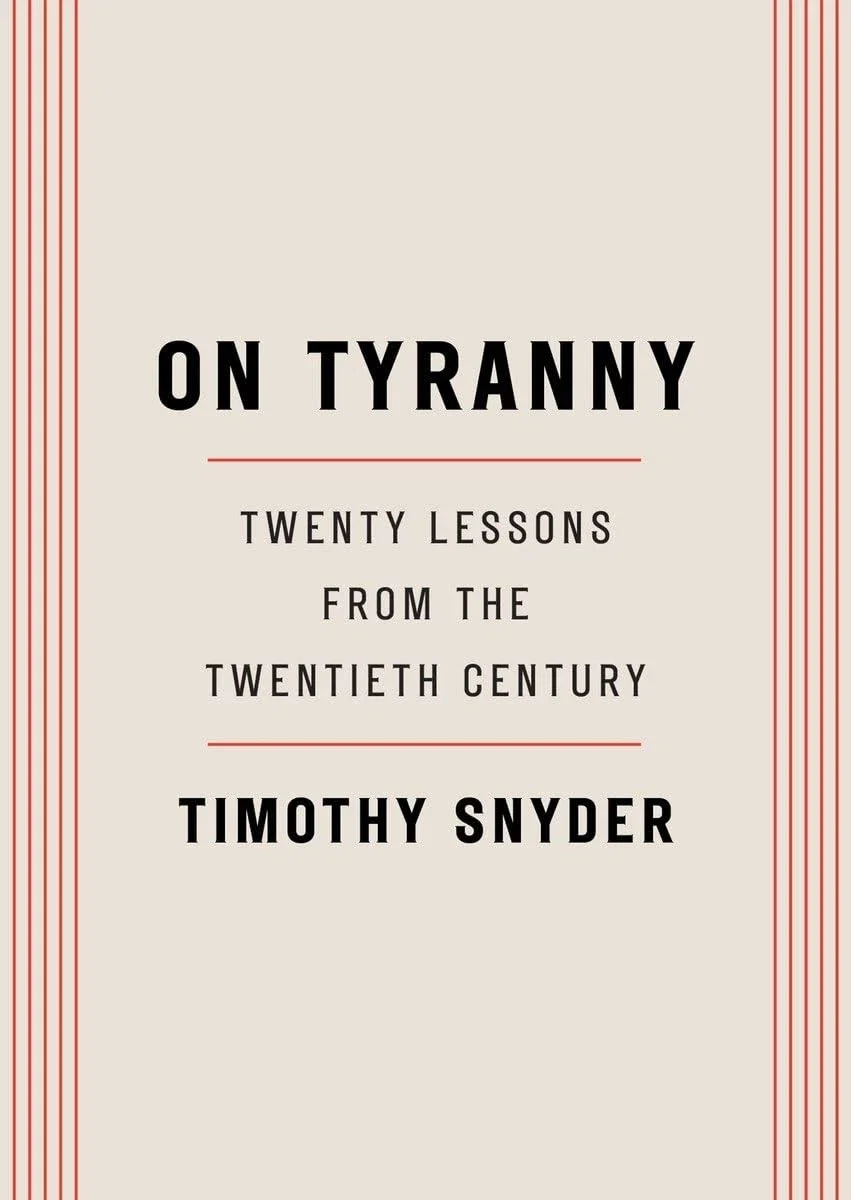
“On Tyranny”
By Timothy Snyder
128 pages
Crown Publishing
$14.00
“On Tyranny”
by Fran Withrow 03.2026
In 2017, Timothy Snyder published his book, “On Tyranny: Twenty Lessons From the Twentieth Century.” It’s been on my TBR pile for quite a while, and finally, when late January’s snowstorm hit, I pulled it out and started reading.
“On Tyranny” is a quick read: you can make your way through in an hour. But you will want to read it more than once, as Snyder’s observations of almost a decade ago are eerily prescient about what is currently going on in our country.
Snyder says that studying the history of Europe in the early twentieth century forewarns us about how tyranny can easily arise in democratic countries. We should not take democracy for granted: they can readily fail, as many did in the aftermath of World War I, World War II, and with the breakup of the Soviet Union.
The twenty lessons in this book are worth pondering, and are powerful suggestions for protecting democracy. I stuck about 50 post-it flags throughout this 128 page book. Everything seems important.
For instance, the first chapter is titled, “Don’t obey in advance.” Snyder explains that it is alarmingly easy for people to anticipate what those in power want, and go ahead and comply. A Yale psychologist even devised a test which showed just how effortless it is for authorities to get people to do even the most horrendous things.
Another chapter, “Beware the one-party state,” might give you pause. But having a two-party state allows for checks and balances. Elections between multiple parties allow for choice. Thus we need both Democrats and Republicans, despite our current political polarization. For democracy to function properly, though, we must strive to end gerrymandering and ensure that every citizen’s vote counts.
Snyder also states that we need to stay informed by reading books and longer articles, not just social media. It is far too simple to share items on social networks that align with our values or what we see as our truths. Snyder says it is our job to verify information and ensure we are not sending false news to others. In the age of the internet, we are all responsible for doing our homework and checking facts before sharing them. He also reminds us to support print journalism, saying, “… while anyone can repost an article, research and writing is hard work.…”
Amid chapters such as “Listen for dangerous words” and “Remember professional ethics” is one we could all do: “Contribute to good causes.” Snyder says this one need not be political. I thought about NPR and our local station, VPM, especially now that they have lost federal funding.
A later chapter reminds us to stand out. One example is the story of Teresa Prekerowa, who was only in high school when she helped Jews in the Warsaw ghetto in 1940. This incredible teenager later became a Holocaust historian. Anyone can stand out.
And that leads me to the last chapter: “Be as courageous as you can.” Courage will look different for everyone, and even small things help. Fortunately, this book can give you a framework for doing just that.