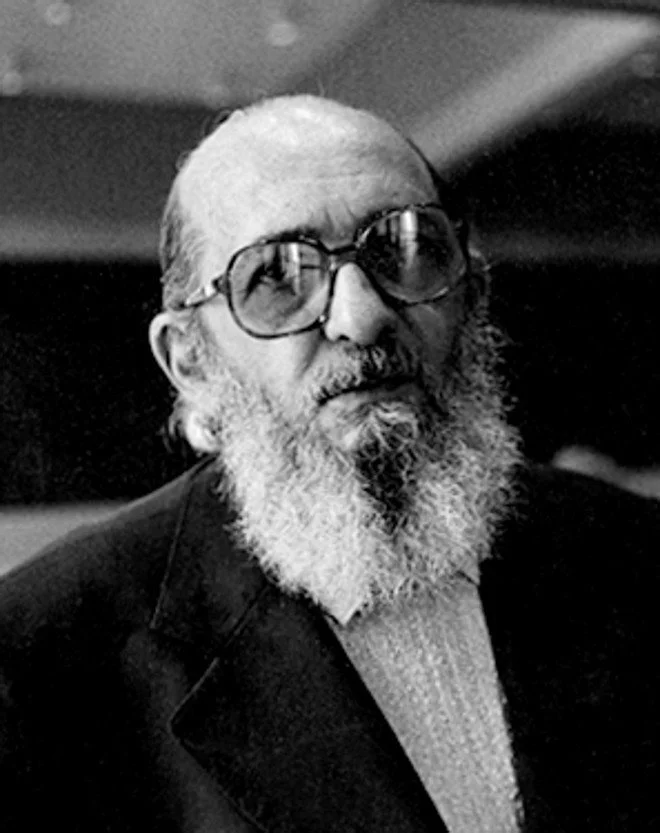
Photo of Paulo Freire 1977. By Slobodan Dimitro - Own work, CC BY-SA 3.0, https://commons.wikimedia.org/w/index.php?curid=5326164
Paulo Freire on Literacy and Voting
by Jack R Johnson 10.2026
They were called “Culture Circles,” in 1963, when Paulo Freire first taught illiterate farmers in Brazil how to read and write within a standard work week’s time: 40 hours, a pedogeological miracle. It was also, at the time, a threat to Brazil’s economic elite. In 1963, Brazil's illiterate population was barred from voting, so Paulo Freire’s education allowed them to vote for the first time in their lives. But having illiterate campesinos voting in national elections was not in the interest of Brazil’s economic elite. Paulo was arrested in April 1964 immediately following the U.S.-backed Brazilian military coup d'état.
After 70 days in jail, Freire went into exile in Bolivia, Chile, and Switzerland. He returned to Brazil under a political amnesty in 1979. Freire wrote 25 books throughout his life of exile, which were translated into 35 languages. His most notable, “Pedagogy of the Oppressed,” described his method for teaching which rejected rote memorization in favor of engagement. According to the Los Angeles Times, “Freire won international acclaim for his teaching technique based on the day-to-day experiences of his students. That meant first training teachers in their students’ vocabulary. Instead of the English word ‘food,’ for example, they taught the word ‘hunger,’ which was more familiar to the students. In his first experiment, Freire taught 300 adults to read and write in 45 days.”
His poor upbringing probably helped him in his break through methods. According to the author of “Critical Pedagogy on the Web,” Christy Stevens, “During his childhood and adolescence, Freire ended up four grades behind, and his social life revolved around playing pick-up football with other poor children, from whom he claims to have learned a great deal. These experiences shaped his concerns for the poor and helped to construct his particular educational viewpoint. Freire stated that poverty and hunger severely affected his ability to learn. These experiences influenced his decision to dedicate his life to improving the lives of the poor: ‘I didn't understand anything because of my hunger. I wasn't dumb. It wasn't lack of interest. My social condition didn't allow me to have an education. Experience showed me once again the relationship between social class and knowledge.’”
Freire maintained that he never would have been arrested or criticized had he stuck to teaching ABCs. The Brazilian military regime accused him of "subversive activities," preaching communism, and acting as an "international subversive" because his adult literacy program empowered poor peasants and sugarcane workers to vote.
Today, his book, “Pedagogy of the Oppressed” is considered one of the foundational texts of critical pedagogy. Combining philosophical, political, and educational theories, and based on his own experience helping Brazilian adults to read and write, Freire calls traditional pedagogy the “banking model of education” because it treats the student as an empty vessel to be filled with knowledge, like a piggy bank. One of Freire’s dictums is that “there neither is, nor has ever been, an educational practice in zero space-time—neutral in the sense of being committed only to preponderantly abstract, intangible ideas.” In other words, all education has a cultural perspective and a political view point. Freire believed education could not be divorced from politics; the act of teaching and learning are considered political acts in and of themselves.
According to Henry A. Giroux, “Freire was like a lightning strike, his book changed the paradigm. He went beyond a whole range of liberal educators who were far more concerned about individual mobility than they were about social change. He [Freire] provided a foundation that was taken up later by a whole range of movements, such as the critical sociology movement in England and the United States, cultural studies, and youth studies. All of these movements were vastly in many ways influenced by Paulo.”
Now Giroux argues the situation has become even worse than it was when Paulo was arrested back in 1964. “The attack on education, for example, is unlike anything I have seen before: the banning of books, the claims that historical consciousness doesn’t matter, the embrace of a rabid kind of anti-intellectualism… In many ways, technology has now taken over the educational process. The power has become so much more concentrated in the hands of the right, that I don’t think Paulo’s work has ever been more important than it is now. This is because he not only understood the school as a site of struggle, he also knew that, in some fundamental way, questions of consciousness and questions of literacy were fundamental to a notion of agency in which young people had to learn something about the conditions that dominated their lives. This was the first step in not only recognizing those conditions, but recognizing the limitations that their situation imposed on them.”
In 2025, “Reading the World,” a documentary on Freire’s work, directed by Catherine Murphy and Iris de Oliveira, came out. Told through the collective memories of farmers, students, and educators that participated in the “Culture Circles,” where they learned to read and write in 40 hours, the film contains archival footage of 1960s Brazil that was recently recovered. After the Brazilian coup d’etat, the film shows how the farmer’s notebooks were set on fire, and Freire was eventually forced into exile for 16 years.
Today Freire is considered one of the most influential philosophers of education in the twentieth century, and revered by educators across the world as the grandfather of Critical Education Theory.
Paulo Freire died of a heart attack in 1997 in São Paulo, Brazil. He is buried at the Cemitério da Paz (Peace Cemetery) in the Morumbi neighborhood near his home.