
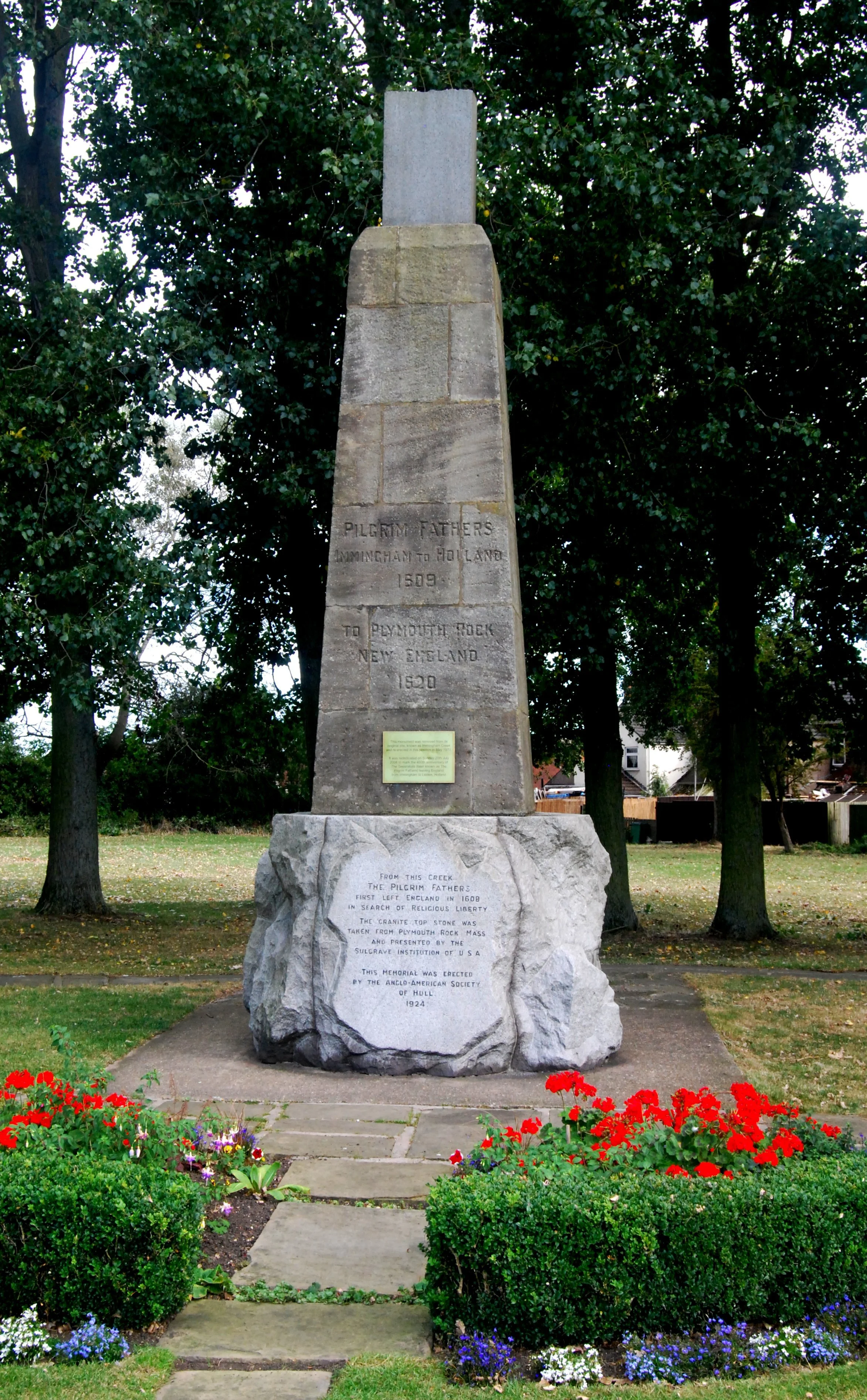
From this creek the Pilgrim Fathers first left England in 1608 in search of religious liberty. The granite top stone was taken from Plymouth Rock Mass and presented by the Sulgrave Institute of USA.
This memorial was erected by the Anglo-American Society of Hull 1924
Photo by Syncopator, CC BY-SA 4.0 <https://creativecommons.org/licenses/by-sa/4.0>, via Wikimedia Commons
Pilgrim's Progress
by Jack R Johnson 12.2025
The average American will tell you that our country was founded on principles such as religious freedom, democracy, individual rights and economic progress. But debt might be a better way to describe our founding principles, or at least those that ruled the first settlers.
In 1608, many of the Pilgrim “Separatists” fled to the Netherlands to avoid persecution from the Anglican church which penalized those who did not attend Anglican services with a fine of one shilling (£0.05; about $32 today) for each missed Sunday and holy day. The penalties included imprisonment and larger fines for conducting unofficial services. But as Nathaniel Philbrick writes in, “Mayflower: A Story of Community, Courage, and War,” Holland was also getting tired of the Pilgrims decidedly ethnocentric behavior. The Pilgrims looked down on their Dutch neighbors and worried that their children would be “drawn away by evil examples into extravagance and dangerous courses.” Additionally, their pay in Leiden was extraordinarily low, a little less than what our minimum wage might be today. They lived in poverty, laboring long hours, weaving, spinning, and making cloth in the Leiden textile mills. This made it difficult to convince their fellow Separatists to join them in Leiden, no matter what their religious rights. “Some preferred and chose the prisons in England rather than this liberty in Holland with these afflictions,” William Bradford, the Pilgrim Governor, noted. So travel to the new world was as much about the opportunity to possess property and a chance at a decent life, as religious freedom, which they were readily granted in the Netherlands.
The Pilgrim “Separatists” looked to the new colonies as a possibility, but to do so they needed money. Nathaniel Philbrick writes that they first approached the Virginia Company, the same group that funded the trip to establish the colony in Jamestown in 1607 which was a disaster. The Virginia Company wasn't terribly interested in fronting another loss on a colonial expedition, but an ironmonger from London named Thomas Weston voiced some interest. In contemporary terms, we might think of him as a private equity investor, or speculator. An historical note describes him as: “eager to reap quick profits from the New World, and not very scrupulous about the means”
Weston represented a group of 70 investors called the London Merchant Adventurers. The Merchant Adventurers agreed to fund the Pilgrim's first voyage by creating and buying shares in the venture. Each of the Pilgrim “Separatists” heading to the New World received one share, worth £10k, for free. The investors staying in London could buy in for about £20 apiece. All told, the Adventurers raised about half a million in today’s money.
Weston and his fellow investors ignored the hard lessons learned at Jamestown and disregarded the upfront money that would be needed for supplies, as well as the length of time it might take for the Pilgrim 'venture' to actually turn a profit. “They failed to calculate that even if the colonists engaged promptly in trading furs or catching fish, their initial task must be to build permanent dwellings and to feed themselves and a fair number of women and children,” writes Ruth McIntyre in “Debts Hopeful and Desperate.”
Originally, the term of the Merchant contract called for the colonists to work four days a week for seven years in the New World procuring goods to pay back the investors. They would also own their own homes and keep 100% of any profits they’d make selling them. But the investors were concerned about their returns and demanded new terms which called for the Pilgrims to work six days a week for seven years for the investors, and split the profits if they ever sold their homes.
William Bradford wrote, “I think there is not a man here who would pay anything, if he had his money in his purse again.” Buyers remorse had set in before the Pilgrims even left English ports.
In early September, 1620, all 102 passengers, and a crew of about 30, plus two dogs, set sail aboard the Mayflower from Plymouth, England. Half of the passengers were Pilgrims, and half were “Strangers,” skilled laborers the investors insisted the Pilgrims bring along to assure some return on their investment. They intended to land near northern Virginia. Two months later they arrived far north of Virginia, in what is today Cape Cod. In early November. In one of the worst winters in decades.
The harsh weather took its toll. The new arrivals started dying on a daily basis from hunger and disease. Those who did survive didn’t have much luck at fishing, or hunting, or growing anything that they could trade for furs. Thomas Weston complained about the Pilgrims’ lack of progress in turning a profit. “I know your weakness was the cause of it,” Weston wrote, “and I believe more weakness of judgment than weakness of hands.“
William Bradford responded fiercely. His wife had just died, after falling off the Mayflower and drowning in the harbor.
“[O]ur arms and legs can tell us to this day that we were not negligent!” Bradford shot back. “But it pleased God to visit us then with death daily, and with a disease so disastrous that the living were scarcely able to bury the dead, and the healthy not in any measure to tend the sick.”
When they finally managed to load a ship with beaver skins, sassafras, and oak clapboards worth about £500 – or $145,000 in today’s dollars – making a serious dent in their debt, The Fortune (a wildly misnamed ship) was seized by a French privateer just before she got to England and robbed of everything.
For the next few years, the Pilgrims continued to ask their English investors for more provisions to help them survive. The Merchant Adventurers reluctantly complied and within a few years the Pilgrims were able to send back lumber and furs. Yet even as Plymouth Colony became more prosperous, they could never turn a profit. Nathaniel Philbrick writes that according to Bradford’s own calculations, “between 1631 and 1636, they shipped £10,000 in beaver and otter pelts [almost $3 million today], yet saw no significant reduction in their debt of approximately £6,000 [$1.74 million].”
William Bradford suspected he was being defrauded by his intermediary in London, but could not prove it decisively. It wasn’t until 1648, nearly 30 years after leaving England, that the Pilgrims finally paid off all of their debts, selling some of their own land to make it happen. Alas, our founding fathers had it worse than an American student loan.
“And thus was this poor church left,” Bradford moaned, “like an ancient mother grown old and forsaken of her children.”
No doubt, Bradford and the Pilgrims would find it odd that nearly 400 years later, we celebrate the brutal terms of their debt repayment with a Thanksgiving feast.
Footnote: According to C.M. Andrews in the book Colonial Period: "[Thomas] Weston, after squeezing all he could out of the Pilgrims, became a planter and burgess in Virginia, where he made trading and fishing voyages to the Maine coast. After being arrested more than once for breaking the Colony's laws, he went to Maryland, acquired new property, and returned to England.” There, he died of the plague.