
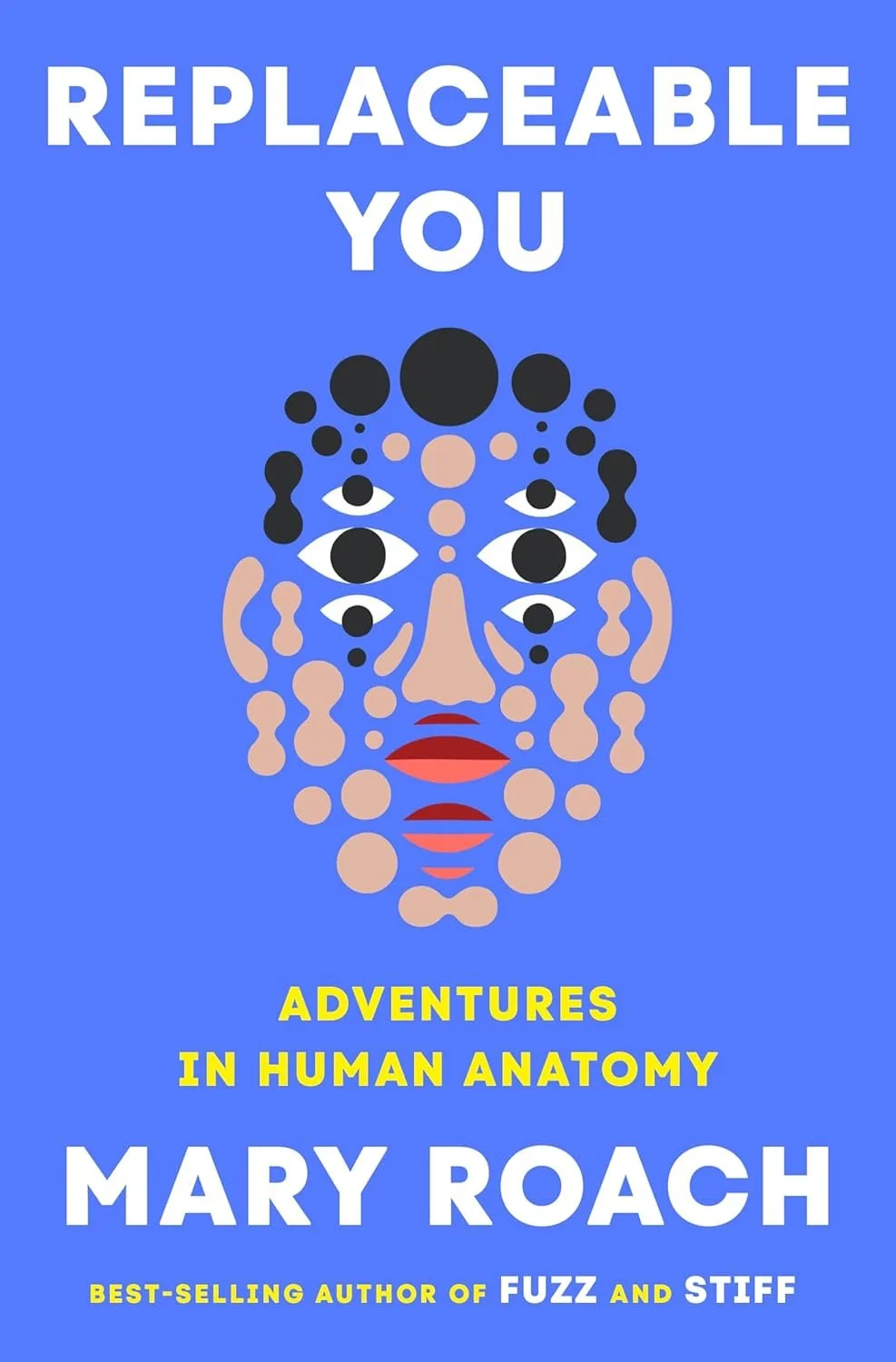
“Replaceable You”
By Mary Roach
$28.99
W. W. Norton & Company
288 pages
Replaceable You
by Fran Withrow 09.2026
Is there any subject Mary Roach can’t write about? Her previous books have touched on a vast array of scientific subjects: the human cadaver (“Stiff), the gastrointestinal tract (“Gulp”), and even outer space (“Packing for Mars”). Her writing is witty and informative, and she dives into her research with relish and a hefty dose of humor.
Her latest book, “Replaceable You,” explores the ways we repair and restore body parts. And goodness knows our bodies are easily damaged and in need of restoration.
Roach grabbed my attention right away with the first chapter: “To Build a Nose.” Did you know the very first nose piece was made of metal and was used in 1566? Brilliant solution, though it did occasionally fall off.
And that’s just the beginning. What about burn victims who need skin grafts? I was surprised to learn that in the 1800s, animal skins were used to cover a burn patient’s vulnerable body. (I am as glad as you are that this is no longer the case.)
Organ and heart transplants, body parts made from intestines, cataract surgery, and prosthetic legs all come under Roach’s inquisitive gaze. Of course, joint replacements get a mention too. Suffice it to say that this particular procedure is vastly different than it used to be.
Most of you are too young to remember polio, a terrifying disease which, in its most severe cases, left its sufferers unable to breathe on their own. The solution was to put them in an iron lung, a large cylinder the patient would lie in with only their heads protruding.
Roach locates an iron lung and plans to spend the night in it, just to experience what it is like to let this machine breathe for her. She describes how tight the collar must be and how one must stifle the need to breathe on one’s own. She learns can’t fight the machine or a bit of panic may ensue. And once inside, she hopes her nose doesn’t itch!
Today, with polio behind us (God willing), we use ventilators for breathing emergencies. I had no idea that there are two types: negative-pressure and positive-pressure, each with their own pros and cons. While negative-pressure ventilators are great for chronic breathing issues, their cons outweigh the benefits when needed in crises like ICUs.
Roach also wonders what the future is for bodily repair. She talks with medical scientists about how gene editing, CRISPR, and artificial intelligence are changing the way body parts can get an overhaul. Will we some day be able to print out a working heart?
Roach follows that up with a visit to a tissue recovery coordinator, watching as this specialist removes various bodily tissues from a deceased donor to provide life-altering help for people. Corneas, skin, and leg bones from just one donor can help a multitude of patients.
You might find yourself, after devouring this engrossing book, viewing your own body with more gratitude, and rightly so. Nothing works quite as well as the original stuff. But how fortunate we are that there are constantly improving options for replacing, repairing, and improving our amazing physical forms; so strong and yet so susceptible to harm.