
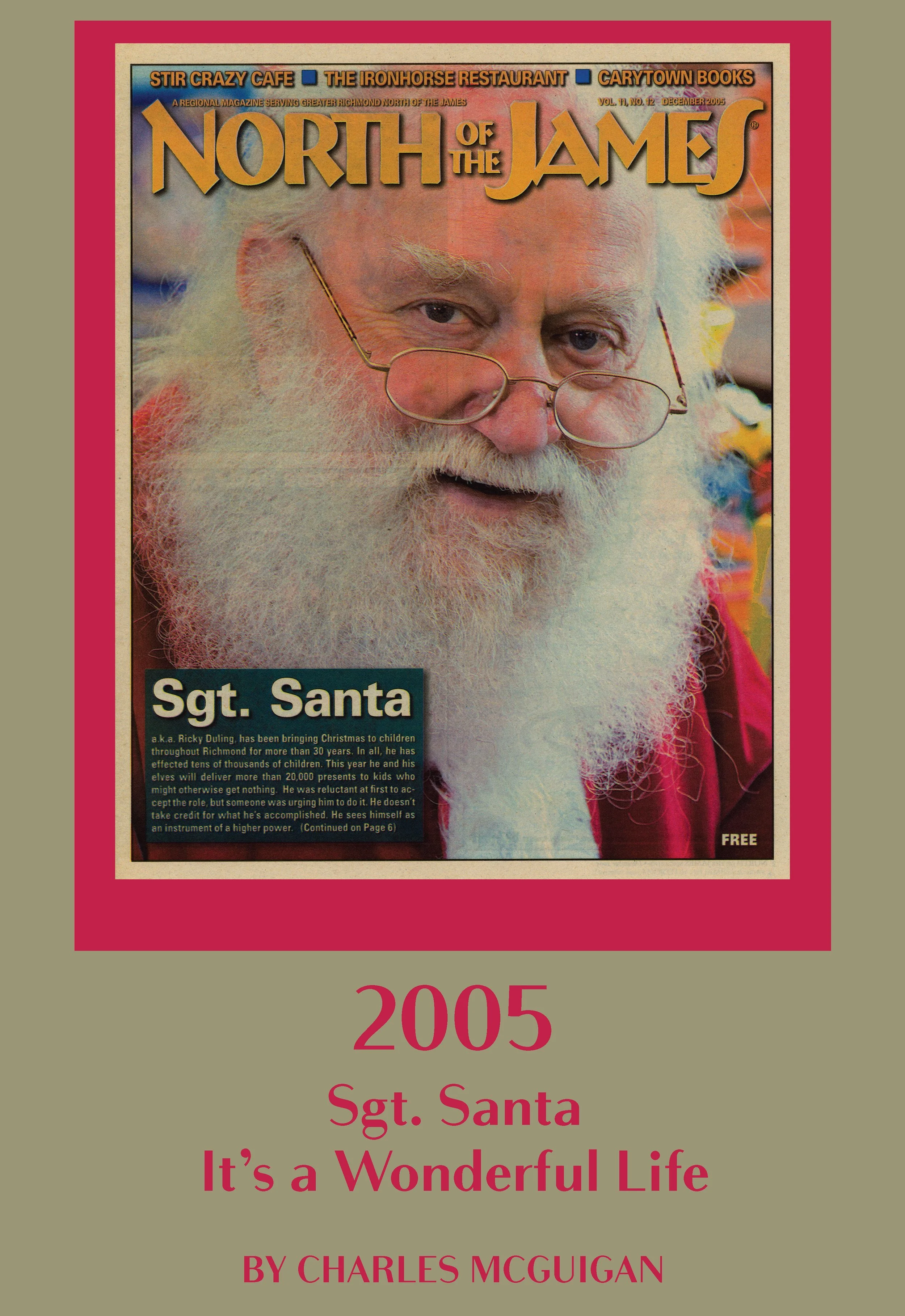
Sgt. Santa: It’s a Wonderful Life
by Charles McGuigan
This story originally published December 2005
I’m seated at a long table cluttered with boxes of bulk candy canes that are being packaged in small sacks by some 30 elves, all working methodically while singing Christmas carols. The head elf, Ruby Clanton, answers the phone, which rings about every other minute. And next to me in a folding chair is the man himself—Sgt. Santa, dressed down in khakis, a blue work shirt, red suspenders and a teal nylon bomber jacket. His complexion is ruddy as a red delicious apple, his eyes blue ice, and beard and hair like raw cotton. A pair of wire rimmed-glasses perch on his nose and he is talking, telling me about his transformation.
He came into the world almost 80 years ago, the son of Frank and Margaret Sarah Duling, and was named Dalton Rotruck Duling, though everyone called him Ricky. He was born in the back bedroom of the family home in the 3100 block of Grayland Avenue. A little over a year later, his father, Frank, a Richmond police officer, was killed in an automobile accident, leaving his wife to tend to the two children—Dalton, and his older brother, Frank. Shortly after the patriarch’s death, the Great Depression hit with a vengeance.
Ricky’s mom was intent on keeping her small family together. She baked pies and cakes, selling them in the community. She took in laundry, made dresses, stretched curtains, did just about anything she could to make ends meet.
At the age of sixteen, he entered the work force, and after working a few go-nowhere jobs, Ricky decided to go into law enforcement. He had the pedigree for it. His father had been a police officer. His brother Frank was a Richmond cop. And so were his two uncles—Tom and Dan. “I went on the force in 1953, and I remained on the force thirty-five and a half years,” says Sgt. Santa. Over the years he worked patrol and traffic and vice in uniform, and in plain clothes as detective.
While working undercover, Ricky grew out his beard, let his hair get long and shaggy. Standing in line one day at the bank, the man behind said this: “I’ve been looking all over town for you. I’ve got plans for you.”
Ricky eyed the man curiously. “How can you have plans for me when I don’t even know what I’m going to do myself?” he said.
“I want you to be Santa Claus.”
“I don’t want to be Santa Claus.”
But the man, who worked at an ad agency, persisted. He wanted to use Ricky in a TV ad for a local shop that sold sports gear.
Finally, during the dog days of summer, Ricky acquiesced. But it was with this proviso: The client would have to donate $500 in sports gear to a summer camp program for inner city kids. That client reluctantly agreed, and Ricky appeared as Santa for the first time.
The following November Ricky ran into a woman who had seen the commercials, and asked him to play Santa at a party. She handed him a Santa suit. Ricky agreed to the gig and she insisted he keep the suit, which Ricky put in the trunk of his police car.
Two weeks later, while Ricky was waiting at a traffic light, something odd happened. The light began to grow, and it didn’t change to green. It was the size of the sun and blindingly red. He blinked his eyes, shut them tight, but when he opened them, the red light was still there, bright as ever, and growing. He took it as a sign.
So the next day, he asked city officials to use a patrol car, and then he collected money from a group of lawyers and purchased enough candy to fill three hundred holiday boxes, which he loaded into his patrol car. That night, donning the Santa suit, he drove into the neighborhood he often patrolled.
“The kids were dumbfounded when they saw Santa in the patrol,” says Ricky. And one of them who recognized him as Sgt. Duling said: “You’re Sgt. Santa, now.”
That first year was so successful that the following year Sgt. Santa was able to collect enough candy, cookies, comic books, coloring books and crayons to fill five hundred boxes. He’d travel all over the city, from Gilpin Court to Oregon Hill, dispensing the Christmas boxes.
A few years later, he received a $500 donation. “That year we jumped from fifteen hundred to five thousand bags of candy,” says Sgt. Santa.
The next year, Sgt. Santa delivered seventy-five hundred bags, the following year ten thousand, and the numbers kept growing. Toys were later added to the bags.
Every year it was the same thing. Sgt. Santa would leave the precinct at eight in the morning. He’d cut on the flashing lights and the sirens, and children would come forth. After he finished with one load he’d return to the precinct and climb into the seat of another car that was already packed and ready to go. “Sometimes it took me eighteen hours to do it all,” he says. As night fell, he would use only the flashing lights and the kids would see the swirling red through their curtains and rush out to the street to greet Sgt. Santa. They called it the “Rudolph Effect.”
On one bitterly cold Christmas Eve, he drove over to Church Hill and a small boy came running down the street. The boy was barefooted and wearing only jockey shorts. He grabbed his presents and ran home. Later, when Sgt. Santa related the story to his colleagues, one of them asked if the boy had given him a hug. “No,” said Sgt. Santa. “The boy couldn’t stand still with the cold.”
There’s a steady stream of tears in his eyes as he relates this story. “As I told you, my father got killed when I was fourteen months old and we didn’t have any- thing, so I know what it’s like” he says.
On another occasion, Sgt. Santa was stricken by the compassion of a small girl who had absolutely nothing. It was out on Government Road in front of an apartment complex. A very little girl came running up to him, received a Christmas bag, and then waited patiently while the other kids came to claim theirs. She stood behind the red-suited man and when he had handed out the last bag and turned to leave, she tugged at his sleeve. Her small hand dug deep into her coat pocket and withdrew two pennies and a nickel that she carefully placed in the large black-gloved hand of Sgt. Santa. “Take this and help the really poor children,” she told him.
Over the years, Sgt. Santa’s operation has expanded exponentially. These days he has a workshop in Scott’s Addition and a large warehouse on West Laburnum. And literally thousands of volunteers help him each year, sorting presents, delivering them, and filling special requests that come over the phone or in letters.
He shows me a mammoth pile of letters. “They come in every day,” he says. He pulls one from the stack and reads it:
“I hope you can help my momma. I am nine years old and I have a little brother and he is eight years old, and my momma is always in pain and stays sick a lot. I am asking for you to help us to please just get one Christmas tree so my momma can smile again and my little brother will have a tree.”
“You see that,” says Santa. “He’s not asking a thing for himself. He’s asking for others.”
There are so many stories he tells that border on the miraculous that you sometimes wonder if there isn’t more than a little spark of immortality in this man. But Santa waves it off. “I have just been blessed,” he says. “It’s the greatest thing that ever happened to me.”
And, to all of Richmond.
Read the full story at: https://northofthejames.com/2005