
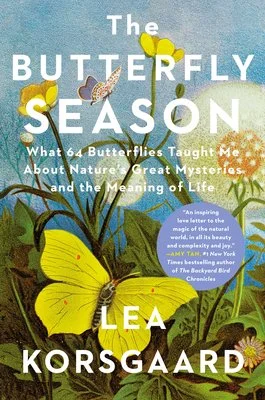
“The Butterfly Season: What 64 Butterflies Taught Me About Nature’s Great Mysteries and the Meaning of Life”
By Lea Korsgaard
320 pages
Knopf
$32.00
Lessons of the Butterflies: Rebirth and Transformation
by Fran Withrow 11.2026
One year, Lea Korsgaard, with no experience in lepidoptery, decides to see all sixty-four of her country’s native butterflies in a single season. “The Butterfly Season” is her luminous exploration of Denmark’s winged insects and a meditation on what she learns as a result.
Korsgaard’s writing is beautiful, her descriptions of nature compelling in their simplicity. She walks with her dog through the woods, hikes with her children, and follows experts. Slowly she begins spotting butterflies, delighted with each find.
Butterflies, creatures so “closely associated with ideas of transformation and rebirth,” also lead Korsgaard to delve into philosophy, religion, and mythology. Seeing these elegant insects that transform from caterpillars into a completely different shape raises a slew of deeper questions. What is the meaning of life? Why are we here? What should our relationship to the world be?
Tough questions all, but traditionally, Christians interpret the last one, our relationship with the world, as one of “dominion” over the earth, which is here solely for our use. This has led us to exploit nature, Korsgaard says. A better interpretation is that it is our duty to respect, care for, and nurture what we have been given. Reciprocity would help ensure a healthy planet for all.
Even politics finds a place in this illuminating read. Western culture, Korsgaard explains, desires continual progress. From the 18th century on, economists believed that development went in one direction (up) with a definitive end point. But today our consumer-oriented society pushes us to use more and more materials with no end in sight.
The result of this constant desire for “more” has led to, among other things, climate change and loss of wildlife. The “global loss of insects…” has “…plummeted by 75 percent since 1970.” Incredibly, people have sounded the alarm for hundreds of years. In 1799 Alexander von Humboldt warned that the loss of forests would change our climate. George Perkins Marsh said that we were destroying “nature’s delicate equilibrium” in 1864. Centuries foretelling our current situation! Yet here we are.
Still Korsgaard pushes on, stepping carefully into the forest, or among the grasses of a meadow, finding a purple emperor or a painted lady. Her appreciation and reverence for these lovely insects is palpable. She carefully photographs each butterfly she finds, and the book is full of her beautiful, hand-drawn renderings.
After I close the last page of “The Butterfly Season,” I go out into my yard, wandering among the fall asters and pink obedient plants. It is October, the growing season slowly fading.
There are more than 170 species of butterflies in Virginia. I have likely noticed only a mere handful. So I walk slowly, and soon find one tiny white butterfly sporting a delicate orange line on its wings. I watch it for several minutes, thinking about the fragility of our planet and how it seems as if we are determined to destroy it. But the butterfly is right here, and I marvel at its exquisite beauty. It sits on a stem, wings slightly askew in the wind, and I am grateful.