
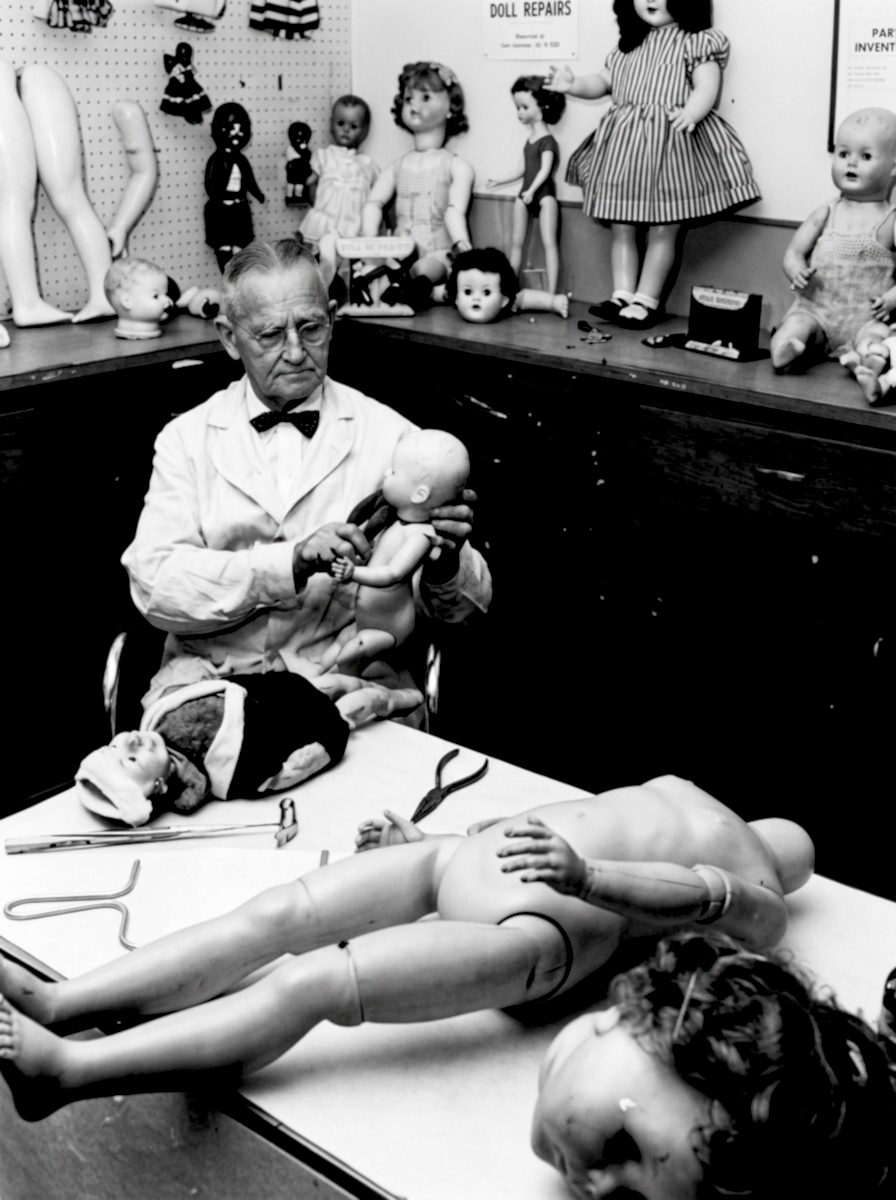
Joseph Hughes in his doll hospital 1960. Courtesy of the September 1960 Richmond Times-Dispatch.
The Eyes Were Always the First to Go
by Dale M. Brumfield 11.2026
Joseph Hughes opened a hospital at 209 North Third Street in Richmond in 1905. He was a general practitioner, repairing broken arms and legs, cracked heads, frayed bodies, and missing eyes.
His patients were not humans but dolls. While that distinction makes the introduction a little less disturbing, consider the photograph that accompanied a Richmond Times-Dispatch profile of Hughes in September 1960 and decide for yourself. A headless body sprawls across a table in the foreground, its head lying innocently beside it. Others wait upright on a shelf behind him, their expressions fixed in an unsettling, eerie cheerfulness. Hughes sits among them, seriously attending to a patient. He looks like a man doing an ordinary day’s work.
For fifty-eight years, it was.
209 North Third Street has been home to an eclectic succession of businesses. In addition to serving as Hughes Doll Hospital from 1905 to 1963, it was the Broadway Adult Bookstore from 1971 to 1973, and then Chong’s Oriental Massage Parlor until 1976. After a run of small retailers, including the Third Street Market in the 1980s, it is today the Veiled Mirror Antique Store, a shop managed by Olivia Lloyd and Kathryn Parker that specializes in Victorian funeral paraphernalia and other macabre collectibles.
The 1960 article described a woman entering the shop with a small bundle. “I need a new arm for Susie here,” she told Hughes, opening the package to reveal not a bloody surprise, but simply another customer in need of a part.
As a boy, Hughes had watched an elderly German repair dolls in a specialty toy shop. What began as an absorbing hobby became his business. By 1960, he occupied a peculiar position in Richmond’s working world, where customers brought in something resembling a battered corpse and reasonably expected to take it home looking like new.
Hughes’ parents had imagined him working as a doctor. “Mother wanted me to be an MD (medical doctor) and daddy wanted me to be a DD (doctor of divinity),” he explained. “I became a DD alright—a doll doctor.”
His father, also a medical doctor, gave him more niche guidance: “Son, you cater to something having to do with children, and you’ll make money!” Hughes took that advice to heart, and the result was a hospital where the physician needed neither anesthetic nor bedside manner.
Hughes admired German dolls. Their makers, he said, possessed centuries of trade knowledge and skill. However, American manufacturers had gained ground, and the Shirley Temple and Patsy dolls of the 1930s had helped American dolls become market leaders.
Progress had consequences for the doll doctor. Patients grew more complex. Inside the familiar little bodies were, as Hughes called them, “mechanical contraptions” that allowed them to walk, talk, eat, and even use the bathroom, but made them harder to repair. When something failed, the doll doctor had to go inside, find the problem, make the adjustment, and restore the voice, eye movement, locomotion, and sometimes even the urinary system.
The upside? They brought in more business, he acknowledged.
The work originally had its seasonal rhythms, but even that changed. For years Hughes saw most of his patients around Christmas, but by 1960 they came year-round.
“It’s like ice cream,” he explained. “People had once eaten it principally in summer; now they eat it all the time.”
He typically had fifteen to thirty “babies” on shelves and tables, awaiting attention. At Christmas, he said, there were often ten times as many. “I like working with dolls,” he explained. “They don’t talk back.”
His wife, Marie, ran the beauty parlor he had added to the business and made wigs from human hair for both the dolls and real humans. Hughes also did picture-frame work to fill slack periods.
The dolls, however, remained his chief interest. His cabinets held “baby” parts ordered in quantity, especially eyes. “As a rule, the eyes are the principal things that get broken,” Hughes said. Accordingly, he stocked more eyeballs than any other part.
There was an explanation, and it was not mechanical failure or careless storage. It was brothers.
“Little boys always like to push their sister’s doll’s eyes out,” said Hughes.
Boys probably accounted for forty percent of his business. Girls, on the other hand, were usually responsible for (badly) cutting their dolls’ hair, sometimes requiring a full replacement.
That answers the hospital’s most unsettling feature: shelves of waiting bodies and parts, a reserve supply of eyes and hair. Even less reassuring was what sent so many patients to his shop: children’s ordinary curiosity about how much that little human-shaped body could physically withstand.
But whatever girls or their brothers could dish out, Hughes could put right again.
Postscript: Joseph and Marie Hughes retired on July 4, 1963.