
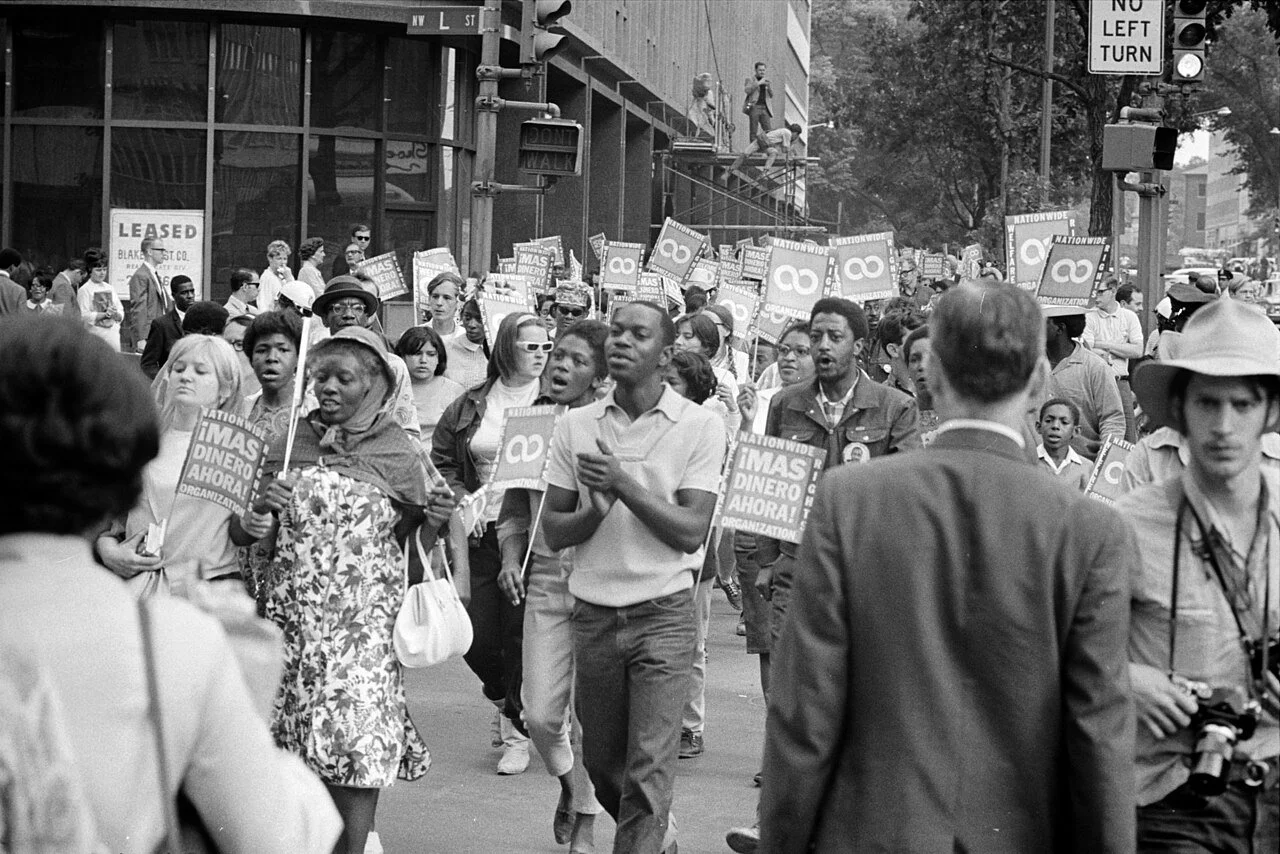
Demonstrators participating in the Poor People’s March at Lafayette Park and on Connecticut Avenue, Washington, D.C. June 18, 1968. Photo from the Library of Congress via digital code ppmsca 04302 http://hdl.loc.gov/loc.pnp/ppmsca.04302. Warren K. Leffler, U.S. News & World Report, Public domain, via Wikimedia Commons
The Poor People’s Campaign and Resurrection City
by Jack R Johnson 07.2026
Although affordability is a buzzword today, the numbers of citizens actually living below the poverty line currently hovers right around 11 percent, a considerable improvement over the poverty rate in the mid to late 1960s when 22 to 33 percent or nearly one-third of our population lived below the poverty line. Much of this poverty was due to racial disparity in wages and employment. In 1966, for example, the poverty rate for non-white Americans was 41 percent compared to 12 percent for white Americans. But by the mid-1960s, President Lyndon Johnson’s “war on poverty” was taking a back seat to other political concerns, like the Vietnam War. In an effort to refocus on economic justice, Martin Luther King, Jr. began what came to be known as the poor people’s campaign.
Although Afro-Americans were overwhelmingly represented in poverty statistics, poor whites, particularly those located in rural areas and the elderly, were also affected. Major job losses devastated specific regions. For example, the automation of the coal industry caused mining jobs in states like Pennsylvania to drop by two-thirds between 1950 and 1960, leaving entire communities economically stranded. Before the expansion of modern welfare programs, the elderly were highly vulnerable. In 1966, 20 percent of families headed by white males aged 65 and over lived below the poverty line due to the inadequacy of early social security systems. Additionally, America's population increasingly lived in cities, not farms (and thus could not grow its own food).
When Martin Luther King, Jr. shared his idea with some of his church supporters, one member commented: “He [King] had done all these other social things but this was the culmination…it was embarking on the financial structure of the country…it was then we understood that Martin Luther King was a revolutionary.”
King kicked off the campaign by writing a lengthy statement to the Southern Christian Leadership Conference (SCLC) of Atlanta: “We will be petitioning our government for specific reforms, and we intend to build militant nonviolent actions until that government moves against poverty. …Our staff soon will be taking new assignments to organize people to go to Washington from 10 key cities and 5 rural areas. This will be no mere one-day march in Washington, but a trek to the nation's capital by suffering and outraged citizens who will go to stay until some definite and positive action is taken to provide jobs and income for the poor.“
Through nonviolent direct action, King and SCLC hoped to refocus the nation on economic inequality and poverty. King wrote that he wanted to bring poor people to Washington, D.C., forcing politicians to see them and think about their needs: "We ought to come in mule carts, in old trucks, any kind of transportation people can get their hands on. People ought to come to Washington, sit down if necessary in the middle of the street and say, 'We are here; we are poor; we don't have any money; you have made us this way ... and we've come to stay until you do something about it.”
Specifically, the campaign requested an “economic bill of rights”, which included a $30 billion anti-poverty package that would be committed to full employment, a guaranteed annual income measure, and increased construction of low-income housing.
While the poor people’s campaign was being organized, King traveled to Memphis, Tennessee to support striking sanitation workers there. He was assassinated at the Lorraine Motel on April 4, 1968. He never saw the campaign in action and never made it to the Mall, but thousands traveled to Washington D.C. to honor King’s memory and to pursue his vision.
According to the King Institute, “SCLC decided to go on with the campaign under the leadership of Ralph Abernathy, SCLC’s new president. On Mother’s Day, 12 May 1968, thousands of women, led by Coretta Scott King, formed the first wave of demonstrators.” The following day, Resurrection City, a temporary settlement of some 3,000 wooden tents and shacks, was built on the Mall in Washington, D.C.
“Braving rain, mud, and summer heat, protesters stayed for over a month. Demonstrators made daily pilgrimages to various federal agencies to protest and demand economic justice. Midway through the campaign, Robert Kennedy, whose wife had attended the Mother’s Day opening of Resurrection City, was assassinated. Out of respect for the campaign, his funeral procession passed through Resurrection City.”
According to Lenneal Henderson who lived in the camp for the duration:
“I was raised in the housing projects of New Orleans and San Francisco, and my parents were very strong community advocates. I also witnessed the Black Panther Party emerge in Oakland in 1966. Stokely Carmichael's call for Black Power focused on the need to transform our communities first in order to get ourselves out of poverty. [Resurrection City] represented an effort to bring together poor people from different backgrounds and different experiences, who really had not been brought together before. In fact, they'd been set against one another. People from all kinds of backgrounds, and all over the country came together: Appalachian whites, poor blacks, to mule train from Mississippi, American Indians, labor leaders, farm workers from the West, Quakers. It was just an incredible coalition in the making.”
The goals of the campaign were never realized and today, 36.8 million Americans are still estimated to live in poverty.
Yet, King’s vision still endures. Early in 2018, several pastors started a revival of the Poor People’s Campaign with the support of organized labor, focusing on raising the minimum wage. Co-chaired by Rev. Dr. William J. Barber II and Rev. Dr. Liz Theoharis, the modern campaign actively coordinates in over 30 states. The organization frequently leads massive rallies in Washington D.C., coordinates state-level "Moral Monday" protests, and leads major voter mobilization and registration drives in low-income communities. Their next Moral Monday was held at 5pm on July 6 in Washington DC, in front of the White House at Black Lives Matter Plaza.