

Bill Martin, the heart and soul of the Valentine Museum. PHOTO Courtesy of the Valentine.
The Twin Pillars: Edwin John “Eddie” Slipek, Jr. & William J. “Bill” Martin
by Charles McGuigan 02.2026
They were the twin pillars that supported a pediment that contained a sort of tympanum relief of Richmond’s unadulterated history along with an homage to its very soul as reflected in the arts and culture both these men nurtured. On December 15 Eddie Slipek died; thirteen days later he was followed into the great beyond by Bill Martin.
“Bill was a towering figure in the Richmond community,” says Cyane Crump of Historic Richmond. “He helped us to understand where we came from, who we are, and where we are going.”
And his was not the white-washed version of history preferred by MAGAts.”He helped to tell the stories about our past that were hard to tell and sometimes even harder to hear,” Cyane says, “as well as the stories that were fun and just a little bit irreverent. He was a huge champion of Downtown Richmond and understood that it was the beating heart of the region and that we, as a community, needed to invest the resources into its care and maintenance.”
Bill came to The Valentine three decades ago when the museum was facing financial ruin. “The museum was in a bit of a crisis with a venture into another campus called Valentine Riverside that ultimately proved to be unsuccessful and was financially devastating for the institution and Bill took the helm as director and navigated the institution through what could have been a very unfortunate end,” according to Meg Hughes, acting director of The Valentine. “It took awhile, but he brought the museum to really solid financial footing and made it much more active in the community. But it took thirty years to get to that point. I tell people that he was both patient and impatient at the same time.”
During the Covid shutdown, after the brutal murder of George Floyd and the subsequent BLM protests which led to the removal of monuments to men who betrayed their Republic and supported the living hell of slavery, Bill and his staff had already been rethinking the exhibit of Edward V. Valentine’s art studio at The Valentine.
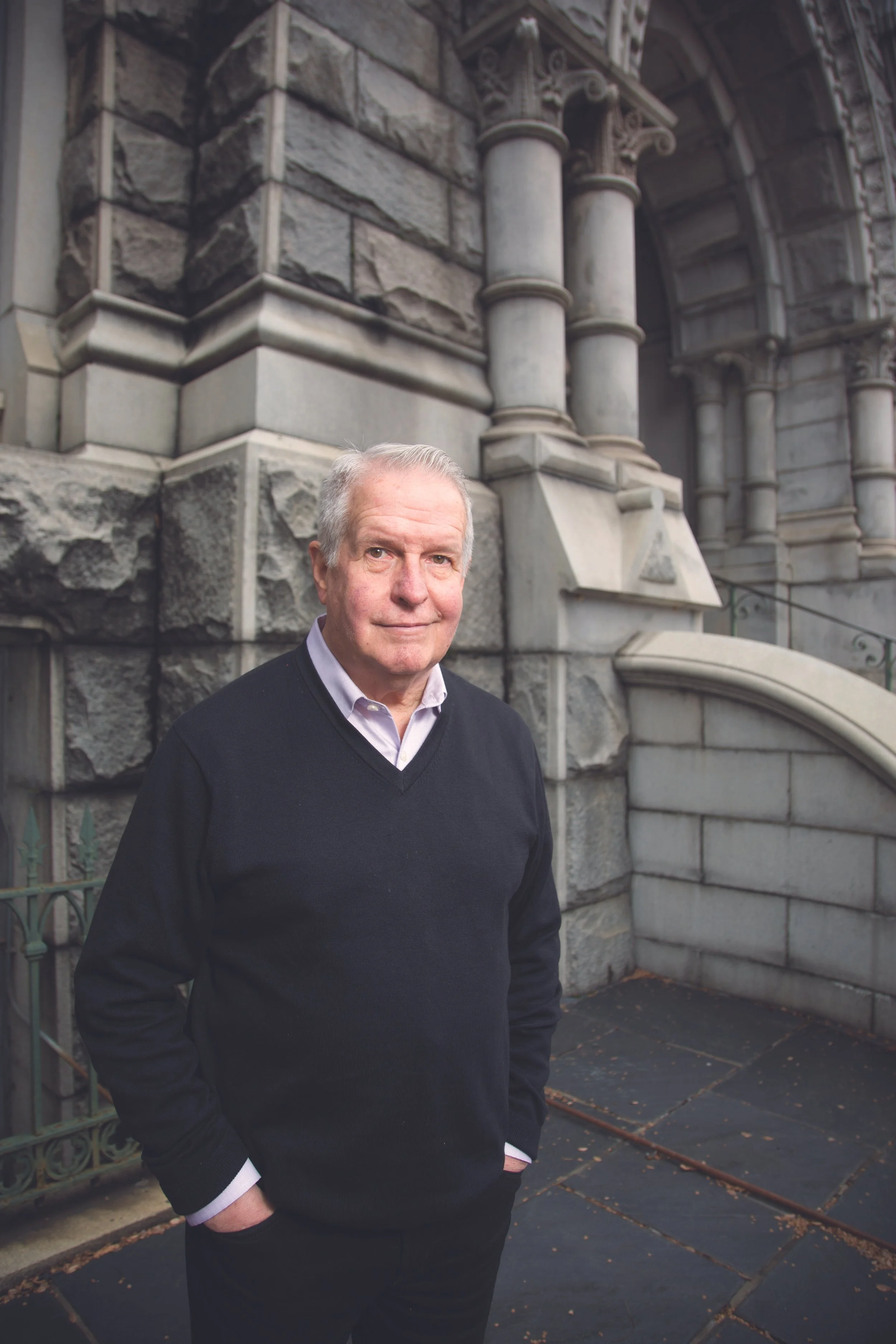
Eddie Slipek. PHOTO by John Henley.
Opened back in 2002, this exhibition was antiquated and did not tell the true story of a sculptor who embraced a distorted view of history, the man who sculpted the statue to Jefferson Davis that stood on Monument Avenue until protesters pulled it down.
“Changing that exhibition was already on our list of priorities, but it jutted up to the top of the priority list once 2020 happened,” says Meg Hughes. “We saw that this was an important opportunity to make a really radical change in how we approached that physical space and those works of art that were part of our collection.”
And so was born Sculpting History at the Valentine Studio: Art, Power, and the “Lost Cause” American Myth
“That exhibition was of particular importance to Bill,” says Meg. “It uses Edward Valentine’s sculpture as a tool to explore the origins of the Lost Cause. What it was? How did people come to their beliefs? And what the ramifications were for those beliefs over generations?”
These were the same kinds of questions tackled by Eddie Slipek, who, like Bill Martin, was a ubiquitous Richmond presence and one that wore a multitude of hats. He was a teacher, an advocate, an historian, a writer, a student of architecture, and a man who had a lifelong love affair with the city of his birth.
He grew up on the Northside and as a boy created a small newspaper called News of the Neighborhood that he home-delivered to houses near his family’s home on Seminary Avenue. He cut his journalistic teeth as executive editor of The Commonwealth Times at VCU, and became the architecture critic for The Richmond Mercury an alternative tabloid that was a welcome relief from the right-wing daily newspaper—The Richmond Times Dispatch.
For a full decade Eddie served as director of communications for Best Products, the nationwide retailer owned and operated by Sydney and Frances Lewis, art collectors who donated more than 1,500 works of art to the Virginia Museum of Fine Arts.
“Eddie hired me to work for Best Products,” photographer John Henley tells me. “He started giving me these corporate jobs with big money on the line.”
When Eddie founded Clue magazine, a short-lived publication devoted to local culture and the arts, John worked for him pro bono as a photographer. “I remember one really funny shoot I did with him,”
John remembers. “He decided he wanted to photograph all of the lifeguards at Virginia Beach, so we started way up north and worked our way down all the way to Rudee Inlet, photographing all these beautiful bodies, girls and guys. That’s a really fond memory.”
And Eddie and John became the best of friends. “He and I went to the symphony together,” he says. “That’s the kind of things we did. He and I were good friends because we connected on a lot of things.”
John describes Eddie as a sort of medium. “He had a zest for life that very few people have and when you were around him you felt it, too,” he says. “When something passed through him he could manifest it somehow to you. And there are not many people like that.”
Eddie had also become a frequent visitor at Historic Richmond. “Not only was he instantaneously the best friend of every staff member, but he was a mentor too,” says Cyane Crump. “As an academic and an unparalleled raconteur, he knew more about Richmond’s history than just about anyone, and he delighted in sharing the stories of the people and places that make Richmond special. He had the reporter’s eye for the story behind the story, finding the unique angle on the people who shaped the places that Richmonders know and love today. Through his body of work, he built a greater appreciation for Richmond’s architecture and history.”
Bill and Eddie had a lot in common: they were both gay; they loved the city itself as almost a living entity along with all of its hidden histories, the good and the bad; they conducted insightful and entertaining walking tours; they were scholars without the stodginess of academics. And this, too—they were both men of “infinite jest.”
“Eddie's knowledge of Richmond architecture was only matched by his joie de vie,” says Mary Burruss, development director at The Branch Museum of Design. “He was always smiling and had this impish sense of humor that was sprinkled throughout his conversations as though he were at a cocktail party with Noël Coward.
Meg from The Valentine also commented on Bill Martin’s wit. “I think right now as we are getting back to work, we’re starting to feel the loss of not having him pop in your office,” she says, “To be able to bat ideas around with him. And to joke around with him. He was a fun person. He was not too serious. He really had a great sense of humor.”
Their absence will be keenly felt for years to come, and their shoes will never be adequately filled.
As Cyane of Historic Richmond put it, “Losing Eddie and Bill together in so short a time period is really devastating for Richmond’s arts and culture community. They both had a tremendous influence as storytellers and truth tellers. Each helped tell the story of Richmond, its people and its places. Each advanced Richmond’s arts and culture in different ways – one as a leader of a multi-faceted cultural institution and the other as an architectural critic and columnist. But each could speak the truths that could be hard for us to hear, helping us to understand where we could do better and be better. At their core, each had such a tremendous love for Richmond, delighting in the beautiful and varied fabric of our community. Each will leave a lasting legacy, and we love them for that.”
And as Mary Burruss of The Branch observed, “A huge hole has been ripped in the cultural fabric of Richmond with the loss of both Eddie Slipek and Bill Martin. They both managed to charm the old money crowd, be everywhere all at once, and be cheerleaders for all things Richmond.”