
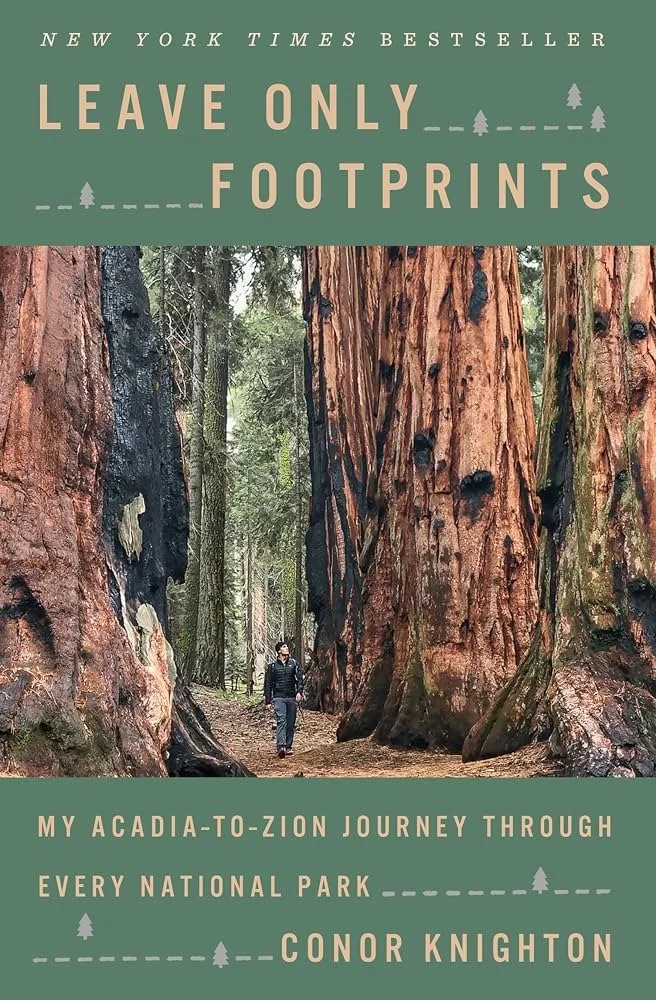
“Leave Only Footprints: My Acadia-to-Zion Journey Through Every National Park”
by Conor Knighton
$28.00
Crown Publishing
336 pages
This Land Is Our Land
by Fran Withrow 10.2026
After his fiancee broke off their engagement, Conor Knighton needed to keep busy. Since it was 2015, and thus the one hundredth anniversary of the National Park Service, he pitched the idea of visiting all 59 national parks in one year to the CBS Morning Show. “Leave Only Footprints” is the story of his journey.
Most travelogues flow in sequential order, but not this one. Knighton groups the parks he visits by themes. Some themes center around the physical aspects of the parks, creating chapters like “Water,” “Canyons,” and “Mountains.” Other chapters explore ideas: “Forgiveness,” “Love,” and “Disconnecting.” Knighton finds himself inspired by the Grand Canyon and Sequoia trees as well as by the mystery inherent in our world and by the magic of nature. The whole thing is just delightful.
While many of our national parks are well known, there are a slew I had never heard of. Did you know that one of our parks is underwater? To visit Biscayne National Park in Florida, Knighton has to undergo scuba training. There’s even a plaque about the Maritime Trail for divers to read under the sea. Other lesser known parks include the Arctic National Park of Alaska and Michigan’s Isle Royale, which is only accessible by boat or seaplane.
Knighton’s writing is warm and lighthearted, full of humor and compassion. His year-long trek includes meeting our dedicated park rangers as well as people from all walks of life, each of whom impact Knighton’s view of the world and of himself.
Knighton’s book addresses serious issues as well. For instance, climate change is altering and threatening many of our parks. An example is Glacier National Park in Montana, expected to have lost all its renowned sheets of ice by 2030. That’s tragic.
Virginia’s own Shenandoah National Park can be found in the chapter on “Diversity.” Knighton says 95% of the park’s visitors are white, due in part to our history of segregation. How can we make parks more welcoming for people of color?
When Knighton visits Alaskan parks, he learns how much native residents value the caribou that feed them. Their connection to the land is deep and respectful. Reading about the gratitude these Alaskan residents feel for the animals and land that sustain them is thought-provoking and moving.
The chapter on “Light” begins with the Great Basin National Park in Nevada. This park, only a couple hundred miles from the lit-up metropolis of Las Vegas, is known for how dark it is. Looking up into the unsullied expanse above him, Knighton is surprised and enchanted at how star-studded the night sky really is. He notes that most of us can see only a few stars, and are unaware of how vast the night-time canopy of celestial bodies is. Light pollution is real, folks.
Knighton’s year-long journey changes him profoundly. It begins to soothe his aching heart, gives him a stronger appreciation for our beautiful country, and connects him to a deeper spirituality. Knighton’s book, like our parks, feels like a gem worth treasuring.