
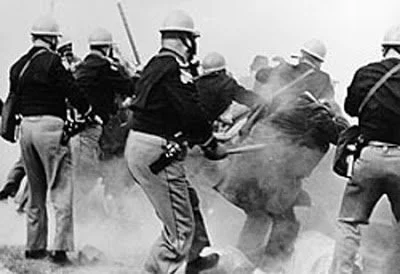
Bloody Sunday - Alabama police attack Selma-to-Montgomery Marchers, 1965.
Voting Rights Act of 1965, RIP
by Jack R Johnson 05.2026
Imagine the year is 1965 and it’s exactly one day before the passage of the Voting Rights Act. If you are a minority living in say, Mississippi, the odds of you not being allowed to vote because of a poll tax, a literacy test, Gerrymandering or some other intimidation I imagined hovered right around 75 percent. To be sure, I decided to check the actual Mississippi voting registration for minorities in 1964. That revealed a stunning average of less than 5 percent successful voting registration for ‘Negroes.’ I stand corrected. Mississippi didn’t just suppress the minority vote. They strangled the vote like an infant in its cradle.
And not just Mississippi. For decades, almost all the Southern state legislatures worked overtime to ensure that minorities were unable to cast a ballot or elect a minority candidate. In 1865, with the end of the Civil War, Reconstruction promised newly freed African Americans their full citizen rights — including the right to vote. But because of the obstinate resistance of the Southern states, the federal government had to use military force to protect black voting rights. This protection largely ended after the Compromise of 1877, which ended Reconstruction.
As ex-Confederates regained control of state governments in the South, they used tactics such as poll taxes and literacy tests to get around the 15th Amendment’s ban on race-based voting restrictions. Violence by the Ku Klux Klan and by lynch mobs prevented many blacks from voting. Blacks who tried to vote were often threatened, beaten, or killed. Their homes were burned; or they were fired from their jobs for trying to vote. Other methods used, including gerrymandering, or whites only primaries, where no black candidates were allowed on the ballot.
But by the 1950s, after black veterans returned from fighting overseas, they’d had enough. A newly formed Civil Rights movement began the Montgomery Bus Boycott and increased pressure on the federal government to protect black voting rights.
Eventually, Congress responded by passing the Civil Rights Act of 1964. The act included some voting rights protections; but it did not prohibit most forms of voting discrimination, including racial gerrymandering.
President Lyndon B. Johnson understood this, and shortly after the 1964 elections in which Democrats gained overwhelming majorities in both chambers of Congress, he privately instructed Attorney General Nicholas Katzenbach to draft "the goddamndest, toughest voting rights act that you can."
He did not intend to push the legislation publicly until his Great Society reforms won passage, but violent events forced Johnson’s hand.
On February 18 in Marion, Alabama, state troopers broke up a nighttime voting-rights march during which officer James Bonard Fowler shot and killed young African American protester Jimmie Lee Jackson. Jackson was unarmed and protecting his mother. Spurred by this event on March 7, Civil Rights activists began the first of the Selma to Montgomery marches, in which Selma residents intended to march to Alabama's capital, Montgomery, to highlight voting rights issues. In 1965, half of Selma’s population was Black, but only 2 percent of the county’s 15,000 eligible black voters were registered to vote.
On the first march, demonstrators were stopped by state and county police on horseback at the Edmund Pettus Bridge near Selma. The police shot tear gas into the crowd and trampled protesters. Televised footage of the scene, which became known as "Bloody Sunday", generated outrage across the country.
A second march was held on March 9, which became known as "Turnaround Tuesday." That evening, three white Unitarian ministers who participated in the march were attacked on the street and beaten with clubs by four Ku Klux Klan members. The worst injured was Reverend James Reeb from Boston, who died two days later.
In the wake of the events in Selma, President Johnson, addressing a televised joint session of Congress on March 15, called on legislators to enact expansive voting rights legislation. In his speech, he used the words "we shall overcome", adopting the rallying cry of the Civil Rights movement. The Voting Rights Act of 1965 was introduced in Congress two days later.
The Supreme Court’s recent 6-3 decision in Louisiana v. Callais effectively nullified Section 2 of the Voting Rights Act and, as Justice Elena Kagan wrote in her dissent, “threatens a half-century’s worth of gains in voting equality.”
Section 2 addresses racial vote dilution through gerrymandering. Justice Kagan strongly warned of “far-reaching and grave” consequences, including the likely elimination of districts “that in the last half-century have given minority citizens, and particularly African Americans, a meaningful political voice.”
Her dissent concluded: “The Voting Rights Act is” (or, now more accurately, was) “one of the most consequential, efficacious, and amply justified exercises of federal legislative power in our Nation’s history. [...] It was born of the literal blood of Union soldiers and civil rights marchers. It ushered in awe-inspiring change, bringing this Nation closer to fulfilling the ideals of democracy and racial equality. And it has been repeatedly, and overwhelmingly, reauthorized by the people’s representatives in Congress. Only they have the right to say it is no longer needed—not the Members of this Court.”
In less than a week after the decision, Louisiana suspended its May 16 congressional primary to approve new districts. In Florida, Governor Ron DeSantis signed a new bill redrawing congressional districts expected to give Republicans an additional four seats. In Alabama, Governor Kay Ivey called a special session for the legislature to handle congressional redistricting, aiming to reinstall maps previously blocked by courts. Tennessee moved to redraw its congressional map to further strengthen Republican representation as well. As an old neighbor of mine used to say, “Save your Confederate money, for the South shall rise again.” I thought he was being ironic, but maybe not. Maybe this is what the Supreme Court’s conservative majority had in mind all along?