Courtesy of Searchlight Pictures.
Wild Horse Nine
by Chris Stewart 11.2026
“It was lonely in Guatemala. It was lonely at the Bay of Pigs. Lonely in Dallas.”
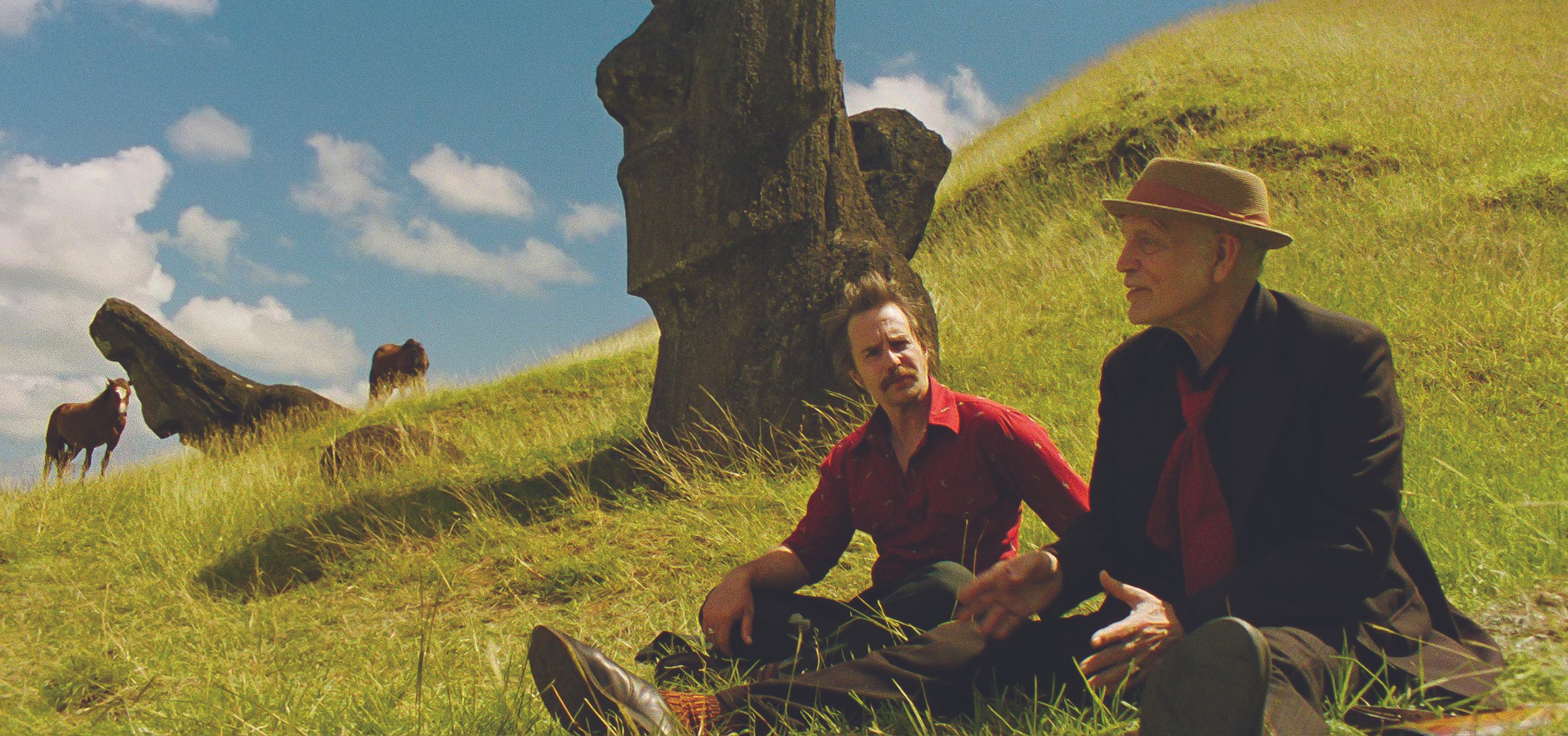
So says seventy-something CIA specialist Chris (John Malkovich) to his decades-younger partner Lee (Sam Rockwell) in Martin McDonagh’s Wild Horse Nine. Through his signature bracingly crass dialogue, McDonagh takes the audience on yet another scenic visit to a beautifully-photographed place where the boyish wills of men will be filtered through argument, philosophy, and a certain degree of 20-20 hindsight. Mind you, McDonagh’s characters would spit at someone quoting an actual philosopher, but McDonagh himself most certainly wants you to know that he’s studied them.
His men are violent and often travel in pairs; one a good soldier and one an ungovernable set of urges, the most important of which is generally the urge to Tell It Like It Is. This allows McDonagh to dismantle, or at least aim to dismantle, the rattle of linguistic politicking. His boys (and the occasional girl) talk quickly and have a witty, crude, perfect rejoinder to almost any comment targeting them. If you met them in person, it would ruin your Thursday. On screen? They sizzle, and are often very funny. And McDonagh, rightly praised as a writer, remains an underratedly skillful director.
The set-up:
Two killers (government-issued variety) are dispatched to Easter Island. Their mission is obscure but high-stakes. They are both cracked vessels; one of them, perhaps, fatally so. They drink, they meet locals, they see the sites. Were this made in the 1970s when it is set, they would also shoot, screw, and generally scavenge away their little getaway. Not so in Wild Horse Nine. A melancholic air pervades.
It’s a chewy, patient comedy, and when it has laughs (fewer for this reviewer than others in the theater), they hit hard. It’s also keenly politically aggrieved. Crucially, a character tells a naïve what will happen, what is coming: the storm of s**t that American policy in Chile will lead to. The very real roundups, disappearances, and deaths. Alright – fair enough. So what, then? McDonagh’s suggestion of outright violent counter-action is his most bracing idea. He has perhaps never been more comfortable in his anger, not to mention his storytelling. The former can be quite beautiful. The latter – in brief moments; tiresome.
Real poignancy aside, it can be hard to discern what McDonagh wants us to forgive and what he needs us to forget. The juvenile righteousness of his Three Billboards Outside Ebbing, Missouri, is absent, thank God, but we’re far from the rich emotional landscapes of The Banshees of Inisherin – McDonagh’s finest film - or the electric misbehavior of In Bruges. In Wild Horse Nine, for all its admirable qualities, McDonagh is somewhat playing the hits.
McDonagh is not a fundamentally rebellious writer; only easily mistaken for one. He is in fact one of our best conventionalists, paying off setups with huge satisfaction. Wild Horse Nine is a clever, rewarding lecture, but also the rare McDonagh film that feels like it should have “Part One” in its title.
Wild Horse Nine
Director: Martin McDonagh
Runtime: 116 minutes